
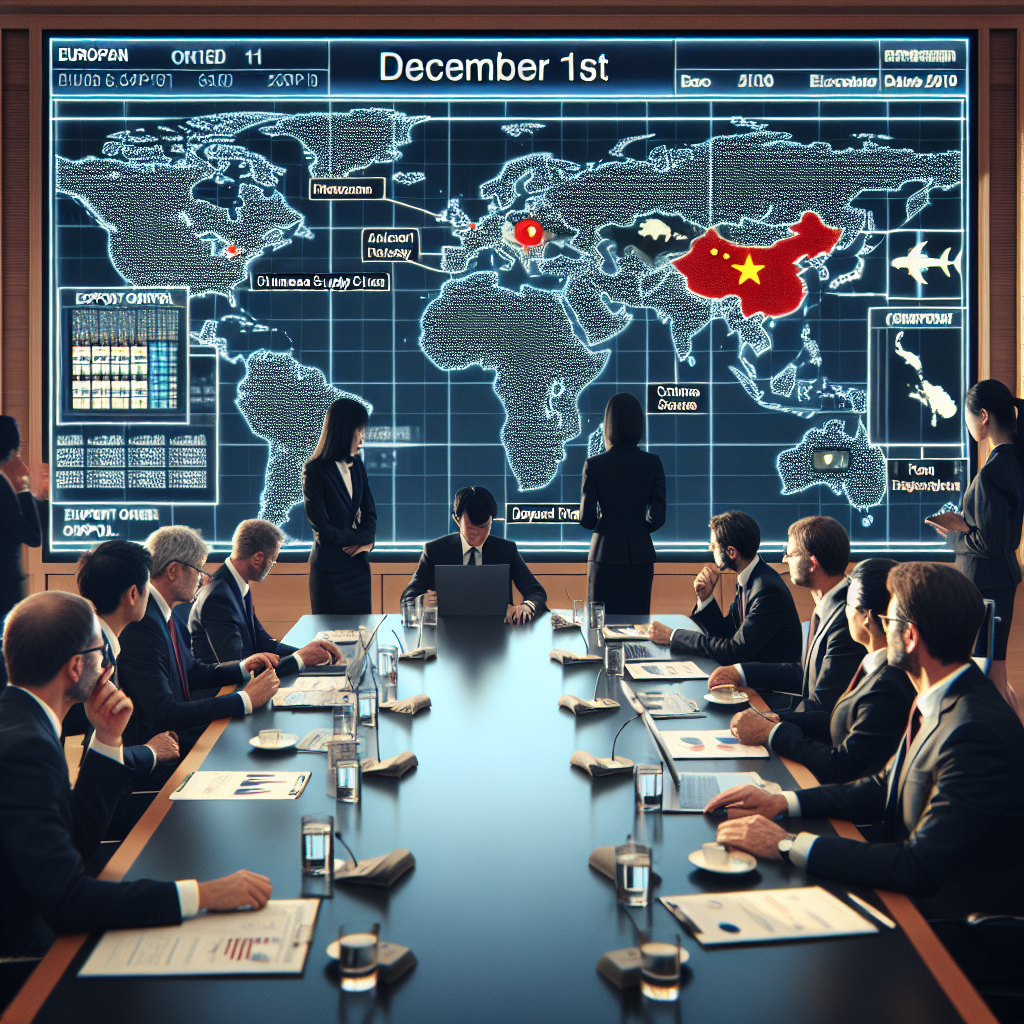
The China-EU Chamber of Commerce stated on Monday (December 1st) that as Beijing tightens export controls, European businesses are speeding up efforts to move away from the Chinese supply chain.
According to the China-EU Chamber of Commerce, one-third of its member companies are considering shifting their sourcing away from China due to Beijing’s export control measures. Additionally, 40% of the respondents in this rapid survey mentioned that the processing speed of export licenses by the Chinese Ministry of Commerce is slower than promised.
Reuters reported that the Chamber’s President, Jens Eskelund, said, “China’s export controls have intensified the uncertainty for European businesses operating in China, facing risks of production slowdowns or halts.” He added that these restrictions “add more pressure to the already heavily stressed global trade system.”
The survey included around 131 participating companies, with members such as German car manufacturers BMW and Volkswagen, Finnish telecommunications manufacturer Nokia, and French energy giant TotalEnergies.
Against the backdrop of the ongoing US-China trade war, in October, Beijing threatened to expand export controls on strategic key technologies such as rare earths. With China controlling over 90% of global rare earth processing capacity, this move disrupted the global supply chain. Although China promised to temporarily suspend the implementation of these restrictions for about a year following the Xi-Jinping meeting in Sichuan, and temporarily eased some controls on key minerals like zinc and germanium, previous similar controls in April led to EU car manufacturers being forced to halt production, keeping the industry cautious.
Volkswagen is making significant investments in Spain and Eastern Europe to build super battery factories, localizing the production of core battery components. Meanwhile, in response to geopolitical risks, multiple car companies, including BMW, are expanding production in the US and Mexico, actively seeking alternative suppliers in Europe to ensure diversification of sources for their electric vehicle components.
In this rapid survey by the Chamber, nearly 70% of the respondents stated that their overseas production facilities rely on Chinese components constrained by export control regulations. At the same time, 50% of exporting companies reported that their suppliers or customers’ produced goods have been affected or will soon be affected by these controls.
European businesses have expressed concerns over the Chinese Ministry of Commerce exceeding the promised 45-day processing time for permit applications. Respondents have also raised objections regarding the lack of transparency and disclosure requirements. They have also expressed worries about potential intellectual property theft.
The survey included anonymous examples of companies affected by Beijing’s export controls. One company estimates that these measures will result in costs amounting to 20% of its global revenue for this year, while another company anticipates incurring over 250 million euros in expenses.
In March of last year, the EU approved the Critical Raw Materials Act (CRMA) that requires member states to ensure that at least 10% of critical raw materials come from within the EU by 2030, accelerating the de-risking process across the European continent. Meanwhile, the US is actively investing in domestic rare earth extraction and processing projects through the Department of Defense and Department of Energy, cooperating with allies like Australia and Canada to establish an independent critical mineral supply chain separate from China.