
A deadly fire broke out at the Grand Fortune Garden in Tai Po, Hong Kong on November 26, sparking widespread concern over the origin of the fire. The controversy over whether the “shelter nets inhibit or assist combustion” has been a focal point in the society. Initial inspections by the Hong Kong government indicated that the bamboo shelter nets used in the building had flame-retardant properties. However, on December 1, officials revealed that samples from the shelter nets on the exterior walls of four out of the 7 buildings that caught fire did not meet the flame retardant standards.
The death toll from the fire at the Grand Fortune Garden in Hong Kong has now risen to 146, with 79 people injured and around 40 individuals still missing.
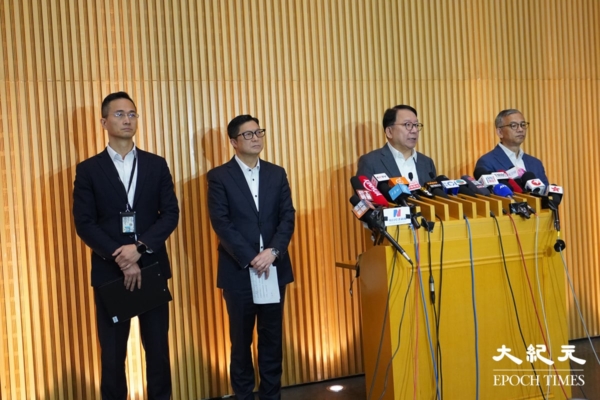
Hong Kong’s Chief Secretary for Administration, Matthew Cheung, along with the Secretary for Security, John Lee, the Commissioner of the Independent Commission Against Corruption, Simon Peh, and the Director of Crime and Security of the Hong Kong Police, Anthony Tsui, announced the progress of the investigation at a press conference on December 1. Cheung stated that samples of the shelter nets collected from various locations in the Grand Fortune Garden in the past two days did not meet the flame retardant test standards.
According to reports from local media, John Lee mentioned that authorities initially conducted preliminary tests on the shelter nets at the Hong Zhi Court, where the fire did not occur, and found them to meet the legal fire-retardant standards, which was unexpected. However, after the fire was controlled, samples were collected from different locations in 8 buildings, and it was discovered that 7 samples did not meet the flame retardant standards, indicating the possibility of non-compliant protection nets being mixed into use. Many of the non-compliant shelter nets have already been burned, with most of the remaining nets meeting the standards.
Commissioner Simon Peh stated that during the typhoon in July, which damaged the protection nets, individuals involved purchased around 2300 rolls, approximately 7500 square meters of non-compliant protective nets from a local supplier in Hong Kong at a price of 54 Hong Kong dollars per roll for replacement, enough to cover the 8 buildings. Subsequently, in late October, the individuals purchased 115 rolls, about 3700 square meters of compliant protective nets from the same supplier at 100 Hong Kong dollars per roll, which were installed at the base of each building and passed subsequent tests.
However, Peh did not specify whether the shelter nets provided by the local Hong Kong supplier were sourced from mainland China.
Secretary for Security John Lee had initially stated on November 27 that during the firefighting and rescue process, it was found that materials on the exterior walls of the buildings involved, including shelter nets, protective films, waterproof canvas, and plastic sheets, spread the fire more vigorously and rapidly after ignition compared to some compliant materials, prompting a thorough investigation by the Hong Kong government.
However, by the evening of November 28, John Lee changed his statement during a press conference, claiming that based on initial examinations, the bamboo shelter nets used in the building did have flame-retardant properties, believing that the initial fire was caused by the shelter nets on the lower levels. He did not clarify the relationship between the flame-retardant “shelter nets used in the bamboo shelters” and the “lower-level shelter nets” where the fire initially started, leading to skepticism among many Hong Kong residents.
Before the fire at the Grand Fortune Garden, Hong Ye Construction, responsible for external wall renovation works, was involved in similar projects in 11 buildings in Hong Kong. Residents of “Fuzhou Gardens Richgate” and “Yi Le Gardens” presented testing reports posted in the community, indicating that the protective nets used in the renovation work were produced by “Shandong Chenxu Chemical Fiber Net Co., Ltd.” and “Binzhou Yuanjin Chemical Fiber Net Co., Ltd.,” named “flame-retardant mesh,” and were tested and approved by the Binzhou City Inspection and Testing Center in Shandong Province.
However, according to the reports, querying the specific report numbers on the official website of the Binzhou City Inspection and Testing Center displayed “no file found.” On the Alibaba sales platform for Binzhou Yuanjin Chemical Fiber Net Co., Ltd., the testing reports from the Binzhou City Inspection and Testing Center were listed, but the products on the platform did not match those announced in the “Yi Le Gardens” community. The whereabouts of these related products are currently unknown.
In fact, as early as 2024 when the Grand Fortune Garden began its renovation, a whistleblower lodged a complaint with the Hong Kong Labour Department, stating that the shelter nets used in the renovation were not compliant flame-retardant nets. The complaint was rejected by the Labour Department citing “no welding work conducted” and “relatively low fire risk,” without issuing a work stoppage order.
Similarly, during the extensive renovations at the Fire Beacon Sui Wo Court, all 9 buildings were surrounded by shelter nets and used foam boards to seal the windows like the Grand Fortune Garden. Testing of the foam and shelter net samples at the Sui Wo Court showed that they continued burning after leaving the source of fire, showing no flame-retardant effectiveness. However, the incorporated contractor presented a flame-retardant certificate for the foam boards from a mainland organization. Fire experts noted that the certification body is not recognized in Hong Kong. The Owners’ Corporation of Sui Wo Court decided to remove the shelter nets from November 30 to reduce negative sentiments among the residents.