
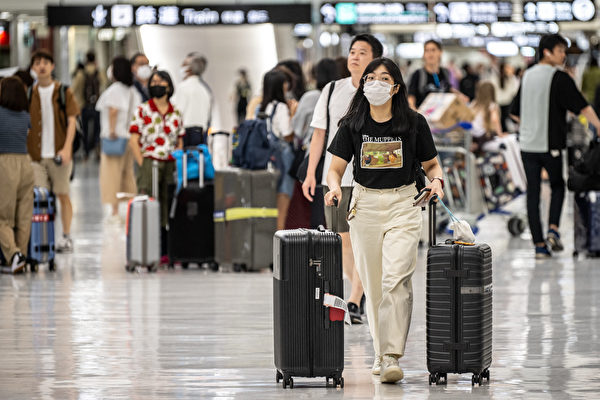
In order to retaliate against the “Taiwan issue” comments made by Japanese Prime Minister Takaichi Sanae, the Chinese Communist Party (CCP) has implemented a series of retaliatory measures, including urging people to avoid traveling to Japan, with the CCP officially announcing the “cancellation of 540,000 airline tickets to Japan.” However, veteran media personality Yaita Akio pointed out that this move by China not only failed to punish Japan but also harmed itself, with limited effectiveness.
On November 30, Yaita Akio posted on Facebook citing an article from the Japanese magazine “Weekly Diamond,” written by Japanese media person Furumai Yoshiko, which exposed the reality of the CCP government’s “economic retaliation” this time. The CCP officially announced the “cancellation of 540,000 airline tickets to Japan,” stating that “rather than punishing Japan, it is punishing Chinese enterprises and people.”
According to Furumai Yoshiko, the “cancellation of 540,000 airline tickets” was actually the result of a “government directive” from the CCP. Since most major airlines and travel agencies in China are state-owned enterprises, with one word from the government, all tickets booked for group tours to Japan were unilaterally canceled without compensation. “Who absorbs these losses? Not Japan, but Chinese state-owned enterprises and Chinese travelers forced to cancel their trips.”
Furumai Yoshiko also pointed out that while 540,000 airline tickets may seem staggering, it translates to approximately 270,000 passengers. “If compared to the latest data published by the Japan Tourism Agency, with up to 8.2 million Chinese visitors to Japan from January to October this year, averaging 820,000 visitors per month, then these 270,000 passengers cannot constitute a comprehensive impact. Moreover, foreign visitors to Japan have been increasing recently, and major tourist destinations are showing signs of overcrowding, so reducing 270,000 visitors could provide a breather.”
Yaita Akio stated that the article also revealed an intriguing detail. “Many of the canceled tickets were for the most common ‘6 days 5 nights for 2,000 RMB’ ultra-low-priced tours favored by Chinese travelers. These tours typically stay in cheap outskirts hotels, serve Chinese-style meals, and have mostly ‘sightseeing through the window’ itineraries, with shopping stops at duty-free stores operated by Chinese people. In other words, while people go to Japan, the money doesn’t really stay in Japan. Such a travel model is unlikely to truly ‘revitalize the Japanese economy.'”
Yaita Akio emphasized that the latter part of the article also pointed out changes in Chinese society. After the pandemic, zero-COVID policies, and economic downturn, many Chinese people no longer completely trust the government and are no longer willing to be “persuaded” by officials. Those with multiple visas can still come to Japan as usual, and airlines from Japan and Hong Kong continue to sell tickets. This means that the CCP government’s “travel ban” is actually limited in its effectiveness.