
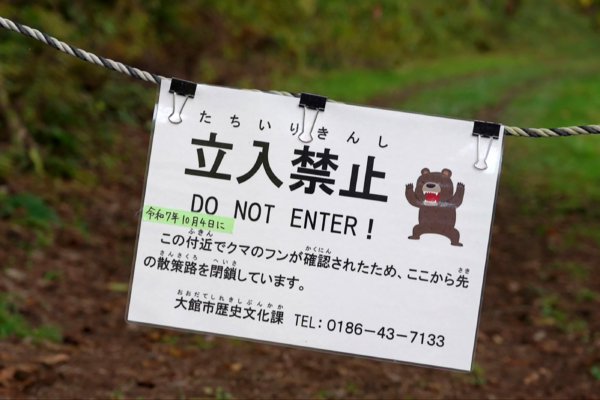
In recent years, incidents of bear attacks in various parts of Japan have been on the rise, resulting in a record high number of injuries and fatalities. To address this escalating crisis, the Japanese government has officially authorized police officers to use firearms to shoot and kill bears that pose a direct threat to residents in emergency situations, marking a significant shift towards a tougher stance on the growing bear menace.
According to reports from the Japan Broadcasting Corporation (NHK), the revised National Public Safety Commission Regulations now explicitly stipulate that police officers can legally use firearms to shoot bears when they intrude into human habitats and directly endanger individuals.
Previously, the control of bear-related issues in Japan mainly relied on local governments commissioning hunters for “emergency hunting.” However, due to the aging of hunters and a shortage of manpower, the emergency response capabilities have been diminishing year by year.
The police department has clarified that this new authorization is only to be activated in “emergency situations.” In principle, hunters remain the primary force, with police intervention reserved for critical situations or when hunters are unable to respond promptly to reinforce local protection capacities.
Official statistics indicate that this year alone, there have been over a hundred bear attacks nationwide, resulting in 13 fatalities, the highest on record. Two-thirds of the fatalities were concentrated in Akita Prefecture and the neighboring Iwate Prefecture, prompting these regions to be the first to implement the new regulations.
Starting from earlier this month, both prefectures have established special units comprising experienced tactical officers with counter-terrorism and firearms expertise known as “Firearms Response Teams,” who will collaborate with local police and hunting associations in joint operations.
Over the past week, team members have undergone intensive training on bear behavior and shooting techniques, including precise shooting within a range of about 50 meters and assessing shooting angles when bears are running. The police department emphasizes that any firearm use must be judged and reported to local governments, maintaining close communication with local authorities and hunters to prevent accidental injuries and operational errors.
To mitigate the risks of human-bear conflicts, the Japanese Ministry of the Environment plans to expand financial support for “spring management capture” in Hokkaido, Akita, and other regions. This program capitalizes on the period when bears emerge from hibernation, allowing for capture to regulate bear populations and enhance their alertness towards humans.
The Ministry will provide subsidies to encourage more local governments’ involvement and consider recruiting retired Self-Defense Force personnel and police officers as “Government Hunters” with firearm licenses to address the manpower shortage caused by the aging hunter population.
As of midday on the 11th, at least 220 people in Japan have been attacked by bears this year, surpassing the historical record of 219 attacks for the entire year of 2023, with 13 fatalities reported.
With the continued deterioration of bear-related incidents, the United States Embassy in Japan and several Consulates issued warnings on the 12th, advising American citizens in northern regions like Hokkaido and Akita to avoid bear-prone areas and report sightings to local authorities.
On the same day, the British government also updated its travel safety information for Japan, urging travelers to check for wildlife warnings in advance, properly dispose of food waste to avoid attracting bears, and stay vigilant during their visits.