
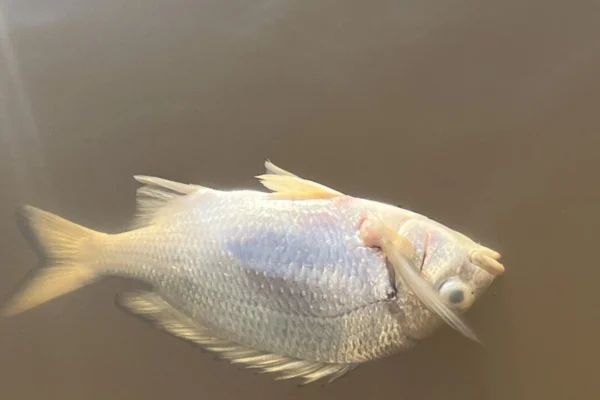
Following the recovery process in the northeast region of Australia from Cyclone Alfred, charity organization OzFish has reported that tens of thousands of dead or dying fish are floating along the banks of the Richmond River in Ballina, northern New South Wales.
They are seeking the public’s assistance in tracking the extent of fish deaths in the area, which was hit by Cyclone Alfred a week ago, leading to extensive flooding in the region and southeastern Queensland.
Local residents have been alerted to prepare for more fish death events, while a spokesperson for the New South Wales government’s fisheries department mentioned that investigations into the fish deaths are currently underway.
“Department staff are cooperating with local governments to monitor water quality and fish deaths in several affected areas,” they stated, “It is expected that ongoing fish deaths may occur in the region in the coming days and weeks.”
OzFish urges local residents to document and report any discovered dead fish to assess the scale of fish mortality.
The organization’s CEO, Cassie Price, mentioned that the extremely low oxygen levels in the “black water” could be a major factor contributing to the fish deaths.
When organic matter like soil and decaying leaves flows into waterways, it darkens the water (“black water”), and during the decomposition process, this organic matter consumes the oxygen in the water.
Photos provided by the charity organization OzFish show a large number of dead fish washed up on the riverbank. Additionally, the organization noted feedback received from the public, with many mud crabs and eels emerging from the water to escape the pollution.
Price mentioned that the results of volunteer-conducted water quality tests don’t look “promising.”
“Healthy water should contain at least 5 milligrams of oxygen per liter,” she said. “Fish start feeling unwell when oxygen levels drop to 4 milligrams per liter, and death occurs when it drops to 2 milligrams per liter. Today, the oxygen level in the Richmond River is almost zero, at only 0.4 milligrams per liter.”
The public can assist OzFish in disaster assessment by marking map locations or geolocating, estimating the number of dead fish, recording identifiable important fish species, and taking photos or videos.
New South Wales reports dozens of fish death incidents annually, with some having severe impacts. In March 2023, flooding in Menindee town on the Darling River caused an estimated 20 million fish deaths. Earlier this year, around 30,000 dead fish were found near Gnoorea Beach on the Pilbara coast of Western Australia, believed to be triggered by ocean heatwaves.
Price emphasized that restoring wetlands around the Richmond River would help prevent similar disasters in the future.
“Immediate action must be taken to enhance the ecological resilience of waterways to prevent further fish deaths,” she said.
The Australian Associated Press (AAP) contributed to this report.