
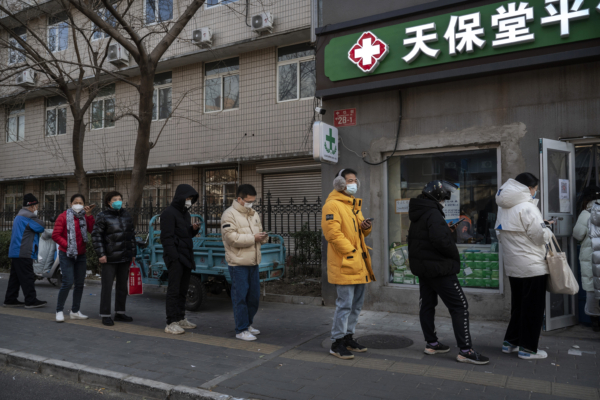
In mainland China, there has been a wave of pharmacy closures since last year, with an average of over a hundred pharmacies shutting down every day. Industry experts believe that this is mainly due to the lack of funds in medical insurance, a decrease in customers, and various fines imposed by the Chinese Communist Party authorities that make it difficult for pharmacies to continue operating.
According to data from Zhongkang, in 2024, the number of retail pharmacies closed in China was approximately 39,000, with a closure rate of 5.7%, resulting in an average of 107 pharmacies shutting down each day. As we entered 2025, the nationwide trend of pharmacy closures has intensified, with some insiders predicting that 50,000 to 100,000 pharmacies may close this year.
In recent months, the Guangdong Provincial Drug Administration has issued a series of announcements for pharmacy cancellations, involving over forty pharmacies in cities such as Foshan, Zhanjiang, Maoming, Qingyuan, and Heyuan. Across the country, multiple provinces including Shandong, Jiangxi, and Jiangsu have also seen numerous pharmacies voluntarily applying for cancellation.
After three years of eliminating the epidemic, local governments across China are facing financial constraints. In 2023, many places implemented mandatory medical insurance reforms, where the 6% basic medical insurance fee paid by employing units was fully integrated into a unified fund, with the 2% paid by employees going into their individual accounts.
Netizens have expressed concerns about the rising costs of medication in pharmacies due to the integration of medical insurance, making medications increasingly expensive. They believe that healthcare insurance funds are being exploited by capital, ultimately hurting those without employee medical benefits the most.
A former pharmacy owner named Karo from Hangzhou mentioned that the profitability of pharmacies is greatly impacted by medical insurance policies. Karo explained that while chain pharmacies affiliated with government health authorities can survive, independent pharmacies without such connections are struggling to stay afloat.
Karo revealed that many pharmacies profit by abusing medical insurance schemes. He highlighted that pharmacies with access to medical insurance for certain medications, often state-owned enterprises, can exploit the system to make substantial profits by overcharging customers and taking advantage of insurance reimbursements.
In April 2024, several Chinese government departments jointly issued a notice to conduct thorough inspections of all entities utilizing healthcare funds nationwide. This initiative aimed to crack down on fraudulent practices involving the sale and reimbursement of medical insurance drugs, as well as the manipulation of insurance claims.
Media reports in China have suggested that pharmacies are closing at a faster rate than bubble tea shops. In the past, pharmacies relied on selling high-priced health supplements and medications for chronic conditions via medical insurance reimbursements. However, recent inspections exposed widespread violations, resulting in punitive actions against prominent pharmacy chains and individual stores.
Moreover, the oversaturation of the pharmacy market in China is also contributing to closures. With over 700,000 pharmacies in 2024—nearly 12 times more than in the United States but serving a population only one-fourth the size—intense competition and price wars have led to financial losses for many pharmacies.
The ongoing healthcare reforms have depleted individual healthcare accounts, forcing many self-employed individuals to opt out of medical insurance payments. As a result, pharmacies have lost a significant portion of their customer base. This shift is reflected in official data indicating a decrease in individual healthcare account revenues from 763.3 billion yuan in 2022 to 635.1 billion yuan in 2023.
Dr. Liu, a medical professional in mainland China, emphasized the financial strain on medical insurance systems. He highlighted that the government’s stringent policies and the dwindling individual contributions have created a significant financial burden on the healthcare sector, making it challenging for pharmacies to operate sustainably.
The collapse of pharmacies is further exacerbated by the continuous scrutiny and penalties imposed by regulatory bodies, causing many establishments to struggle financially. As a result, the viability of the pharmacy business model is increasingly in question, with many facing imminent closure.
Reflecting on the widespread closures, industry insiders like former pharmaceutical executive Liu Ao underscore that apart from government policies and market dynamics, a critical factor contributing to pharmacy shutdowns is the shrinking customer base. Liu Ao observed a notable decline in consumer demand following the successive waves of the epidemic since 2023, significantly impacting pharmacy revenues.
As Liu Ao noted, the fall in pharmacy revenues is not solely attributable to improved medical insurance or reduced illnesses but rather stems from the stark reality of mass casualties caused by the epidemic. The ensuing decline in customer footfall, coupled with stricter regulatory measures and challenges for private healthcare providers, has culminated in the unprecedented wave of closures rippling across the pharmacy sector.