
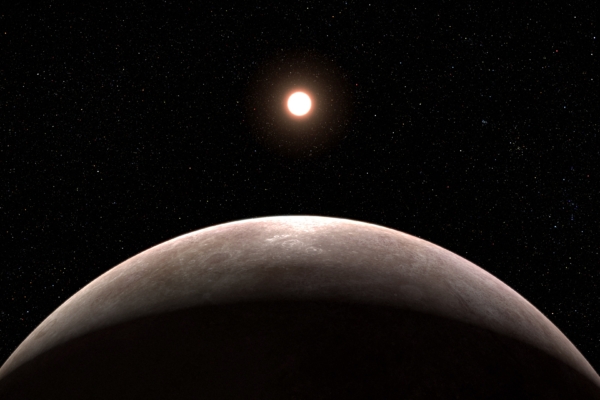
Astronomers have discovered a “super-Earth” located approximately 20 light-years away from Earth, orbiting within the habitable zone of its parent star. This exoplanet, named HD 20794 d, may have liquid water on its surface, making it suitable for sustaining life.
According to a report from Space.com, HD 20794 d, the exoplanet with a mass 6.6 times that of Earth, orbits in an elliptical path within the habitable zone of its parent star at a distance of only 19.7 light-years. The habitable zone is the region where liquid water could exist, a crucial component for known forms of life.
Astronomers used the ESPRESSO (Echelle SPectrograph for Rocky Exoplanets and Stable Spectroscopic Observations) and the HARPS (High Accuracy Radial Velocity Planet Searcher) instruments at the European Southern Observatory in Chile to detect HD 20794 d.
The parent star of HD 20794 d, HD 20794, is a yellow G6 type star slightly dimmer and smaller in mass than the Sun. With a brightness of 4.3 magnitudes, it is relatively bright in our night sky and can be seen with the naked eye in the Eridanus constellation. This sets HD 20794 apart from many other stars with exoplanets that are too dim to be visible to the naked eye.
Due to its relatively close proximity to Earth, astronomers have been observing HD 20794 for about 20 years. In 2011, two other planets orbiting HD 20794, named HD 20794 b and HD 20794 c with orbital periods of 18.3 and 89.6 days respectively, were discovered.
However, HD 20794 d was more challenging to detect as its signal was hidden within background noise. After years of data analysis, astronomers finally confirmed the existence of HD 20794 d, with an orbital period of 647 days.
One of the members of the research team that discovered HD 20794 d, Dr. Michael Cretignier, a postdoctoral researcher from the University of Oxford in the UK, stated, “We have analyzed years of data, carefully eliminating sources of contamination.”
One remarkable feature of HD 20794 d is its orbit, which is longer than any planet in the solar system. Its distance from HD 20794 can extend up to 2 astronomical units (300 million kilometers). In comparison, Mars, located at the outer edge of the habitable zone in the solar system, orbits at an average distance of 1.5 astronomical units (228 million kilometers) from the Sun.
The climate on a planet like HD 20794 d would be extremely unusual. Winters would be long and challenging, with the planet likely being frozen for most of the time. The potential for life to survive in such an extreme world remains unknown.
Another member of the research team, Assistant Professor Xavier Dumusque from the University of Geneva in Switzerland, mentioned that the brightness and proximity of HD 20794 d make it an ideal target for future telescopes. Astronomers could directly observe the exoplanet’s atmosphere and study signs of habitability and life.
These research findings were published on January 28 in the journal “Astronomy and Astrophysics.”