
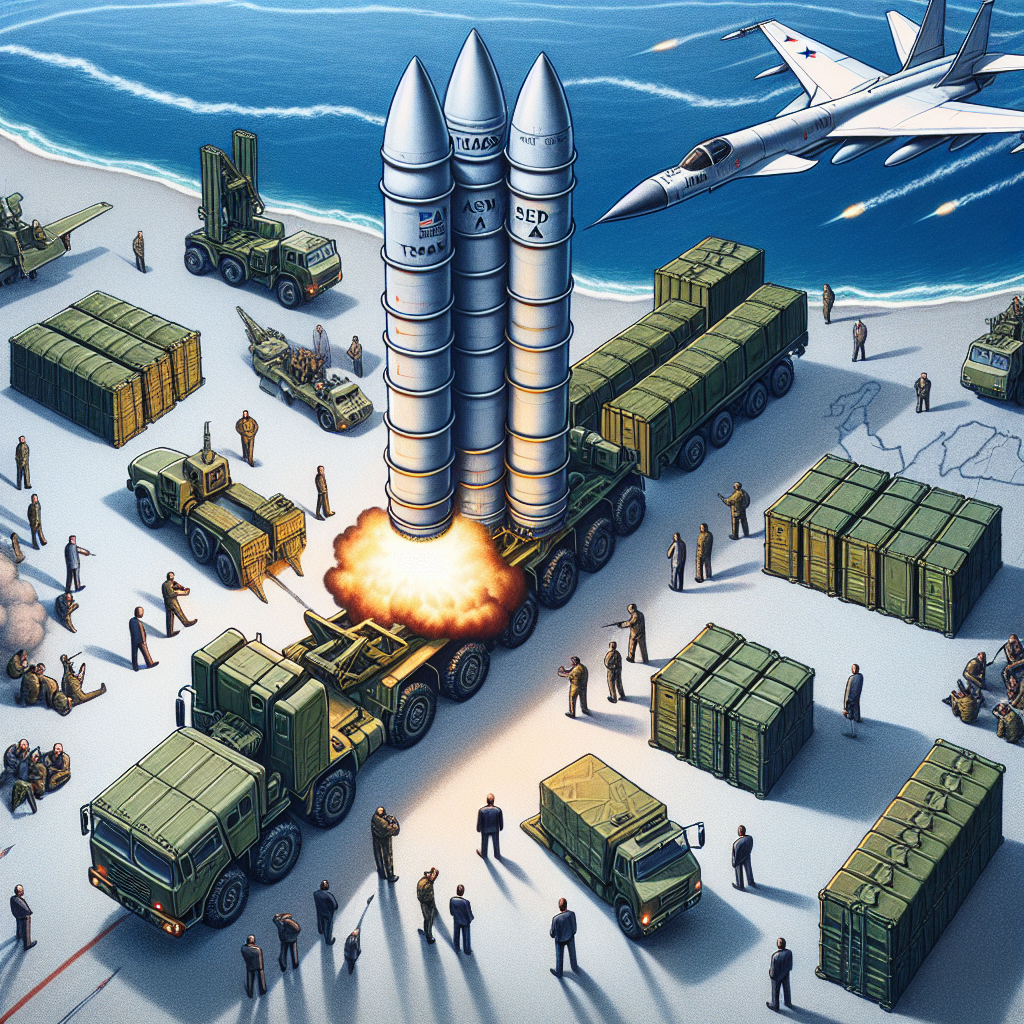
On November 29, 2024, the Russian Ministry of Defense acknowledged that the US Army’s Tactical Missile System (ATACMS) had hit a set of S-400 air defense radar systems deployed near Kursk. Following this incident, discussions arose about whether the more advanced US Army Precision Strike Missile (PrSM) should also be deployed in the Ukrainian battlefield as a replacement for ATACMS, considering it could serve as an ideal testing ground for PrSM.
On November 19, Lockheed Martin and the US Army successfully completed another production qualification flight test of the Precision Strike Missile at the White Sands Missile Range in New Mexico. During the test, the HIMARS launched two Precision Strike Missiles, demonstrating the system’s accuracy and readiness.
Carolyn Orzechowski, Vice President of Precision Fires Launchers and Missiles at Lockheed Martin, stated, “PrSM has demonstrated outstanding system performance and reliability. We will continue to advance this credible deterrent strength, integrating 21st-century secure technologies into baseline and future variants to support cross-domain and maritime operations.”
The Precision Strike Missile is the US Army’s next-generation long-range precision ballistic missile capable of destroying targets up to 400 kilometers away. This new ground-to-ground weapon features an open-system architecture design, enabling cost-effective and flexible long-range precision strikes. Its modular design allows for adaptation to future development needs and compatibility with the M142 High Mobility Artillery Rocket System (HIMARS) and M270A2 Multiple Launch Rocket System (MLRS), aiming to ultimately replace the current Army Tactical Missile System.
The distinction between the Precision Strike Missile and the Army Tactical Missile lies in the former’s longer range and faster speed even under similar operational conditions. In testing conducted in 2019, the Precision Strike Missile achieved flight speeds surpassing 5 Mach, making it a true hypersonic missile, whereas the Army Tactical Missile’s speed is approximately 3 Mach. The Army Tactical Missile has a range of about 300 kilometers, whereas the current Precision Strike Missile’s range can reach 499 kilometers. In fact, the Precision Strike Missile’s range can far exceed 499 kilometers. Initially, the missile’s range was limited to comply with the Intermediate-Range Nuclear Forces Treaty with Russia. After the US withdrew from the treaty in 2019, the Army was able to develop medium-range ballistic missiles. Subsequently, Lockheed Martin, in 2023, signed a contract with the Pentagon to significantly increase the Precision Strike Missile’s range from 499 kilometers to over 1,000 kilometers.
Despite the limitations of the US Army’s Precision Strike Missile as a short-range ballistic missile even after range improvements, it’s considered low-end equipment in the Army’s plans to deploy a three-tier missile force in the coming years. The intermediate tier will be filled by the Typhon missile, also known as the medium-range capability system, capable of launching the US Navy’s Standard Missile-6 (SM-6) and the land-based Tomahawk missile. The high-end capability of the US Army’s three-tier missile force will comprise the Dark Eagle Long-Range Hypersonic Weapon (LRHW). The US Army believes that this three-tier missile system, including these missiles, is crucial for winning future high-end conflicts against China or Russia.
The basic short-range precision strike capability represented by the PrSM, particularly in modern warfare, highlights its tactical significance. With the continued successful testing of the Precision Strike Missile and Ukraine recently receiving Army Tactical Missiles and Storm Shadow cruise missiles for striking Russian military targets, the newly equipped US Army Precision Strike Missiles have an opportunity for combat validation in the Ukrainian battlefield. However, considering that the initial deliveries of the missiles started only in December 2023 and with the US Army planning to purchase only 230 Precision Strike Missiles per year, estimated unit costs ranging from $2.7 to $3 million USD, the availability of this new type of weapon is still very limited, making it highly unlikely for Ukraine to acquire them through the Presidentially Determined Assistance program.
Since the relaxation of restrictions on the use of the Army Tactical Missile, numerous reports have emerged within days of successful Army Tactical Missile strikes on Russian military targets. This demonstrates the missile system’s capability to penetrate Russian defense systems and successfully reach and destroy targets.
John Kirby, spokesperson for the US National Security Council, confirmed that the Ukrainian military had used the provided Army Tactical Missiles against Russia, a fact also confirmed by Russian officials who reported recent Army Tactical Missile attacks launched by Ukraine. Kirby stated on November 25 that the Ukrainian military could use the Army Tactical Missiles for self-defense and confirmed their use in the Kursk region and its surroundings. Kirby’s statement marked the official confirmation of the US authorizing the Ukrainian military to use the Army Tactical Missiles to strike military targets within Russian territory. The Russian Ministry of Defense uncommonly acknowledged on November 26 that the Ukrainian military had recently targeted military objectives in the Kursk region, with 5 Army Tactical Missiles launched on the 23rd damaging an S-400 air defense radar system near Lotalovka (northwest of Kursk City) and 8 missiles launched on the 25th damaging infrastructure at Kalynivka Airport and causing injuries to personnel.
US intelligence analysis indicates that out of the 8 Army Tactical Missiles launched by Ukraine in Russia, only 2 were intercepted by Russian forces. This suggests that the Army Tactical Missile system is at least to a degree “immune” to Russian air defense systems, including the S-400, and indeed multiple ATACMS missiles hit their targets.
The Russian Ministry of Defense admitted that the damaged S-400 Triumph air defense system could be valued as high as $200 million USD. The unit cost of the Army Tactical Missile is approximately $1 to $1.5 million USD, making it a favorable return on investment for Kyiv if multiple missiles can result in the damage to an S-400 air defense system. This loss marks another significant blow to Russia’s advanced air defense network, potentially far greater than what the Russian Ministry of Defense is willing to acknowledge.
Despite the limitations of Ukraine in terms of the quantity of such missiles causing limited damage to Russian forces and the Army Tactical Missile unlikely to have a decisive impact on Ukrainian military operations throughout the war, it does enhance Kyiv’s capability to strike military targets behind Russian lines, holding strategic significance in weakening Russian military capabilities across the entire theater of war.
However, even with the significant losses caused by the Army Tactical Missile to Russian forces, its limited range of 300 kilometers and speed of approximately 3 Mach are notable. One can imagine the impact of Precision Strike Missiles with ranges exceeding 400 kilometers and speeds surpassing 5 Mach entering the Ukrainian battlefield and reshaping the capabilities available to the Ukrainian military.
Given that Russian forces have already redistributed military installations and logistics centers closer to the frontline to evade ATACMS attacks, moving them outside ATACMS range, the impact on the number of Russian targets susceptible to ATACMS attacks has decreased compared to several months ago. If the Precision Strike Missiles were to enter the Ukrainian battlefield, it would bring back into striking range military facilities previously moved further away by Russian forces.
Regardless of the low chance of the Precision Strike Missile entering the Ukrainian battlefield, its significance for the US Army in gaining practical battlefield experience with new weapons remains substantial. Particularly, its ability to penetrate Russian air defense systems is highly worthy of combat testing and validation in this conflict to demonstrate its crucial capabilities for potential high-end conflicts in the Indo-Pacific region against China.