
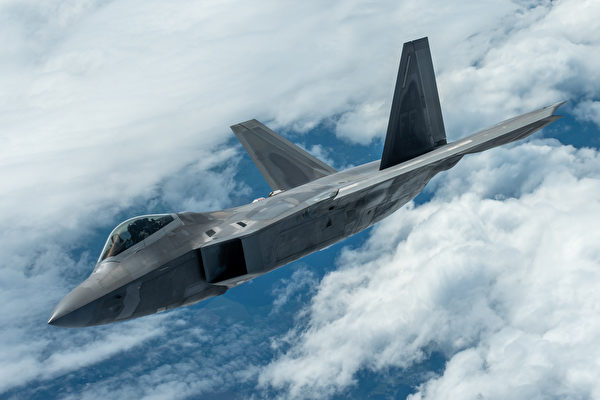
This summer, the United States’ fifth-generation fighter F-22 Raptor once again flew over Southeast Asia, visiting several countries around the South China Sea. At the same time, several US allies in the Indo-Pacific region also possess F-35 fighter jets. Amid escalating tensions caused by frequent provocations from the Chinese Coast Guard in the South China Sea, the US military’s F-22 and F-35 participated in military exercises and training in multiple Southeast Asian countries to strengthen relations with the region and send deterrent signals to China.
The visit of the F-22 fighter jets began with this year’s “Pitch Black” exercise, in which 20 countries, including the United States, deployed 140 fighter jets for training in northern Australia. This exercise marked the largest scale in its history and the most participation of fifth-generation fighter jets, known for their low detectability as “stealth aircraft.”
Among the stealth aircraft, the US Air Force’s F-22 Raptor participated for the first time in the “Pitch Black” exercise. Australia’s F-35A and F-18 fighter jets also took part in the military exercise.
As tensions with China have escalated, northern Australia has become a strategically significant area in the Indo-Pacific region. The US has begun constructing facilities worth hundreds of millions of dollars in the region to support B-52 bombers, F-22 stealth fighters, tankers, and transport aircraft. This initiative is part of the US strategy to disperse forces and reduce risks at military bases.
Shortly after the exercise ended on August 2nd, F-22 jets flew north to Japan for a redeployment operation under the codename “Iron Blade.” On August 6th, four F-22 fighter jets landed at I Gusti Ngurah Rai Air Base in Bali, marking the first time that US stealth aircraft, including the F-35, landed in Indonesia.
Escorted by a C-130 transport plane, these four F-22 Raptors conducted aerial refueling operations before taking off again, enhancing interoperability with Indonesia and strengthening operational awareness in Indonesian airspace.
These aircraft are part of the 27th Expeditionary Fighter Squadron based at Joint Base Langley–Eustis in Virginia and are deployed as part of a dynamic force exercise.
The US Air Force stated, “Through bilateral training, the US and Indonesian Air Forces enhance interoperability to further expand our investment and strengthen our relationship.” The Pacific Air Forces and Indonesia’s engagement in exercises, civil-military activities, and military exchanges contribute to maintaining peace and stability in the region.
With the landing of F-22 fighter jets in Indonesia, other F-22 aircraft also touched down at RMAF Labuan Air Base in Brunei, making it the second deployment of US stealth aircraft to visit Brunei after the US Air Force F-35A jets visited in March.
At the end of August, the F-22 jets remained active near the South China Sea, conducting aerial combat training with aircraft from other Southeast Asian countries and engaging in aerial refueling operations with A330 tankers.
This summer marked a milestone tour for the F-22 Raptor in Southeast Asia, following the significant visit of F-35 jets to the region. The F-35 fighters arrived in Thailand for the “Cope Tiger” exercise following their first visit to Brunei on March 1st. This annual exercise has been held since the mid-1990s, but this year marks the first participation of US fifth-generation fighters.
The F-35 is the most advanced fifth-generation fighter on the market. The deployment of F-35 and F-22 (which is not for export) jets to the Pacific region allows various countries to test their pilots and aircraft against these top stealth fighters.
General Kevin Schneider of the US Pacific Air Forces mentioned that Australia, Japan, and South Korea already have F-35 aircraft. The continued growth in the number of these aircraft signifies more opportunities for joint advanced combat missions.
On July 3rd, the US Department of Defense announced plans to deploy 48 F-35A stealth fighters at Misawa Air Base in Aomori Prefecture, Japan, to enhance deterrence in the Indo-Pacific region.
The USS George Washington aircraft carrier of the US Navy is set to be stationed in Japan, and an F-35 squadron will be deployed to Iwakuni Air Base to join the 5th Carrier Air Wing.
The Pacific region has become a hotspot, with frequent provocations by Chinese military aircraft and ships near Taiwan, standoffs in the South China Sea, and disputes between China and Japan in the East China Sea.
On August 31st, a Chinese navy survey ship entered Japanese waters, following recent incursions by Chinese military aircraft into Japanese airspace. This marked the second intrusion by Chinese forces into Japanese territory within a week, prompting an official protest from Japan.
In a statement, US State Department spokesperson Matthew Miller condemned China for actively disrupting Filipino lawful air and maritime activities in the South China Sea, including at Thitu Reef, throughout August 2024.
Miller stated that China’s actions in the South China Sea have become increasingly aggressive, threatening freedom of navigation and overflight for all countries.
The frequent military exercises involving F-22 jets in August reflect the growing importance the US places on relations with Southeast Asian countries, considering these nations strategically significant due to their proximity to the South China Sea.
The US military has deepened its relations with long-time ally the Philippines and sought to enhance cooperation with former adversary Vietnam. Schneider emphasized that for the Pacific Air Forces, this focus is evident in “exchanges, exercises, dialogue between pilots, and more cooperation.”
The US Pacific Air Forces continue to develop and strengthen relations with US allies while seeking to expand relationships with other countries.
“In addition to Japan, South Korea, Australia, the Philippines, and Thailand—our bilateral allies, I am also very interested in India, Vietnam, and New Zealand. I mention these countries first because I plan to visit them,” Schneider said.
US intelligence estimates suggest that China has ordered its military to be prepared to reunify Taiwan by force by 2027. On March 12th, US Air Force Secretary Frank Kendall highlighted at the Air & Space Forces Association’s “warfare seminar” the most pressing challenge facing the US as “China, China, China.”
To confront the repeated challenges posed by China in the Pacific, the US and its allied militaries are strengthening training efforts and actively preparing to respond to potential conflicts.