
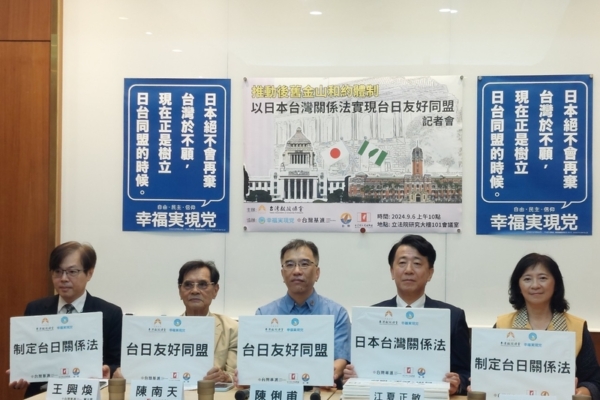
The Taiwan Relations Act established by the U.S. Congress celebrates its 45th anniversary this year. The Taiwan Association of Professors held a press conference today (6th), where participants expressed their views on the theme of “Advancing the Post-San Francisco Peace Treaty System and Supporting the Realization of Taiwan-Japan Friendly Alliance through Japan’s Taiwan Relations Act”.
President of the Taiwan Association of Professors, Chen Lifu, mentioned that September 8th marks the 73rd anniversary of the signing of the “San Francisco Peace Treaty,” which determined Taiwan’s international status after World War II for the second time. In recent years, the Japan Happiness Realization Party, which has been promoting Japan-Taiwan alliance, sent its party secretary to Taiwan to participate in the press conference to support the institutionalization of friendly cooperation between Japan and Taiwan through the legislation of Japan’s version of the Taiwan Relations Act. The party has proposed a draft law similar to the Taiwan Relations Act in Japan and stated that this will be their policy focus.
Kasumi Enatsu, the Secretary-General of the Japan Happiness Realization Party, expressed that the world is currently in a state of chaos. In the midst of the Russia-Ukraine conflict, Western countries are pushing Russia towards China and North Korea. If this continues, the nuclear capabilities of Western countries, China, Russia, and North Korea will be evenly matched, leading to a polarized world and a potential situation of a world war. Enatsu called for stopping Communist China from becoming a hegemonic power, sweeping across Asia. The Happiness Realization Party aims to “protect Japan and the world from the influence of China (Communist)”, promoting various activities to strengthen the Japan-Taiwan relationship.
He emphasized the need for Japan and Taiwan to work together to safeguard freedom in the Asia-Pacific region. While the U.S. has the “U.S.-Japan Security Treaty” and the “Taiwan Relations Act” with Taiwan, there is no legal basis between Japan and Taiwan, only a fragile relationship built on people-to-people exchanges. Therefore, the Happiness Realization Party has drafted a “Taiwan Relations Act Trial Implementation Plan”.
The plan clearly articulates the principles of “freedom, democracy, and belief” and the strengthening of “security connections.” “China should truly transform into a ‘parliamentary country’. If the Taiwanese people cannot be happy, unification is unnecessary.” Alternatively, “Taiwan’s freedom, democracy, belief, and prosperity should be expanded to mainland China to liberate the Chinese people from the dictatorship of the Communist Party.” They advocate for “upholding Taiwan’s freedom and achieving the Taiwanization and democratization of China”.
Chairman of the Taiwan Solidarity Union, Zhou Ni’an, stated that as democratic partners in the Western Pacific, Taiwan and Japan should strengthen their cooperation at the government level. Besides facing military expansion from China like Taiwan, Japan is also confronting threats from Russia, North Korea, and other countries. Deeper mutual assistance between Taiwan and Japan in areas like navy, air force, maritime security, and defense logistics will enhance their ability to deal with authoritarian threats.
To achieve mutual support in a community of shared destiny, Zhou Ni’an hoped to see forces within the Japanese political arena pushing for Japan’s version of the “Taiwan Relations Act”. This not only defends Taiwan but also showcases Japan’s rightful position in Asia. By promoting friendly relations between Taiwan and Japan, they can safeguard peace and security in East Asia together.
Chairman of the Taiwan Progressive Party, Wang Xinghuan, pointed out that the U.S. “Taiwan Relations Act” essentially supports the assertion that “Taiwan does not belong to China (Communist),” involving arms sales, military cooperation, and opposition to changing the status quo in the Taiwan Strait by non-peaceful means. The layout of the “U.S.-Japan Security Treaty” or the Indo-Pacific strategy aims to block the challenges posed by the two land powers, China and Russia, to the maritime order. Taiwan, which lacks sovereign status internationally, has become a necessary ally in the U.S.-Japan Pacific strategy.
Therefore, on the eve of the 73rd anniversary of the signing of the “San Francisco Peace Treaty,” the Taiwan Progressive Party and local organizations jointly called for Taiwan and Japan to promote Japan’s version of the “Taiwan Relations Act,” clarifying a strategic understanding that when “Taiwan is in trouble, Japan is involved.” Compared to the U.S., Taiwan and Japan share stronger bonds of friendship, which could further enhance economic and cultural cooperation alongside geopolitical defense.
After the war, Taiwan’s economic development benefited from Japan’s technical and financial support. Wang Xinghuan advocated for expanding cooperation between the two countries based on the strategic layout in the Western Pacific and mutual trust between Japan and Taiwan, creating a “security supply chain disconnected from China (Communist)” to align economic security with national security. Just like the TSMC factory in Kumamoto, Taiwan-Japan economic cooperation can comprehensively strengthen ties.
He emphasized, “A secure Taiwan is an international Taiwan. We cannot afford to be absent in establishing the new international order to deter China’s expansion. We should actively collaborate with Japan to build a closer military, economic, and cultural alliance, hoping our Japanese friends can convey the voices of the Taiwanese people back to Japanese society.”
Chairman of the Taiwan Independence Confederation, Chen Nantian, noted that the Japan Happiness Realization Party currently has 56 local councilors who are concerned about regional security issues between Japan and Taiwan. They are endeavoring to complete the formulation of Japan’s version of the “Taiwan Relations Act,” enabling the Japan Self-Defense Force to intervene in Taiwan’s defense in a legal manner when needed, promoting freedom, democracy, and love to counter communism and authoritarianism, steering China towards democratization.