
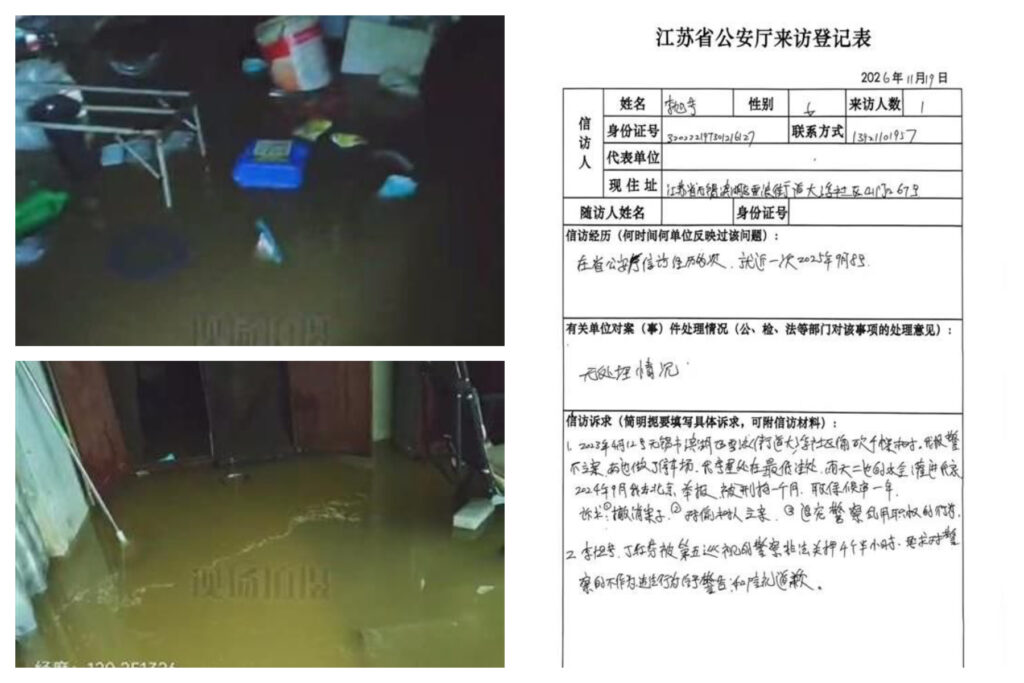
In Wuxi City, Jiangsu Province, the Dafu Community of Xuelang Street in the Binhu District has taken drastic measures by cutting down a large expanse of trees surrounding the home of resident Li Xufang. The community transformed the land into a parking lot for profit, resulting in the destruction of natural drainage pathways. Consequently, whenever it rains, water has no outlet and flows back into Li’s ancestral home, causing severe flooding.
For the past three years, Li has repeatedly raised concerns about her predicament, but her appeals have gone unanswered. Instead, she has faced criminal detention and has been placed under residential surveillance. To this day, her case remains stagnant at the procuratorate, with no prosecution, no ruling, and no resolution in sight.
On November 19, 2026, Li took her grievances to the Jiangsu Provincial Public Security Department in an attempt to defend her rights. She is demanding the revocation of the erroneous criminal charges against her and a thorough investigation into the community’s illegal logging and unapproved filling of drainage channels. She is also calling for accountability from the negligent officials involved.
Li’s ancestral home was once surrounded by a beautiful forest, providing a tranquil living environment. However, in 2023, the Dafu Community, without any necessary approvals or legal logging permits, cut down thousands of mature trees near her property. They also elevated the land to convert it into a parking lot on a large scale.
The newly elevated parking lot is now nearly a meter higher than the base of Li’s home, and the natural drainage ditches that once existed have been sealed off and buried. As a result, her house has become the lowest point in the area. Whenever it rains, the water has nowhere to drain and floods into her home.
Li described her plight, stating, “The walls of my house have cracked due to prolonged exposure to water, and mold has caused damage, making the structure unsafe. The tiles on the floor are uneven, and all my furniture and appliances have to be raised just to keep them from being damaged by the water. Every time there’s a storm, my family has to wade through the water, scooping it out by hand at midnight. We’ve suffered from flooding for years, and our living conditions have become unbearable.”
In her quest to protect her ancestral home and safeguard her legal rights, Li has sought clarity about accountability: “Who approved the logging without permits? Who is responsible for the filling in of the drainage ditches? Who gave the go-ahead for elevating the land? If my home has been damaged, who will bear the losses?” Unfortunately, her pleas have been ignored. Li remarked, “The community director even threatened that they would not solve my problem. With nowhere to turn for help, I had no choice but to go to Beijing and report the community’s illegal logging activities.”
However, upon arriving in Beijing, Li was inexplicably taken into custody for criminal detention. She was later indicted and subsequently placed under residential surveillance. Her case remains unresolved at the procuratorate, with no prosecution, no judgment, and no dismissal.
Li expressed her frustration that those who unlawfully destroy the environment and infringe upon the welfare of the community can live unscathed, while ordinary citizens who seek to uphold their rights are ensnared by the judicial process. Even more astonishing is that her mother-in-law, who played no active role in her claims, faced legal repercussions simply for helping Li book a ride to Beijing, being summoned for “suspected provocation and troublemaking” and, like Li, placed under residential surveillance.
Li emphasized, “Reporting illegal activities is a legitimate right granted to every citizen by law. My case has dragged on for two years without any new evidence being presented, yet the authorities refuse to close the case or correct their mistakes. This is essentially a manipulation of the judicial process to delay justice, forcing innocent people to suffer due to others’ negligence.”
She further highlighted, “According to criminal law, large-scale logging without permits constitutes illegal logging. The individuals involved in the logging haven’t been questioned, yet the person who reported it ended up in detention. The case has been pending for two years without a hearing or conclusion. My demands are straightforward: investigate the facts surrounding the illegal logging, resolve the drainage issues, address the flooding concerns, dismiss the absurd case at the procuratorate, and restore my innocence.”