
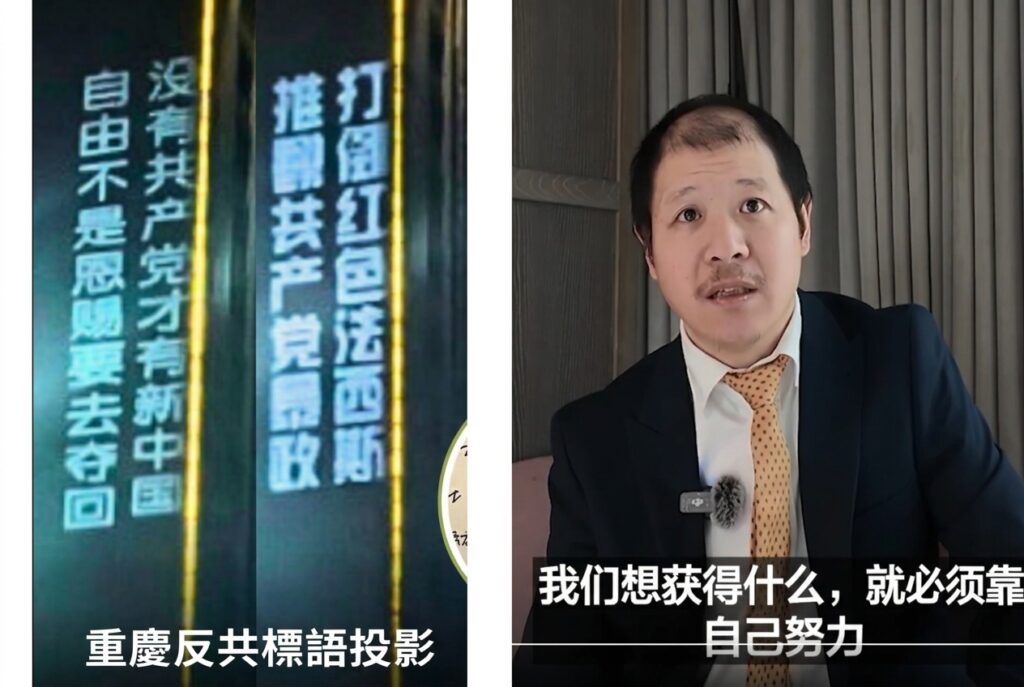
On November 28, 2026, a remarkable event transpired, shedding light on the unwavering spirit of those striving for free expression under oppressive regimes. Just a year prior, on the eve of the Chinese Communist Party’s grand military parade, significant actions took place in Chongqing, where an anti-communist message was projected onto the exterior of a high-rise building. The individual behind this bold move, identified as Qi Hong, was in the United Kingdom at the time, having remotely activated the projection equipment.
This defiant display included messages such as “Down with Red Fascism, Overthrow the Communist Tyranny,” “Without the Communist Party, There is a New China,” and “No Lies, Only Truth; No Slavery, Only Freedom.” The slogans illuminated the building for approximately fifty minutes before law enforcement intervened to halt the projection. Alongside the projections, Qi left an open letter stating, “Truth is truth, just as clouds may obscure the sun, it does not mean the sun has disappeared.”
Fast forward to November 25, 2026, and Qi Hong was honored in London with the Index on Censorship’s Annual Freedom of Expression Award. During the awarding ceremony, he expressed shock at the amount of attention his actions had garnered.
“I am just an ordinary person. Faced with injustice, I could no longer remain silent, so I chose to stand up and speak out,” Qi stated.
Founded in 1972, the Index on Censorship has been awarding annual accolades since 2001 to individuals and organizations that make significant contributions to protesting censorship and promoting freedom of expression. The awards are divided into four categories: arts, advocacy, journalism, and a special award from the board.
Qi was the recipient of the advocacy category for the year. Alongside him were other notable winners, including the Russian poet Artem Kamardin, who was imprisoned for his anti-war poetry, and the independent investigative media outlet Abzas Media, which has faced severe repression from Azerbaijani authorities, leading to imprisonment and exile for some of its members.
Qi emphasized that this honor is not solely his but belongs to all those who bravely choose to speak out despite the risks of losing their freedom or even their lives.
“I am not the first person to voice concerns, nor will I be the last. It is because those before me have spoken up that I had the opportunity to learn the truth and found the courage to stand up,” he remarked.
He also added, “A single voice may be faint, but it can inspire another’s courage; one person’s bravery can motivate many others.”
Jemimah Steinfeld, the Editor of Index on Censorship, published an article following the award ceremony, highlighting this year’s winners amid the global landscape of restricted freedom of expression.
She noted that all the awardees come from countries where free speech is heavily curtailed and have paid a dire price for exercising their rights to expression. Steinfeld specifically mentioned Qi Hong, who now finds himself separated from his family, who cannot safely communicate with him. His “crime,” she pointed out, was merely projecting critical messages about the Chinese Communist Party onto a wall in Chongqing, an act that he had to perform remotely to avoid arrest.
In her piece, she stated that participating in society, monitoring power, and expressing opinions should be fundamental rights accessible to everyone, without the prerequisite of extraordinary courage or meticulous planning.
Ma Jian, a Chinese writer based in the UK and a former recipient of the Index on Censorship’s Freedom of Expression Award, shared with Voice of America that Qi Hong’s projection protest represents a novel means of expression, distinctly different from earlier generations of dissenters. He described Qi’s actions as “highly creative,” emphasizing that they not only protested against a totalitarian regime but also prioritized the safety of the activist.
However, the British Index on Censorship reported that, following the incident, the Chinese authorities had interrogated Qi’s relatives and friends, froze his bank accounts, and pressured his wife’s family. Qi’s lawyer, Ben Keith, a prominent barrister in the UK, cautioned that while international attention may help safeguard Qi and his family, it does not eliminate the risks posed to other relatives.
In an interview with Voice of America, Qi conveyed that his decision to speak out was inspired by the courage of individuals such as Peng Lifang, a hero from the Sitong Bridge incident in Beijing, and the participants in the White Paper Movement. He expressed hope for transformative changes within Chinese society, asserting, “If you want freedom, you have to stand up for it yourself. You cannot rely on any leader or organization; it is only when everyone genuinely stands up and voices their opinions that change will occur.”