
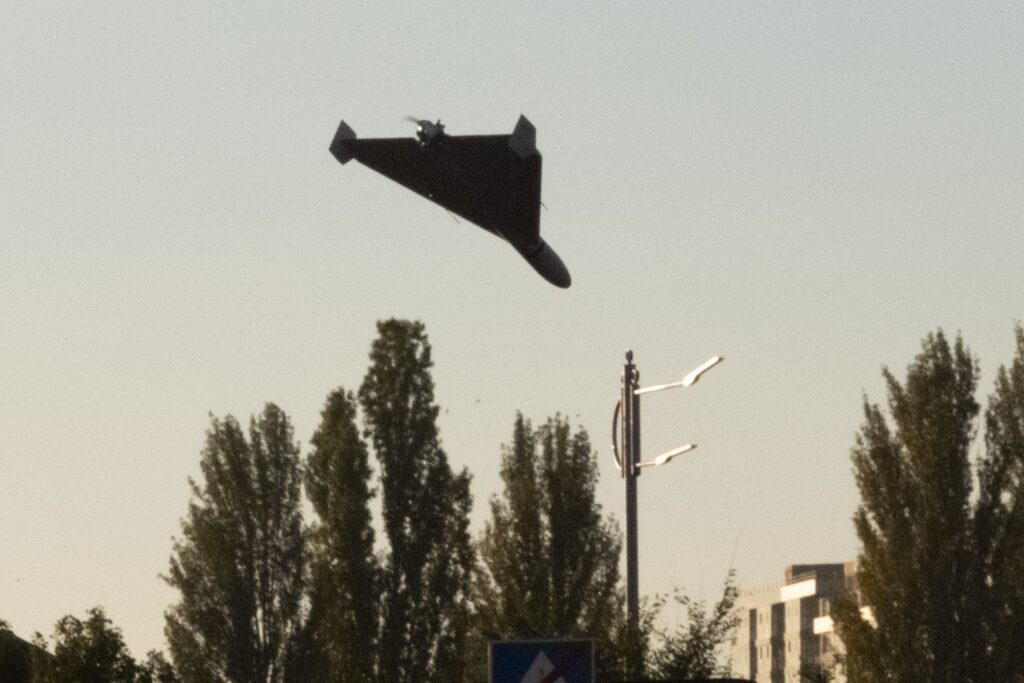
On November 25, in a video shared via Telegram, Serhii Beskrestnov, an advisor on defense technology to the President of Ukraine, announced a groundbreaking achievement by Ukrainian forces. He reported that a new aerial defense laser system, known as “Blysk,” successfully intercepted and destroyed a Russian Geran drone. Beskrestnov described this event as the first of its kind in the world.
The “Blysk” laser weapon has been developed by Ukraine’s Carmine Sky company under the national “Private Air Defense” initiative, which is backed by the government’s Brave1 defense technology cluster. This significant development showcases Ukraine’s commitment to enhancing its defense capabilities amidst ongoing conflicts.
Beskrestnov stated that several Ukrainian enterprises are currently engaged in researching and developing air defense laser systems. He emphasized the complexity and high costs associated with laser technology, noting that this success brings encouraging news. However, he cautioned that the laser system is still undergoing testing, making it premature to discuss mass production plans.
At present, the account of this successful interception remains unverified by independent third-party sources. Nevertheless, several international media outlets have reported on the claim. BBC Ukraine reported on November 19 that the “Blysk” system was put into operation at the beginning of November. The system has a power output of approximately four kilowatts and an effective range of around one kilometer (0.6 miles). This technology can automatically detect and lock onto aerial targets, using laser beams to heat the object until it disintegrates.
According to the report, smaller First-Person View (FPV) drones can be destroyed in less than a second, while thicker-shelled Iranian-designed drones, known as Shahed, require several seconds of exposure to the laser to be neutralized. Notably, the BBC indicated that as of the time of the report, the system had not been confirmed to have downed any drones.
Carmine Sky explained that the effectiveness of the laser weapon is significantly influenced by weather conditions. In Kyiv, the frequent clouds and fog in November can weaken the laser beam’s intensity. They also highlighted that the laser weapon can be reused repeatedly as long as it has a power supply, making its operational costs significantly lower than those of traditional missile interception systems. However, it is worth noting that its power output is much less than Israel’s laser defense system, which has an approximate output of about 100 kilowatts.
In recent months, Russian forces have increasingly relied on jets capable of reaching speeds between 400 to 600 kilometers per hour, replacing older, slower propeller-driven drones. This shift is reportedly due to the increased difficulty Ukrainian forces face in intercepting these faster unmanned aerial vehicles (UAVs).
Data provided by the Ukrainian Air Force and the military non-profit organization “Come Back Alive” revealed that in September alone, Russian troops launched over 3,000 Geran-4 and Geran-5 drones against Ukraine. In contrast, only around 350 were dispatched in June. The Geran drones are modified versions of Iran’s Shahed drones, which have also been used extensively in conflict.
The Ukrainian General Staff reported that the interception rate for Geran-4 drones over the past three months is nearing 60%, with some air attacks reaching an interception rate as high as 80%. In comparison, the interception rate for the slower propeller-driven drones is as high as 95%.
During an interview with Radio Free Europe in November, Ukrainian Prime Minister Serhii Koretskyi warned that Russian forces could launch approximately 6,500 jet drones in November alone, marking a twelvefold increase from the 530 drones launched in August.
In response to this escalating threat, Kyiv has been actively seeking more cost-effective interception methods. On September 3, President Volodymyr Zelensky ordered a quickening of the development of high-speed interception drones. Following a report from the Ukrainian Security Service (SBU) on September 19, he announced that a new type of interception drone, developed by the SBU’s military counterintelligence unit, had been successfully deployed specifically to counter jet drones.