
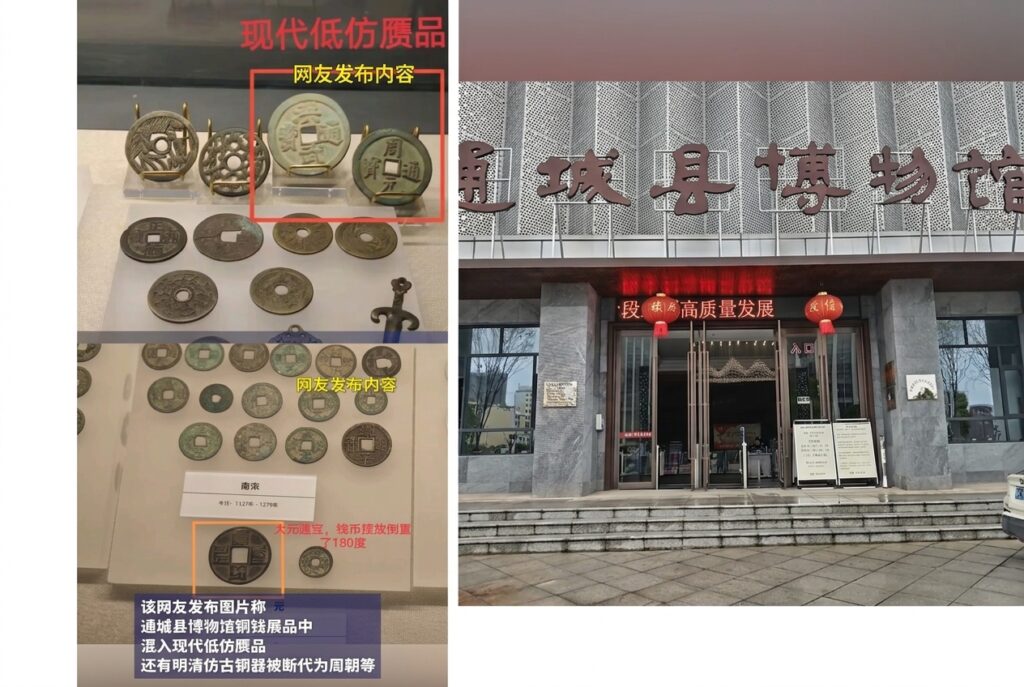
Recently, two local museums in Hubei Province have found themselves at the center of controversy due to disputes over their exhibits. The Tongcheng County Museum faced scrutiny over two ancient coins that were claimed to be modern replicas, prompting the museum to remove the items from display while awaiting expert verification. Similarly, the Qianjing City Museum was criticized by collectors for numerous inaccuracies in the dates and designations of its artifacts.
Reports indicate that the coins on display at the Tongcheng County Museum, specifically the “Zhou Yuan Tong Bao” and “Hong Wu Tong Bao,” have drawn skepticism from internet users, with some asserting that they are products of contemporary craftsmanship. Additionally, the chronological labeling of the exhibits has also been called into question.
The museum’s director, Li Jian, stated on November 26 that the disputed coins have been taken out of the display cases. However, he emphasized that withdrawing the items does not equate to an admission of them being counterfeit, as a final determination will depend on the assessment by provincial experts.
Li Jian further revealed that the two coins in question were acquired around 1987 by the previous museum director from a local scrap metal purchasing station, where they were obtained at prices typical for scrap copper. These coins later made their way into the exhibition hall following the museum’s relocation. He noted that if they turn out to be forgeries, the issue would lie with the inadequate assessment conducted at the time of their acquisition.
Regarding the inaccuracies in dating some of the exhibits, Li Jian acknowledged that experts had pointed out issues over two years ago, such as the need to clarify one description from “Zhou Dynasty” to “Qing Dynasty imitation of the Zhou Dynasty.” The museum made subsequent updates to the exhibition labels.
As of now, there has been no official authentication regarding the authenticity or the production dates of the disputed coins.
Wang Yongsheng, the former head of the research information department of the China Currency Museum, provided his preliminary assessment to reports, indicating that the coins bear similarity to those from the Republic of China era, and do not appear to be modern reproductions.
Wang further elaborated that both “Hong Wu” and “Zhou Yuan” are common themes found on folk currency, which has been minted by citizens across various dynasties. These types of coins, often referred to as ‘flower money,’ were primarily used for blessings, warding off evil, and as ornamental pieces, rather than as official circulating currency. Therefore, it is misleading to solely rely on the inscriptions of the years on the coins to determine their manufacturing period.
The controversy surrounding the exhibits at the Tongcheng County Museum is not an isolated incident.
In mid-November, the collector group known as “Museum Anti-Counterfeiting” highlighted several discrepancies at the Hubei Qianjing City Museum, including mislabeling Qing Dynasty porcelain as Ming Dynasty and a Qing bronze mirror labeled as Western Zhou, alongside other inaccuracies regarding coins and inscriptions.
The “Museum Anti-Counterfeiting” group has released over 180 videos identifying mistakes in museum exhibits, highlighting issues across various museums and cultural institutions within multiple provinces.