
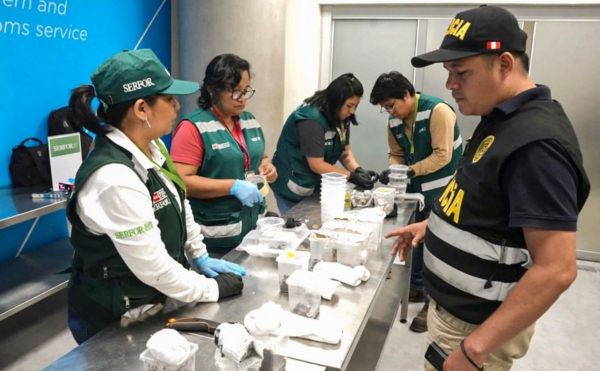
Peru’s National Forestry and Wildlife Management Authority (SERFOR) has reported a significant wildlife trafficking incident that took place on November 26th at Jorge Chavez International Airport in Lima. Authorities seized over 670 live wild animals being transported in the luggage of two Chinese citizens. These creatures included tarantulas, centipedes, and scorpions, raising concerns over the illegal wildlife trade.
In a statement made by Cora Suarez, a technician from SERFOR, the authorities discovered these animals during a coordinated raid involving SERFOR staff and customs officials. The operation resulted in the confiscation of a diverse assortment of wildlife, comprising 386 tarantulas, 166 centipedes, 112 scorpions, and 7 lizards. Additionally, six dead ants were also found among the seized items.
The animals were stored in sealed bags within plastic containers, and many of them were wrapped in damp paper towels to maintain their moisture. Notably, one container holding tarantulas was hidden inside a small plush backpack carried by one of the travelers.
According to Suarez, the individuals were traveling from Lima to Paris with subsequent plans to continue on to China. The value of this shipment was estimated to be around $100,000, demonstrating the large sums involved in the illegal wildlife trade.
Suarez emphasized that these types of animals are often sold as pets in Asian and European markets. As holiday seasons approach, the illegal wildlife trade typically sees a surge, as many people seek out exotic animals to give as gifts.
It is crucial to note that the illegal transportation or smuggling of Peru’s wildlife, including live animals, eggs, or protected species, is a serious offense. Those caught can face arrest, confiscation of their goods, and criminal prosecution. Remarkably, this incident marks the second case of illegal live animal transportation seized at Jorge Chavez International Airport within the span of a month.
Earlier in November, authorities intercepted a group of three European travelers who were attempting to transport a large number of live tarantulas concealed within socks and containers as they prepared to travel to Germany. The total count from that seizure exceeded 10,000, consisting of eggs, spiderlings, and adult specimens.
These incidents highlight the urgent need for stricter enforcement and awareness regarding wildlife trafficking, as it poses significant threats not only to biodiversity but also to global public health and safety.