
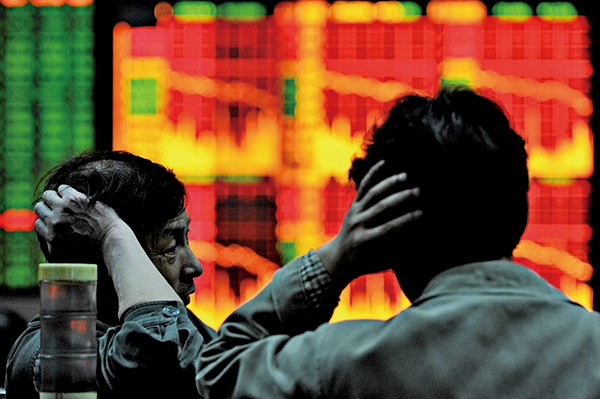
A recent development has prompted renewed focus on China’s state-owned financial institutions, commonly referred to as the “national team.” These entities are generally understood to signify the government’s intervention in the capital market. In a notable departure from tradition, the State Council of the Communist Party of China has issued a press release, marking the first time it has explicitly mentioned the “national team” while calling for the stabilization of the stock market. Analysts suggest that the recent decline in stock prices is indicative of the ongoing deterioration in China’s economic conditions.
On November 27, the stock market experienced a significant rebound in the afternoon trading session. By the close of trading, the Science and Technology Innovation Index had risen by 14.21%, achieving the largest single-day increase seen in over two years. Other indices also saw substantial gains: the Northern Stock Exchange 50 rose by over 13%, the ChiNext Index climbed more than 11%, the Shenzhen Component Index increased by over 7%, and the Shanghai Composite Index gained nearly 4%. Across the board, more than 5,300 stocks posted gains, with over a thousand hitting the daily limit or rising by more than 10%. However, sectors such as fishing, coal, petrochemicals, and banking saw declines. Total trading volume exceeded 2 trillion yuan, reflecting an increase of over 690 billion yuan compared to the previous trading day.
Chinese media attribute the stock market’s upward movement to the State Council’s rare issuance of a news release during trading hours. On the same day, Premier Li Qiang chaired a State Council executive meeting, during which the concept of the “national team” and descriptions analogous to “stabilization funds” were officially included in the communication.
The term “national team” commonly refers to entities that intervene in the market during challenging times. This collective is typically managed by the Central Huijin Investment Company, a subsidiary of the Ministry of Finance tasked with domestic investments for the sovereign wealth fund.
Tian Lihui, the director of the Financial Development Research Institute at Nankai University, remarked that issuing the press release during trading hours was a significant shift from the usual practice of releasing statements post-market close. He noted that this bold move serves as a targeted indicator for managing market expectations, aiming to promptly mitigate emotional volatility and liquidity tensions experienced during trading.
Regarding the emphasis on enhancing the role of the “national team” in stabilizing the stock market, as well as the functions of the Central Huijin Company akin to stabilization funds, Tian posited that this marks a transition from an ad-hoc crisis management tool to a permanent fixture in financial governance.
The State Council’s surprising departure from protocol in issuing the news release and mentioning the “national team” occurred during a period of substantial market declines. On November 24, the three major exchanges in Shanghai, Shenzhen, and Beijing reported that 3,496 stocks had declined. The following day, the A-shares continued to plummet, with the Shanghai Composite Index falling below 3,500 points, and nearly 5,000 stocks were in decline, representing a staggering proportion of about 90%. The market was riddled with significant selling pressure, particularly among technology stocks, where previously high-flying segments like semiconductors, computing hardware, and physical AI faced massive sell-offs.
Expert analyst Li Tingqian elaborated on the situation, stating that this was not merely a correction confined to a handful of stocks but rather a collective release of market confidence. The underlying factors contributing to the erosion of market confidence stem from the persistent deterioration of China’s economic fundamentals. According to official data from October 2026, retail sales of consumer goods showed a meager increase of merely 0.4%. Concurrently, significant negative growth was reported in fixed asset investments, private investments, and real estate development investments, revealing a profound crisis characterized by feeble domestic demand and a contraction in investments.
The article argues that the current economic and stock market malaise is rooted in the government’s long-standing reliance on a highly centralized decision-making model, abrupt shifts in real estate policy, and the deteriorating business environment for private enterprises. The Chinese government’s excessive dependence on the “national team” and state capital to artificially prop up the market has distorted the market’s pricing mechanisms and failed to address fundamental issues such as declining corporate profits and reduced consumer spending willingness. This reliance on administrative intervention has replaced institutional trust, making it challenging to foster healthy long-term market confidence.
International perspectives mirror these sentiments. A recent survey conducted by Bank of America indicates that global fund managers are gravitating toward the same market directions; 39% are betting on an uptick in global semiconductor stocks, claiming the top position. In stark contrast, 14% are shorting Chinese stocks, occupying the second position. This survey reflects a heightened level of caution among international fund managers regarding investments in Chinese equities.