
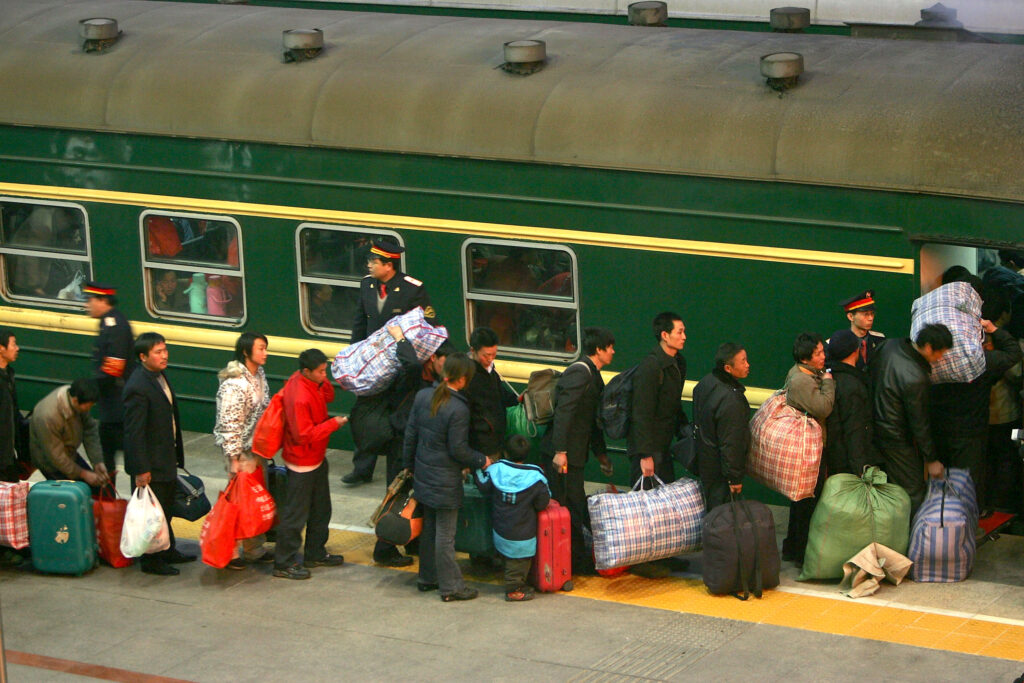
On the evening of December 10, 2025, a group of seventy to eighty passengers boarded a green train traveling from Hangzhou to Beijing. These individuals shared a common story: they were once successful business owners who now found themselves in dire financial straits, subjected to court-imposed restrictions limiting their high-consumption activities. This restriction means they are forbidden from flying or using certain high-speed trains, driving their need to seek new opportunities for redemption in the world of business.
According to reports, these passengers were entrepreneurs who were deeply in debt and were on their way to Beijing to explore potential projects. Inside the train, many displayed acts of camaraderie, like giving up lower bunks for older travelers or capturing the moment with their phones. A specific form of interaction emerged within the carriage: “You look quite impressive; what brings you aboard a green train?”
Among the passengers was 63-year-old Lin Yuan, a former owner of a poultry business that once employed nearly a thousand people but now bore a staggering debt of approximately 86 million yuan. While a flight from Hangzhou to Beijing would take just over two hours at a cost of a little over 300 yuan, Lin was resigned to a journey that would take more than sixteen hours on a regular train.
Inside the carriage, the atmosphere was a mix of past and present. Some passengers dressed smartly in collared shirts and belts maintained their former business demeanor, while others resorted to instant noodles for sustenance, engaging in discussions focused on strategies for regaining business contracts and repaying debts.
Reports highlighted Lin’s ability to recognize fellow entrepreneurs by their attire and mannerisms. He still wore an LV belt, a remnant of his former prosperity that he hadn’t sold off yet. His habitual patterns shaped during his time as a businessman had not completely dissipated since his company’s downfall.
Another notable figure was Cheng Xin, an entrepreneur from Wuhan who had ridden the green train for eleven consecutive years while managing his business and tackling debt. On the evening of September 25, 2026, during the Mid-Autumn Festival, the 45-year-old Cheng took his backpack and boarded a green train at Wuchang Railway Station bound for Shiyan to meet potential clients. While the fastest high-speed train from Wuhan to Shiyan takes less than two hours, Cheng found himself on a journey that lasted over six hours on a conventional train.
Cheng took over a car parts manufacturing business with his father back in 1992. By 2009, he had secured a loan of six million yuan to expand production, and the factory once boasted annual sales exceeding 20 million yuan while exporting products to Southeast Asia and South America. However, as the company grew, it encountered financial hurdles, eventually leading to a broken cash flow in 2015, with debts accumulating to over 20 million yuan and 117 creditors filing lawsuits.
After his wife left him, Cheng faced a period of hiding from creditors and even contemplated suicide. Ultimately, he resolved to keep his business afloat and repay his debts by converting large projects into smaller orders and networking city by city, client by client. Once his factory’s cash flow collapsed, the courts allowed for a survival tactic known as “active sealing,” permitting the factory to continue production while repaying debts based on a proportional income. However, the pandemic led to a stoppage in production, severely disrupting his repayment plans.
As of September 2026, Cheng managed to repay around 14 million yuan, reaching settlements with over 90% of his creditors, though he still owed more than 6 million yuan. He also faced hurdles when trying to participate in public tenders, as restrictions due to high-debt limitations presented barriers that cost him lucrative contracts worth millions. Consequently, he was left to take on subcontracting orders through other firms, which yielded significantly lower profits.
Cheng observed that many passengers on the green train, dressed neatly and presenting themselves as business-minded individuals, were also suffering under similar high-debt restrictions. These individuals were on a quest for business opportunities, discussing projects and market insights until they disembarked, only to part ways afterward. Cheng emphasized, “Those who owe money yet continue to chase business do so with a glimmer of hope, aspiring to clear their debts and make a fresh start.”
Another compelling story emerged from a former game company owner from Shenzhen, known among peers as “Egg Boss,” who likewise found himself trapped in debt due to changing business conditions. Reports indicated that “Egg Boss,” once at the helm of a game company with nearly a hundred employees and millions of users, found his fortune dwindling following new regulations aimed at preventing addiction and enforcing real-name verification. The decline in user and advertising revenue forced a transition that did not yield the expected outcomes, ultimately leading to his company’s dissolution and leaving him with debts of around 7.5 million yuan.
Looking back on his entrepreneurial journey, “Egg Boss” remarked, “When the small game platform was booming, it felt like every game release was a profit machine. I thought I was quite capable and aimed to scale up. Yet many times, a policy shift can extinguish all that effort in an instant.”
His experiences illustrate the profound impact of policy shifts on business operations. Over the past decade, industries such as P2P lending, off-campus tutoring, and pre-prepared meals have undergone extensive regulatory crackdowns, prompting many organizations to shut down or pivot in response to changing consumer demands and government directives.
Beginning in 2018, the Chinese government reversed previously encouraged policies surrounding “Internet finance” and “mass entrepreneurship,” tightening financial regulations as the P2P lending sector entered a phase of concentrated restructuring. Reports suggested that the number of functioning P2P lending platforms plummeted from approximately 5,000 at its peak to virtually none, driven by issues of non-compliance, ruptured cash flows, or regulatory purges.
In July 2021, new “double reduction” policies were unveiled, significantly limiting extracurricular subject-related training for students in compulsory education. Data from the Education Ministry in 2022 revealed that the number of offline tutoring institutions was reduced by 94.2%, while online training providers saw a decline of 87.07%. Many businesses reliant on academic training were left with no choice but to shut down or shift their operational strategies.
The government’s initiatives for promoting pre-prepared meal industries in February 2023 were met with mixed reactions. Just as the market saw entry from various businesses as a result of new supportive policies, backlash from parents against school meal issues resulted in public outcry and pressure against related catering programs in various regions.
Economic scholars like Song Qinghui have predicted that among the approximately 68,000 pre-prepared meals companies currently, only about 5,000 may survive in five years.
From P2P lending to off-campus education, an array of industries has experienced market withdrawal and restructuring, leaving many enterprise owners burdened with debt and under court-ordered restrictions on high-consumption behaviors. While no precise statistics quantify how many have journeyed aboard a green train as a result, recent anecdotes have surfaced online about individuals encountering former entrepreneurs, now burdened with debt, traveling the same routes in search of new business opportunities.
In October 2025, Wang Zizhu, the former founder and CEO of a tech media outlet known as Zealer, was also seen dining on instant noodles aboard a green train. The phrase “Wang Zizhu, with a debt of 100 million yuan, rides the green train for business” trended on Weibo. Coverage indicated that he dealt with nearly 100 million yuan in debt related to equity buybacks, leading to restrictions placed upon him.
In another viral video circulated on social media, a man, later identified as Lin Yuan, shared during an interview on the green train that he felt “outmatched by this era,” expressing a strong desire to rise again through hard work. The interviewer lamented the shift from a time when the green train predominantly transported migrant workers to now accommodating numerous businesspeople affected by high-debt limitations.
Professor Shen Laijin from Wuhan University of Technology commented in an interview that while high-consumption restrictions aim to curb unnecessary spending by debtors, it is vital to also consider the needs of those willing to repay debts but currently unable to do so in full. He highlighted that if such restrictions obstruct business orders and income, it could create a cycle of “the more restrictions, the harder it becomes to repay.”