
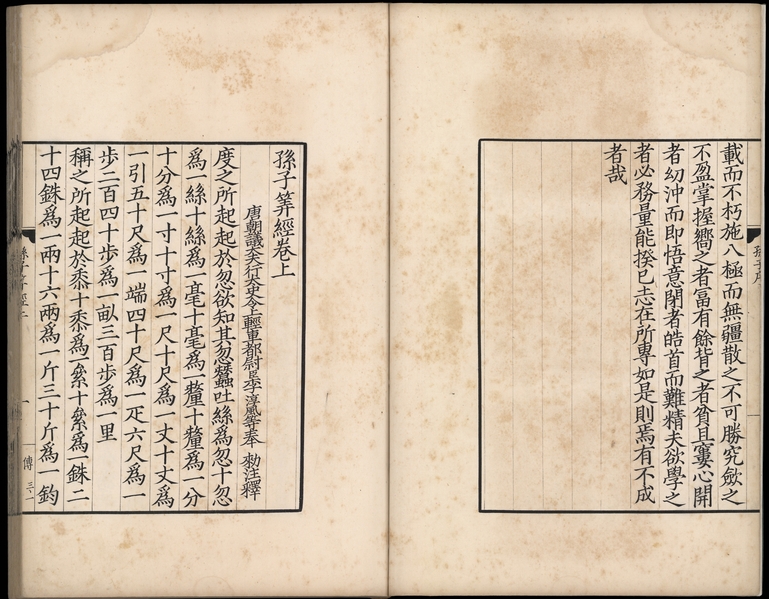
The National Palace Museum in Taiwan has launched a special exhibition titled “Mathematics in the Context of the Universe: A Study of Ancient Mathematics in the National Palace Museum’s Collections.” This exhibition opened on November 25 and provides a fascinating look at the integral role mathematics has played in traditional Chinese culture, linking it to the imperial knowledge traditionally associated with governance.
The museum released a statement on its official website emphasizing that while mathematics is often referred to as the “mother of all sciences” or the “queen of sciences,” many people view it merely as a cold, abstract set of formulas taught in modern classrooms. However, according to Liu Guowei, a research fellow from the museum’s Department of Calligraphy and Historical Literature, the ancient texts in the museum’s collection reveal that “calculative studies” have always been intertwined with humanity’s understanding of the universe, governance, and everyday life.
In Liu’s words, this exhibition, “Mathematics in the Context of the Universe,” aims to break down the barriers between the arts and sciences, encouraging visitors to rediscover the beauty of mathematical principles hidden within ancient texts and artifacts.
The title of the exhibition carries a dual significance. The term “mathematics” refers to the rules and regulations of precise deductions and measurements, while “the universe” symbolizes the operational paths of all things in existence. From ancient times, the renowned “River Map and Luo Shu” illustrated odd-even symmetries and the mysteries of magic squares through the arrangement of numbers. Additionally, the “Zhou Ritual” identified “the nine numbers” as one of the Six Arts essential for noble youth, indicating that mathematics has been imbued with both philosophical inquiry and practical application since the Pre-Qin period.
Throughout history, mathematicians in China not only established problem-solving paradigms in classics such as the “Nine Chapters on the Mathematical Art,” but during the Song and Yuan dynasties, they reached peaks in advanced algebra and geometry. By the Ming dynasty, the use of the abacus made advanced calculations accessible to the general populace, demonstrating a rich tradition that combined high theoretical understanding with practical usage. Liu pointed out that in the 17th and 18th centuries, as Western learning spread to the East, mathematics became a vital bridge for dialogue between Eastern and Western civilizations.
During the reign of Emperor Kangxi in the Qing dynasty, the emperor was motivated by the principle “If I do not know, how can I judge right from wrong?” He dedicated himself to studying Western astronomy and mathematics, creating the comprehensive “Imperially Compiled Explanations of Mathematics” at the Changchun Garden. Additionally, he amassed a collection of compact and exquisite logarithmic tables and Western surveying instruments to retain on hand.
Through the treasures housed in the National Palace Museum, Liu notes that one can glimpse how emperors and scholars simplified complex concepts and expanded their horizons at the intersection of Eastern and Western knowledge.
Liu emphasizes that ancient mathematical texts are not merely vessels for calculation formulas but encapsulate the curiosity and rigorous spirit of scholars throughout the ages as they sought to explore the unknown. He sincerely invites the public to delve into the exhibition and discover the intellectual crystals of ancient wisdom. Visitors can experience the intertwining of numbers and shapes, feeling the rationality and poetic essence that transcends time, residing within a confined universe.
The exhibition “Mathematics in the Context of the Universe: A Study of Ancient Mathematics in the National Palace Museum’s Collections” is divided into five main sections: “Introduction: Mathematics Before the Qin,” “The Ten Mathematical Classics,” “Peaks of Mathematics in the Song and Yuan Dynasties,” “Mathematical Exchanges in the Ming Dynasty,” and “The Revival of Mathematics in the Qing Dynasty.”
These sections portray the evolving trajectory of mathematics within traditional Han culture. From the cosmic order established by the “River Map and Luo Shu,” foundational theories laid out in the “Ten Mathematical Classics” during the Tang dynasty, to the mathematical zenith during the Song and Yuan Dynasties, and the profound dialogues between Chinese and Western mathematical thought in the Qing dynasty, the exhibition showcases rare texts that present the history of mathematics in China from a royal perspective.
The first section, “The Ten Mathematical Classics,” includes textbooks mandated by the Imperial Academy during the Tang dynasty, which form the cornerstone of traditional Chinese mathematical theory. This section features texts detailing the “Heavenly Model” of the universe and the Pythagorean theorem from the “Zhou Bi Suan Jing,” groundbreaking solutions akin to modern Gaussian elimination from “The Mathematical Art of Nine Chapters,” and the origins of the classic problem “Rabbits and Chickens,” as well as the early development of the Chinese Remainder Theorem in “Sun Zi’s Mathematical Art.”
These invaluable documents record crucial algorithms such as the approximation of π and polynomial techniques, reflecting the scholarly efforts of Qing dynasty intellectuals to correctly interpret and assemble these ancient mathematical texts.
The second section, “Peaks of Mathematics in the Song and Yuan Dynasties,” reveals a golden age of mathematical development in ancient China. The achievements of the Song and Yuan dynasties were globally prominent, featuring theories such as “Tian Yuan Shu” for the numerical solutions of higher-order equations, “Si Yuan Shu” for multivariate polynomial systems, and “Duo Ji Shu” for the summation of higher-level arithmetic sequences.
Among these masterpieces, “The Sea Mirror of Measuring Circles,” completed in the third year of the Yuan dynasty’s Emperor Ding Zong (1248), exemplifies world-leading mathematical accomplishments of that time, utilizing a method to formulate and solve single-variable high-order equations.
The third section, “Mathematical Exchanges in the Ming Dynasty,” showcases dialogues between Chinese scholars and those from the Korean Peninsula, Japan, and Western missionaries. During this time, advanced mathematics lessened in China but flourished in Korea and Japan, an unusual phenomenon where indigenous knowledge sought validation abroad.
This section highlights a rare copy of “Yang Hui’s Algorithm,” republished in the eighth year of the Ming dynasty’s Xuande period (1433), summarizing the achievements of Southern Song mathematician Yang Hui, exploring the summation of higher-level arithmetic sequences and showcasing the accomplishments of combinatorial mathematics during the Song dynasty.
The National Palace Museum notes that this work inspired Japan’s “Calculating Sage” Seki Takakazu (circa 1642-1708) in his research on determinants and series theory, constituting a significant artifact of early scientific exchange in the Ming dynasty. Towards the end of the Ming dynasty, Western missionaries introduced European geometry and practical mathematics, with “The Elements of Geometry” translated by Jesuit Matteo Ricci and published in the 35th year of the Wanli reign (1607), serving as the earliest standard edition, thus initiating preliminary dialogues between Chinese and Western mathematical thought.
The fourth section, “The Revival of Mathematics in the Qing Dynasty,” illustrates how Emperor Kangxi deeply integrated traditional Chinese mathematics with Western mathematics and established official institutional recognition of this discipline. He regarded mathematics as a vital tool for assessing scientific credibility and consolidating his rule, founding the “Mengyangzhai Mathematical Pavilion” and personally overseeing the compilation of significant scientific works.
Within this section, the exhibition displays the pinnacle of Qing dynasty mathematics, “Imperially Compiled Explanations of Mathematics,” which serves not only as an encyclopedia of Eastern mathematics but also astonishingly introduces Western algebra (including root-finding techniques) and logarithm tables for the first time in a formalized setting. Motivated by royal endorsement and exposure to Western learning, Qing scholars rekindled efforts to study and revise traditional mathematical texts, thereby unifying centuries of mathematical achievements from the Han to the Tang dynasties, ultimately consolidating these works within the “Complete Library in Four Sections.”
The exhibition “Mathematics in the Context of the Universe: A Study of Ancient Mathematics in the National Palace Museum’s Collections” began on November 25 and will run until February 28, 2027, with a subsequent phase starting on March 5, 2027, and extending until June 6, 2027.