
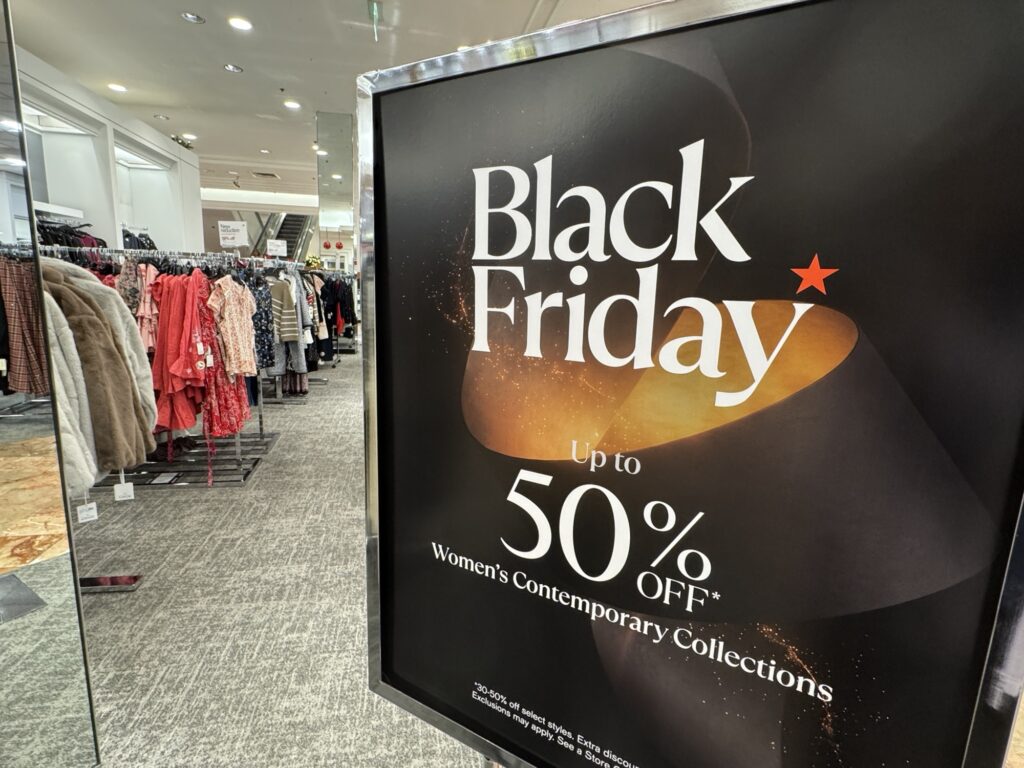
This year’s Black Friday in the United States, which fell on November 27, saw a significant shift in shopping trends. Consumers were not only filling their carts with Christmas gifts and electronics, but also stocking up on essential household products. With the rising cost of living, a growing number of Americans took advantage of the end-of-year shopping season to purchase necessities while enjoying discounts. Additionally, many savvy shoppers utilized artificial intelligence (AI) tools to compare prices and hunt for the best deals.
According to reports, U.S. retailers have consistently offered substantial discounts both online and in physical stores throughout November, leading to online shopping expenditures that exceeded expectations. Data on foot traffic revealed a decline in the frequency of consumers visiting brick-and-mortar stores, indicating a more calculated approach to shopping and a notable reduction in impulsive purchases.
Analytics from technology firm Adobe highlighted that from November 1 to 22, online sales of personal care items in the United States surged by 40% compared to the average in October. Likewise, sales of household cleaning supplies rose by 33%, and basic apparel saw an increase of 27%.
Vivek Pandya, the director of digital insights at Adobe, noted that typically, the holiday shopping season conjured images of luxury handbags and jewelry. However, an increasing number of consumers are now using this shopping season to stock up on life’s essentials.
Salesforce, another tech company, projected that this year, the deepest discounts during the holiday shopping season would be seen on clothing, home goods, and health and beauty products. Specifically, the average discount for health and beauty items from November 24 to 30 was expected to reach 33%, which is approximately a 30% markdown from the regular price.
Many retailers in the U.S. preemptively launched Black Friday promotions this year, with some even beginning their sales prior to Halloween. Data from Salesforce indicated that retailer discounts in November were 8% stronger compared to the same month last year, while the average price of physical goods saw a slight decrease of 1%.
Moreover, Pandya anticipated that the prices on Thanksgiving and Black Friday would remain the most competitive. For instance, the average discount on televisions for the first 22 days of November was recorded at 11%, but was expected to spike to 23% on Black Friday itself.
Rising prices have prompted consumers to place greater emphasis on price comparison. Adobe’s data revealed that in November, the volume of visits to retail websites via links from AI tools more than doubled compared to the same period last year.
On the other hand, figures released by Walmart and Amazon suggested that customers utilizing AI shopping assistants tend to spend more.
John Furner, the CEO of Walmart, stated in a recent earnings call that customers using the company’s AI shopping assistant, Sparky, spent on average 40% more per order than those who did not utilize the service. Similarly, Andy Jassy, CEO of Amazon, informed analysts last month that shoppers using the company’s AI assistant, Alexa, had a spending amount that was 50% higher than those who did not use it.
Overall, U.S. online shopping expenditures have surpassed expectations this year. As reported by Adobe, American consumers spent an impressive $82.5 billion on online shopping in the first 22 days of November, marking a year-on-year growth of 9.1%.
As consumers navigate these changing trends, it appears that the combination of strategic purchasing and technological assistance is shaping the shopping landscape more than ever before.