
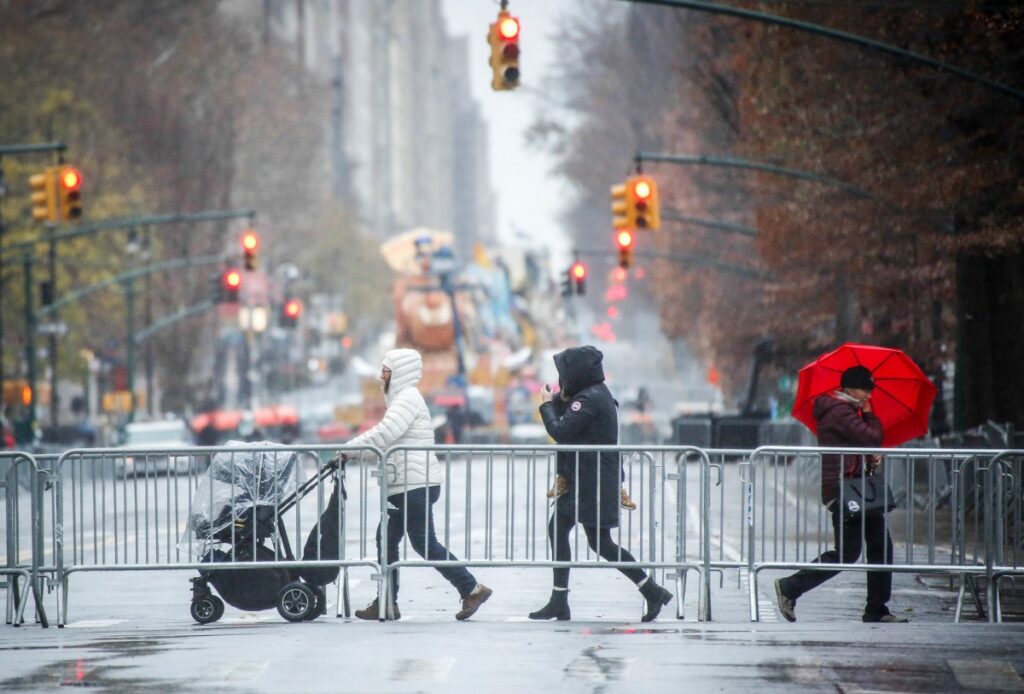
On the fourth Thursday of November, the United States traditionally celebrates Thanksgiving. However, this year, the holiday was marred by severe weather conditions along the East Coast and other regions, leading to flooding and power outages. As a result, the highly anticipated Macy’s Thanksgiving Day Parade had to be postponed.
On November 26, powerful winds and heavy rainfall struck both the East and West Coasts of the United States, significantly disrupting holiday travel plans. According to data from the power outage tracking website poweroutage.us, over 800,000 households and businesses were left without electricity on Thursday afternoon, most of them located in various states along the East Coast. Flight tracking service FlightAware reported that by noon, approximately 1,700 flights across the country were delayed and more than 400 had been canceled.
Due to concerns that the giant balloons featured in the parade could be damaged by the strong winds swirling between Manhattan’s skyscrapers, Macy’s decided to delay the annual Thanksgiving event until Saturday.
The storm caused significant impacts across many areas, unleashing torrential rain, fierce winds, and inundating streets with floodwaters. New Jersey’s Governor Mikie Sherrill declared a state of emergency statewide on Wednesday night, while New York’s Governor Kathy Hochul issued a similar declaration for certain parts of the state. Weather warnings for strong winds were also issued for regions spanning from northern Georgia to much of central Atlantic and southern New England.
Coastal towns and cities from North Carolina to New Jersey experienced flooding due to the storm. Roads became impassable, and rescuers worked tirelessly to assist individuals trapped in vehicles engulfed by rising waters.
In Avalon, New Jersey, the area faced one of the worst flooding disasters in its history. Scott J. Wahl, the area’s commercial chief, reported to the Associated Press that floodwaters pushed debris onto the roads, leading several drivers to inadvertently enter flooded areas while bypassing barricades; thankfully, there were no reports of injuries.
A video shared by the Margate City Fire Department, near Atlantic City, New Jersey, showed floodwaters beginning to surge into urban streets before heavy rains even commenced. A firefighter on the scene remarked on the alarming strength of the tide, warning that even though it was still an hour away from high tide, homes were already at risk as floodwaters encroached significantly.
The ferocious storm also prompted the temporary closure of a number of roads and bridges. The Chesapeake Bay Bridge-Tunnel in southern Virginia, which spans nearly 18 miles, was shut down for several hours on Thursday morning due to strong winds. Meanwhile, in North Carolina’s Outer Banks, the only highway linking Hatteras Island to the mainland was closed as seawater breached the dunes and inundated the roadway.
In Maryland’s Montgomery and Prince George’s Counties, nearly two million water customers were urged to conserve water, as the storm caused intermittent power outages.
Several tornado warnings were issued as storms swept through on Thursday, including a rare tornado reported just southeast of Seattle, Washington.
In addition to the wind and rain, a winter storm impacted parts of Missouri and Illinois, bringing significant snowfall. St. Louis recorded 7.3 inches of snow, while Ste. Genevieve, Missouri, reported a remarkable 14 inches of snow accumulation.
An ice rink in Wentzville, Missouri, experienced partial roof collapse early Thursday morning as heavy snowfall piled on. Mike Lueck, the director of the city’s Parks and Recreation Department, noted that the venue primarily hosts hockey and other skating events. Fortunately, no one was inside at the time of the collapse, which occurred around 3 AM. The facility will remain closed until further notice.
Simultaneously, coastal areas along the Pacific faced continued flooding as waves and strong winds brought about hazardous conditions. The National Weather Service projected that this situation would persist through Friday.
California’s coast experienced record tidal surges, which forced many residents to evacuate. The tidal impacts stretched from Humboldt County in the far north, through the San Francisco Bay Area, all the way down to Ventura County near Los Angeles.
The West Coast has been grappling with exceptionally high tides throughout the duration of this storm.
Footage from Wednesday revealed the Pacifica Pier in California being battered by massive waves, causing sections of the structure to collapse and plunge into the ocean. Officials had closed the L-shaped pier over the summer after discovering cracks in its foundation.
On Thursday morning, Amtrak’s Pacific Surfliner announced multiple service changes via social media due to damaged tracks and ground erosion caused by rising tidal waters, resulting in service suspension on several routes.
This series of extreme weather events has served as a stark reminder of nature’s unpredictability, even during a time of festivity and gratitude.