
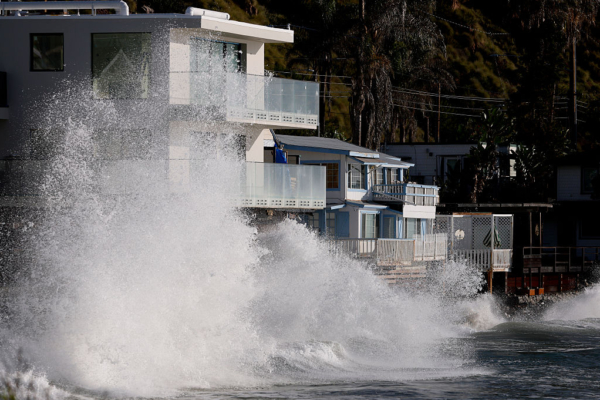
On the eve of Thanksgiving, millions of visitors flooded into the Los Angeles area, creating bustling crowds at major attractions. Meanwhile, the Southern California coast experienced unprecedented high water levels and towering waves under clear skies and gentle breezes. The National Weather Service (NWS) warned that these extreme tides and giant waves could result in moderate to severe coastal flooding, urging the public to prioritize safety and stay away from the water’s edge while enjoying the holiday.
According to forecasts issued by the NWS, significant tidal peaks in Santa Monica were expected on Thursday, November 26, at 9:23 AM, and again on Friday, November 27, at 10:10 AM. A coastal flood warning for the Los Angeles area was set to remain in effect until 2 PM on Saturday, while a high surf advisory would continue until 9 PM that evening.
On Wednesday, November 25, water levels at multiple coastal locations in Southern California reached historic highs. At the Port of Los Angeles and Santa Monica, the water reached a staggering 8.19 feet (approximately 2.5 meters), marking the highest level since 1923 for the port (tying with records from October 27), and the highest at Santa Monica since 1933, just shy of the 1982 record of 8.22 feet.
Newport Beach recorded an exceptional water level of 8.5 feet, breaking its previous record of 8.4 feet set in October, while Santa Barbara reported a new high of 8.21 feet. Several coastal communities in Orange County experienced flooding, with numerous streets in Huntington Beach submerged, prompting authorities to close off beachside roads.
Such elevated water levels are usually accompanied by strong winds, yet on this particular day, Santa Monica enjoyed mild breezes and sunshine. Meteorologists attributed this phenomenon primarily to two factors:
The first factor is the occurrence of “King Tides.” Recently, the moon’s orbit brought it to its closest point to Earth, combined with the alignment of the sun, moon, and Earth, creating a gravitational effect that led to the highest tides of the year. This year, rising sea levels have intensified the tidal effects.
The second factor is the strong El Niño phenomenon. The National Oceanic and Atmospheric Administration (NOAA) predicts that El Niño conditions will peak between November and December this year, pushing warm equatorial ocean currents eastward and propagating along the west coast of the Americas. This creates Kelvin waves, extending for thousands of miles, which can raise California’s sea levels by approximately 30 centimeters.
Both the National Weather Service and the Los Angeles County Department of Beaches and Harbors (DBH) have strongly advised the public to avoid areas near the water during this period. If a visit to the coast is necessary, individuals are urged to remain in lifeguard-supervised areas, avoid turning their backs to the ocean, and pay close attention to the possibility of waves suddenly washing ashore.
The DBH has implemented preventive measures, including maintaining protective sand berms, relocating lifeguard towers away from the shoreline, and coordinating with fire and other agencies to monitor beach conditions. Before entering the water, individuals should consult lifeguards to understand ocean conditions, avoid rocks, jetties, piers, and cliffs susceptible to wave activity, and keep a close watch on children and pets.
The National Weather Service particularly emphasized the importance of not bypassing roadblocks or entering areas with unknown water depths, and refraining from swimming in unguarded zones. Staying safe and informed is critical during this time of extreme weather.