
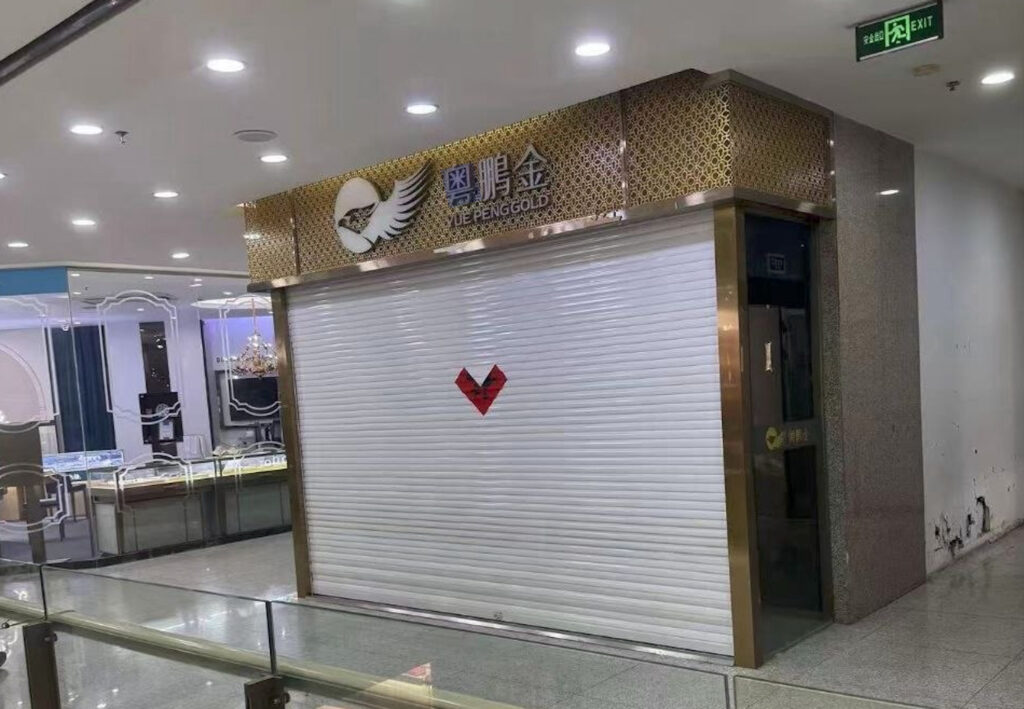
In a shocking turn of events, the gold recovery company “Yuepeng Gold” in Nanjing, Jiangsu, has suddenly closed its doors, leaving its responsible party untraceable. This has prompted approximately 200 merchants who stored their gold with the company to step forward and seek justice, as the total amount involved could reach several hundred million yuan. One merchant expressed his concern that many peers had relied on loans to acquire gold, and now find themselves in significant financial distress.
On November 24, the “Yuepeng Gold Recovery Store,” located in Nanjing’s New Century Plaza, unexpectedly shut down, and the person in charge went missing. Numerous affected merchants flocked to the police station in Wulaocun, Nanjing, to file reports, demanding the return of their stored gold and any related losses.
Affected clients have reported that, in addition to regular gold recovery services, the store also offered a “Gold Interest Accrual” service. This service promised clients who entrusted their physical gold to the store regular interest payments or returns.
In light of the recent wild fluctuations in gold and silver prices, several clients attempted to retrieve their gold, only to discover that the store was empty and abandoned.
A merchant, identified as He Junfeng, who has been in the gold recovery business for four years, shared his experience with the company during an interview. He stated that his transactions with “Yuepeng Gold” had previously proceeded smoothly until this alarming financial crisis emerged unexpectedly.
He recalled that on November 23, a local business person from Nanjing had gone to the company to deliver raw gold materials and settle payments, only to be informed that the company lacked the funds to complete the transactions. When the colleague requested the return of previously stored gold, the company was equally unable to fulfill this request, ultimately leading to police involvement.
In the aftermath, the chat groups of fellow merchants erupted with messages as they collectively pressed for the company to refund their money and return their gold.
He revealed that approximately 200 people had come forward to demand justice, with some individuals having stored as much as 5,000 grams—or 5 kilograms—of gold, and the largest individual amount possibly reaching 12,000 grams, or 12 kilograms.
The participation of merchants in storing large quantities of gold with a single company can be traced back to common industry practices regarding advance payments. He explained that he and other front-line gold recovery merchants typically acquire gold from individual sellers on the street and then entrust the raw gold to larger, more specialized companies for processing. “Since we lack sufficient funds, we send the gold to Yuepeng Gold for safekeeping,” he noted, clarifying that they weren’t selling the gold but merely storing it.
According to their collaborative model, for every set amount of gold deposited, the company would provide about 70% of the funds upfront.
For instance, if a merchant stored gold valued at 1,000 yuan, the company would initially pay out 700 yuan, with the remaining 300 yuan set aside to hedge against potential decreases in gold prices. However, with the continuous decline in gold prices this year, the value of stored gold diminished, leading to significant discrepancies between previously received prepayments and the current worth of the gold. Consequently, the company began requiring merchants to cover the deficit caused by these price fluctuations.
He Junfeng admitted that while he did not directly supplement his payments in cash, he sent gold worth around 120 grams to the company in three separate parcels to try to cover prior financial gaps.
“This year has seen a steady decline in gold prices. As the value of gold fell, we hoped it would rise again, which led us to hold onto our gold, but each drop resulted in further losses,” he lamented.
He illustrated how gold recovery merchants typically use capital to acquire gold from individual sellers before seeking downstream channels for sale or storage. When gold prices fall consistently, their cash flow and inventory valuations can suffer dire consequences.
For example, if he spent 10 million yuan acquiring gold, it might only be worth 9 million yuan at the time of sale.
The pressure from falling gold prices ultimately impacts the financial records of each merchant.
He disclosed that he currently has about 1,000 grams of gold stored with “Yuepeng Gold,” and based on the company’s potential forced liquidation or current settlement methods, he estimates losses could exceed several hundred thousand yuan.
Initially, he believed that entrusting his gold to a well-established recovery company would be more secure than seeking various downstream trade channels, only to find himself in the predicament of being unable to reclaim either his gold or payments.
The deeper implications of this incident lie in the survival struggles faced by upstream small merchants in the gold recovery supply chain.
He pointed out that these street-level gold recovery merchants, operating on the front lines, have limited capital and often rely on loans and borrowed funds to acquire gold, which then gets handed over to larger downstream recovery companies.
He explained that it is precisely due to the brand recognition, channel access, and capital strength of these large recovery companies that many small merchants are willing to concentrate their gold with them. With these downstream firms suddenly unable to fulfill their obligations, upstream merchants not only lose their gold but also face the continuing burden of bank loans and personal debts.
“Everything is based on loans. Now, we have lost every penny. With the company’s owner gone, where do we turn to retrieve our funds? Many merchants are facing ruin,” he said.
He further noted that the financial involvement in this situation could be as high as several hundred million yuan, affecting hundreds of merchants. However, exact figures concerning the amounts involved and the total number of victims have not yet been officially confirmed.
Adding to the merchants’ grievances is the alarming fact that the company changed its legal representative just days before the crisis erupted.
He revealed that the company altered its legal authority on November 20, and a mere three days later, the failure to fulfill obligations occurred.
“The legal representative was changed on the 20th, and by the 23rd, the crisis surfaced, raising suspicions of premeditation,” he asserted.
Moreover, He reported that merchants have reached out to various departments, including the criminal police team, local police stations, complaint offices, and district governmental agencies to relay their circumstances. Those involved, including relevant personnel, have already been placed under investigation, and merchants have seen the case admission documents, yet uncertainties remain regarding further proceedings and the whereabouts of the funds.
As for whether the company would channel the merchants’ stored gold through the Shanghai Gold Exchange or other avenues, He maintained that merchants have no access to the internal transactions or accounts of the company, leaving them unable to confirm where the gold has ultimately gone.
Beyond the merchants’ misfortunes, industry insiders have offered differing perspectives on “Yuepeng Gold’s” operational methods.
Han Ming, a gold upstream professional from Anhui, shared his views in a recent interview. He expressed concerns that the company’s operating model bears significant risks, particularly due to its sizable advance payment practices coupled with low warehousing costs related to the gold storage business. “Yuepeng Gold has made considerable advance payments while maintaining remarkably low warehousing costs and rarely engages in hedging,” he explained.
In Han’s view, such business practices may attract a substantial customer base. As their store expands and their market visibility grows, more individuals become willing to entrust their gold to the company for management.
However, he cautioned that the apparent expansion of business scale and customer base does not necessarily indicate that the company possesses sufficient financial strength or risk management capabilities. Particularly when a business heavily relies on advance payments without appropriate hedging strategies, any disruptions in cash flow or gold delivery can quickly shift risk back to the customers.
Han also raised concerns about the relationship between the company’s brand and its operational nucleus. He argued that consumer trust is often predicated on store size, brand awareness, and market promotion, yet these factors do not guarantee the company’s financial reliability.
He notably questioned, “With their brand name, how could it possibly not be an entire entity?”
Regarding the situation with “Yuepeng Gold,” Han expressed that he views the crisis as premeditated rather than a sudden operational failure.
He bluntly stated, “This departure has been planned for a long time; it is now complete.”
When asked about the potential for premeditation, Han advanced further: “Their collapse was the goal, rather than a consequence.”
He elaborated that the underlying situation behind such events could be far more complex than the mere shuttering of stores, the absence of the company’s owner, and customers seeking their gold. The real issues may go beyond just business failure and could involve strategically arranged finances and operational activities.
Han added that some clients may perceive their investments as merely lending to the company, yet they may not fully understand where their funds and gold have ultimately ended up. He views the breadth of business activities and the number of people involved as potentially complicating the resolution process.
However, regarding tangible evidence of any behind-the-scenes plans, fund transfers, or other interests, Han refrained from providing independently verifiable information, repeatedly stressing that these matters are not as straightforward as they may appear.
A review of recent media reports in mainland China indicates that “Yuepeng Gold” is not the first gold enterprise to encounter such troubles.
According to reports from the Beijing News on November 6, the Nanjing Zuncai Gold Jewelry Store also faced a similar crisis. Customers reported investing tens of thousands of yuan in custom gold jewelry only to find that the store had disappeared by the agreed-upon pickup date. On November 5, employees from that store indicated that the company’s owner had abruptly declared bankruptcy on the 4th, prior to which there were no evident issues in their operations.
Currently, over 400 individuals have reported suffering financial losses. Additionally, employees themselves faced losses, with some having previously invested in gold or silver bars that they now cannot reclaim.
On September 13, 2025, Shenzhen’s Shuhebei, China’s largest gold jewelry distribution center, was also hit by revelations that a gold materials supplier had vanished, absconding with massive sums of money.
Reports from the Huaxia Times and other outlets indicated that the Shenzhen Yuebiaoxin Precious Metals Co., Ltd. had suddenly ceased operations, leading to store closures and impacting approximately 400 upstream and downstream gold merchants and recoverers nationwide. Furthermore, a gold shop in Xuchang, Henan, lost over 1 kilogram of gold it had entrusted for refining, valued at around 900,000 yuan.
Additionally, larger-scale gold enterprises have revealed financial risks as well. According to reports from First Financial, several investment products related to the gold firm Jinyafu Group experienced widespread defaults in December 2025, with initial estimates of the financial impact reaching around 7 billion to 8 billion yuan. Investigations uncovered that Jinyafu’s Shenzhen headquarters had nearly been emptied, with delayed salary disbursements for employees and issues regarding payments to suppliers.