
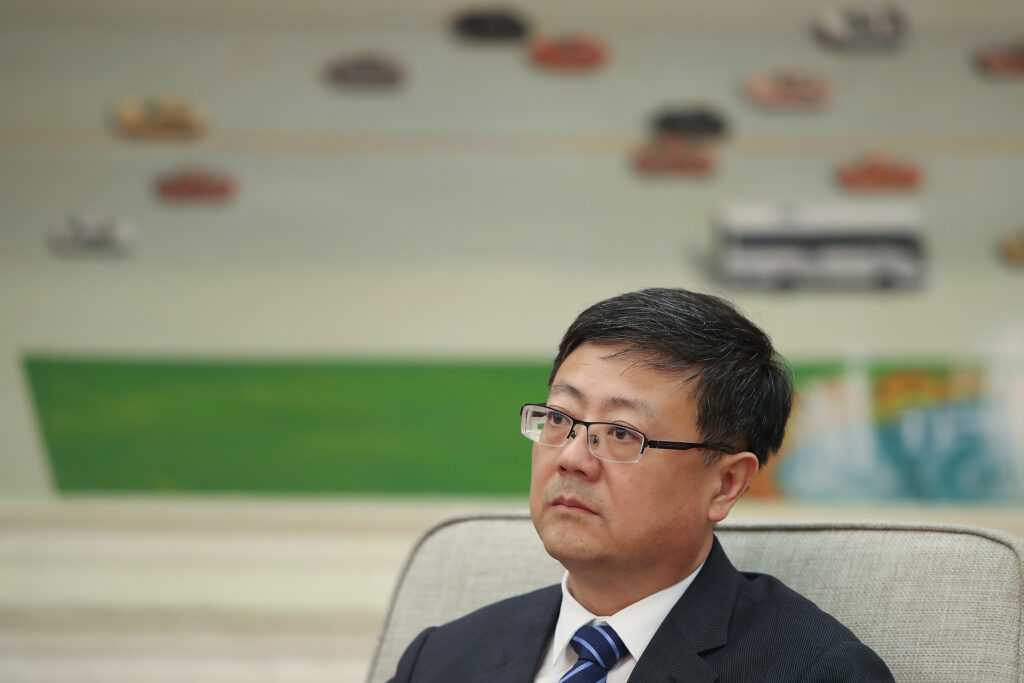
In a startling turn of events, Chen Jining, Shanghai’s party secretary, was unexpectedly removed from his position, sending shockwaves through the halls of power in the Chinese Communist Party (CCP). Speculation and political rumors erupted almost immediately, as the political landscape became rife with uncertainty. However, insights shared with reporters suggest there may be more to this unfolding drama than initially meets the eye.
A source close to the upper echelons of the CCP, using the pseudonym Liang Wenjiang, disclosed that Chen was apprehended by the Central Guard Bureau shortly after attending a meeting of the Political Bureau in Beijing. This operation occurred without the prior knowledge of the Secretary of the Central Commission for Discipline Inspection, Li Xi, indicating a deep level of internal intrigue. The capture was reportedly orchestrated by high-ranking officials Cai Qi and Ding Xuexiang, with the cooperation of Li Qiang. This incident not only encompasses vast investments worth trillions of yuan in Shanghai but is also deeply enmeshed in the fierce power struggles at higher levels of the CCP, particularly ahead of the upcoming 21st Party Congress.
Liang Wenjiang further revealed that when Chen Jining was taken by the Central Guard Bureau, there had yet to be a conclusive decision by the top CCP leaders regarding his future. Following his detention, an emergency meeting of the Standing Committee of the Political Bureau was convened, where a majority supported a decisive course of action against Chen, culminating in an official announcement that evening.
On the night of November 24, at 7:30 PM, the state-run Xinhua News Agency reported that Chen Jining was under investigation for serious violations of discipline and the law, although it did not specify the allegations against him.
Sources suggest that the disclosure was abrupt, contradicting earlier rumors that an investigation had been underway for months. Liang stated that the Central Commission for Discipline Inspection had no prior warning and that Chen was apprehended shortly after the Political Bureau meeting, with information circulating only that very evening.
“It was the Central Guard Bureau that took control of him after the meeting. It wasn’t the Discipline Inspection Commission that apprehended him; it was directly handled by the Central Guard Bureau,” Liang explained.
This incident stands in sharp contrast to previous cases like that of Ma Xingrui and Zhang Youxia, who were reported after leaving their posts. In Chen’s case, he was captured while still serving as the Shanghai Party Secretary, making his situation all the more unprecedented.
Chen Jining’s detainment marks him as the first Shanghai Party Secretary to face investigation while still in office since the fall of Chen Liangyu in 2006.
Later that evening, the Shanghai Municipal Committee held an enlarged meeting to relay the central government’s decision regarding Chen Jining’s investigation, with attendees expressing collective support.
Interestingly, just five days prior, on November 19, Chen Jining was seen conducting inspections at the China Ocean Shipping Group, suggesting no immediate sign of trouble.
Weeks earlier, exclusive reports indicated that on October 29, Chen had been “summoned” by the General Office of the CCP, an event characterized as ominous. Following this, he made a public appearance in Shanghai on October 30.
Liang Wenjiang further suggested that when the Central Guard Bureau controlled Chen on the afternoon of November 24, the senior leadership of the CCP had not finalized their treatment of him nor had they anticipated an announcement that evening.
He asserted that, after Chen was held, Xi Jinping quickly convened a meeting of the Standing Committee of the Political Bureau to deliberate on Chen’s fate. During this session, opinions favoring action against Chen received support from at least four members, allowing Xi to make a decisive move.
“It wasn’t a straightforward process of capturing him and preparing to act against him. The immediate action was taken, and then the Standing Committee was promptly convened, leading to a consensus on how to handle the situation. Otherwise, no one would have expected the outright announcement during such a critical moment,” Liang noted.
He indicated that the impetus behind Chen Jining’s fall stemmed largely from Cai Qi and Ding Xuexiang, with Li Qiang playing a supportive role. Within the Standing Committee, key players such as Li Qiang, Cai Qi, and Ding Xuexiang had participated in the deliberations about Chen, but prior to his arrest, the Central Commission for Discipline Inspection had not been informed.
The allegations against Chen, particularly in relation to interests in Shanghai and dissatisfaction among the party committee members, had already been communicated to Xi Jinping through other channels, bypassing the usual procedures involving the Discipline Inspection Commission.
From the time he was detained at around 2 PM to the official announcement just before 8 PM, approximately five and a half hours elapsed.
Liang pointed out that the manner in which Chen Jining was apprehended reflects a significant shift in how power dynamics are currently operating within the CCP. The direct intervention of the General Office and the Central Guard Bureau in handling a Political Bureau member signals a notable departure from standard protocol, where the Discipline Inspection Commission would normally take the lead.
“Such a critical issue would usually require a convening of the Political Bureau to inform the Discipline Inspection Commission’s Secretary about proceedings, or to arrange for his questioning. By circumventing those protocols, it shows that the General Office was able to maintain control of the situation directly,” Liang contended.
Despite being a member of the Standing Committee and the Secretary of the Discipline Inspection Commission, Li Xi arguably held little decision-making authority in significant CCP cases involving high-ranking officials.
Liang further expressed that power struggles amid significant cases illustrate the current inadequacies of the Discipline Inspection Commission, which had historically maintained a stronger grasp on such matters.
Following CCP disciplinary regulations, investigations concerning potential misconduct are typically managed by the Central Commission for Discipline Inspection, encompassing preliminary verification, case initiation, and announcement processes. However, in the case of Chen Jining, it appears the Discipline Inspection Commission was not the key influencer, raising serious questions about Xi Jinping’s approach to cleaning house within the upper echelons of the party.
This unexpected arrest conveys that Xi’s purges have evolved into a direct and decisive action mode, implementing arrests even among high-ranking officials without prior discussion or protocol, which portrays a dramatic shift in how authority is exercised within the party structure.
The Central Guard Bureau is officially designated as the “General Office of the Central Committee of the Communist Party of China” and is tasked with serving the supreme leader of the CCP, currently Xi Jinping, as well as serving under Cai Qi, who holds both the title of director of the General Office and a prominent advisory position.
Liang has asserted that Chen Jining was initially slated to take a prominent position as the Executive Vice Premier in the next Standing Committee, with Xi having already decided on a lineup of next-generation leaders. However, the power plays orchestrated by Cai Qi and Ding Xuexiang ultimately led to Chen’s sudden downfall.
He indicated that the events leading to Chen’s capture involve more than just power distributions in Shanghai; they are intertwined with broader struggles for positions ahead of the 21st Party Congress.
While outsiders may interpret Chen’s political connections and endorsements as favorable, Liang argues that the reality is more complex. “What the outside world perceives about Chen Jining’s good relations with Cai Qi is inaccurate. Their relationship has been strained. Chen Jining aligns more with Chen Xi, as opposed to being linked with Cai Qi.”
This backdrop of internal rivalry and loyalty, juxtaposed with aspirations for political advancement, has intensified competitive endeavors among senior leaders.
Liang emphasized that Cai Qi’s actions in moving against Chen Jining highlight a temporary gain for his own political standing, but they could lead to significant repercussions for him in the future.
It is noteworthy that, as political factions continue to wage battles against each other prior to the Party Congress, mutual targeting of family members is becoming prevalent, with even the son of Cai Qi becoming part of the spotlight due to allegations.
In summary, Chen Jining’s sudden removal has cast a long shadow over the political plans ahead of the 21st Party Congress, prompting careful scrutiny of potential successors and indicating a grasping of power that may herald further upheaval in the deeply political environment of the CCP. As observers await Xi Jinping’s next moves, the selection of a successor for Chen’s now-vacant position will be pivotal in shaping the future leadership landscape within the party.