
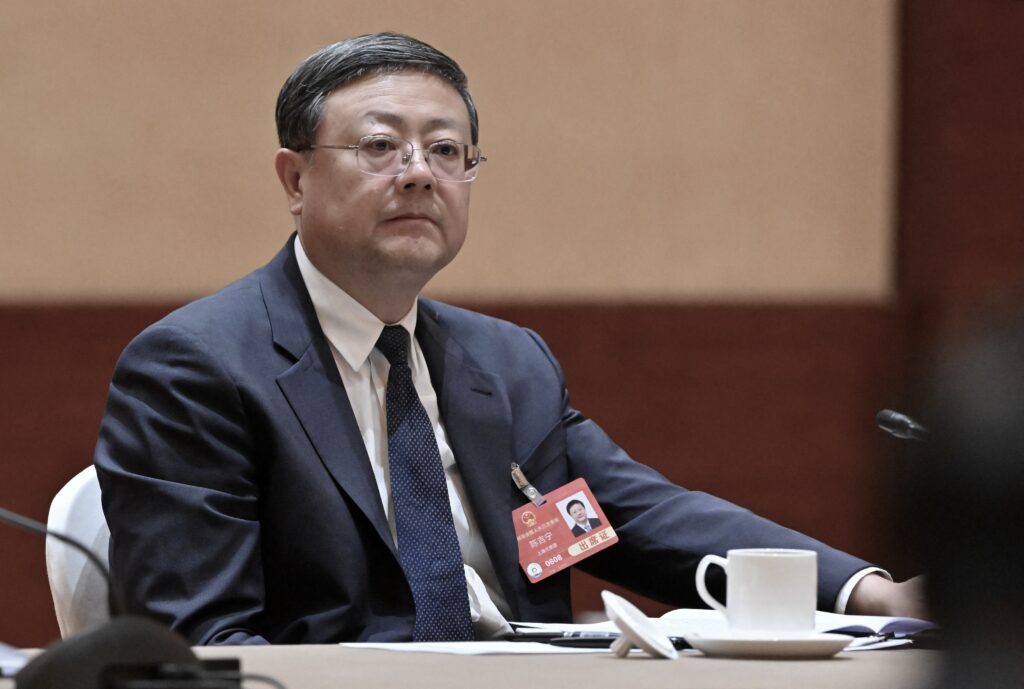
On November 24, a significant announcement from the Chinese Communist Party (CCP) revealed that Chen Jining, the Secretary of the Shanghai Municipal Committee, is under investigation for “serious violations of discipline and law.” This move is widely interpreted as part of a continuing campaign by Party leader Xi Jinping to consolidate power through purges. However, the abrupt fall from grace of Chen Jining has caught the attention of many Chinese specialists, prompting a flurry of analyses and opinions.
Chen Jining was not only a member of the CCP’s Politburo but also seen as a strong contender for entry into the highest echelons of power within the Communist Party. At one time, he was even viewed as a potential successor to Xi Jinping. His sudden removal raises questions about the stability of assumed pathways within the party hierarchy.
Historically, the position of Shanghai Municipal Party Secretary has been considered a stepping stone to the highest leadership in the CCP, but recent developments suggest that this pathway is increasingly unpredictable.
According to reports from Reuters, Wen-Ti Sung, a non-resident fellow at the Atlantic Council’s Global China Hub, highlighted that the Shanghai Secretary role no longer serves as a direct springboard to promotion within the Politburo Standing Committee. Nowadays, political loyalty seems to outweigh traditional career trajectories.
Over the past 40 years, eight Shanghai party secretaries have ascended to the Politburo Standing Committee, including Chen’s predecessor, Li Qiang, who currently serves as the Premier of the State Council and is also a member of the Standing Committee.
The shock surrounding Chen’s downfall is particularly pronounced given that he did not appear to pose any military threat and maintained alignment with Xi’s positions on major symbolic issues, such as ethnic policy. Wen-Ti Sung remarked, “Chen’s purge is surprising because he has not deviated from Xi’s stance on major matters. Yet, he was still targeted without any explanation, which is bound to send shockwaves across the political landscape.”
Neil Thomas, a senior research fellow on Chinese politics at the Asia Society Policy Institute, shared his insights on social media platform X, stating, “This serves as a reminder that even many CCP officials are largely unaware of what is happening at the upper echelons of Chinese politics.”
Thomas further commented, “Chen Jining clearly did not possess the understanding of the CCP’s inner workings that he believed he had.”
He elaborated that the investigation into Chen represents a recent step in Xi Jinping’s “self-revolution” movement, a term used within the CCP to describe stringent disciplinary measures.
During the recent Fifth Plenary Session of the CCP, it was announced that 33 members of the Central Committee were expelled from the Party—marking the largest purging effort in a single session since the reforms initiated in 1978.
Looking ahead, the 21st Party Congress is anticipated to take place in the second half of 2027. As Neil Thomas pointed out, there may be additional purges before this important event, as Xi seeks to promote a new generation of officials who demonstrate unwavering loyalty to his leadership.
Steve Tsang, the director of the China Institute at SOAS University of London, remarked to the Australian Broadcasting Corporation (ABC) that the current wave of purges sends a clear message to CCP officials: to remain fearful and obedient. “The reality is that almost anyone at this level could be brought down due to issues of corruption,” he said. “But this is not merely about corruption; it often revolves around who has caught Xi’s attention and who might be perceived as having said or done something that made Xi uncomfortable.”
Tsang explained that Xi’s “anti-corruption campaign” is essentially a renaming of internal party consolidation efforts. While the specific reasons behind Chen Jining’s troubles remain vague, Tsang is not surprised that someone of his rank became a target.
According to the Associated Press, Joseph Torigian, a professor at American University with expertise in Chinese and Russian politics as well as internal power struggles in authoritarian regimes, commented that the recent purges among Politburo members reflect the fluid nature of CCP politics. Even officials with attributes that Xi values are not immune to the risk of dismissal.
He stated, “On paper and in terms of qualifications, they seem like people Xi would appreciate, but once they fall out of favor, we quickly generate various hypotheses to explain why Xi might want to eliminate them.”
Akio Yabuki, Executive Director of a think tank focused on Indo-Pacific strategies, noted that Chen Jining, once perceived as a close associate of Xi and a discreet technocrat, facing investigation demonstrates the intensifying intra-party competition ahead of the 21st Party Congress. He emphasized the importance of Shanghai as a crucial stepping stone for local leaders to enter the central government. The focus moving forward is whether the investigation will be limited to Chen or expand to implicate other officials within his administration.
Yabuki also speculated that another potential reason for Chen’s purge is his decade-long residence in the UK, which made him one of the higher-ranking officials more familiar with Western values and languages, able to communicate fluently in English with foreign leaders—a significant concern for Xi.
In Yabuki’s analysis, there is a noticeable trend of Xi promoting a more inward-looking approach for China, seeking to distance the country from the West. In this context, any senior official perceived to have close ties with Western nations might raise suspicions and come under scrutiny.