
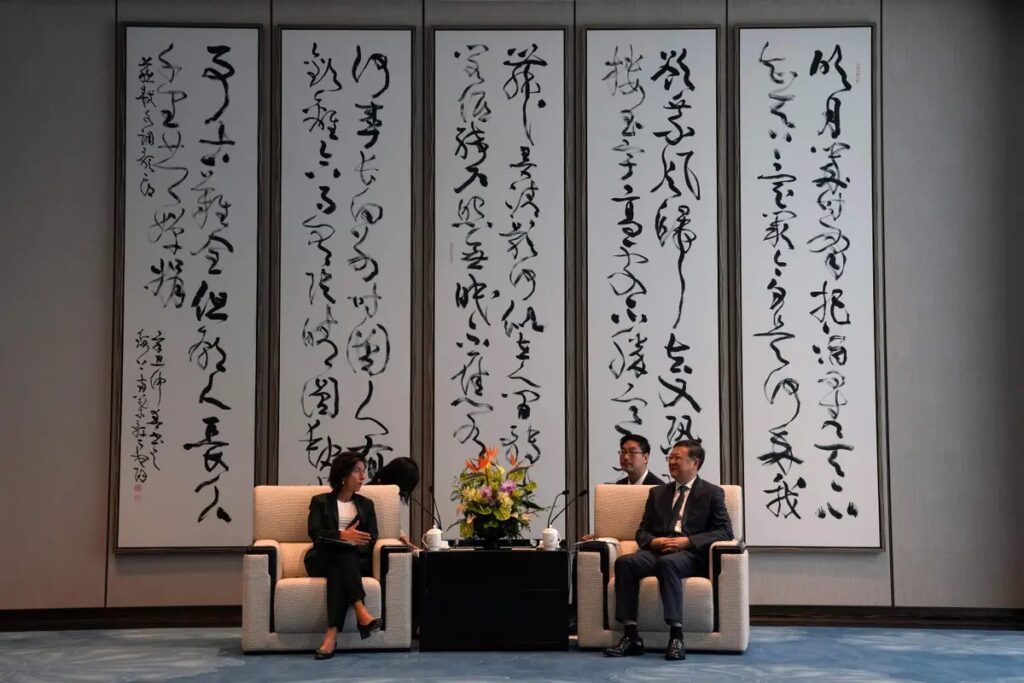
Bloomberg reports describe Chen Jining, a former official with a cautious and low-key demeanor, as someone who seldom mentioned his overseas experiences, particularly after his tenure as the Shanghai Party Secretary. An insider revealed to Bloomberg that Chen is aware of the distrust the top leaders of the Chinese Communist Party (CCP) have towards his foreign background.
On the evening of November 24, within a WeChat group consisting of hundreds of finance and business professionals, a user commented that the reasons behind Chen Jining’s dismissal were “obvious,” but stated that they could not discuss the specific details publicly. Several groups discussing his fate were shut down or voluntarily disbanded out of fear, and some personal accounts were silenced.
Earlier that day, the CCP suddenly announced Chen Jining’s downfall, a piece of news that sent shockwaves through foreign businesses and the financial community.
Among foreign business circles, Chen Jining was seen as an official who frequently interacted with foreign executives. His removal came as a surprise, with little warning compared to the dismissal of other Politburo members like He Weidong and Zhang Youxia, who had already dropped out of public view months before their investigations were announced. In fact, Chen’s last public appearance occurred just a few days prior to the announcement.
George Chen, a partner at Asia Group, stated in a report that many were caught off guard by Chen’s ouster, expressing that “everyone was shocked; no one expected such an event.”
Chen Jining, an environmental expert with a PhD in Environmental Systems Analysis from Imperial College London, had studied in the UK in the 1990s and was among the highest-ranking officials with overseas degrees.
Just ten months ago, he visited an industrial park that incubates AI startups in Shanghai. This was a notable contrast to many native CCP officials, as an insider from the industrial park disclosed that Chen encouraged corporate executives to openly discuss the difficulties they faced in China during his inspection.
When the CCP suddenly announced Chen Jining’s dismissal, the same source reacted with disbelief, stating, “I could hardly believe it.”
Former colleagues of Chen revealed that he rarely spoke of his overseas experiences, particularly following his role as Shanghai Secretary, and he was aware of the lack of trust the top leaders had in his foreign exposure.
The motivations behind the CCP’s investigation into Chen Jining remain unclear. Neil Thomas, a senior geoeconomic analyst at Eurasia Group, suggested that some foreign politicians and business leaders viewed Chen as a potential successor to Xi Jinping, which could have heightened the risks surrounding his downfall. Chen is six years away from the CCP’s unofficial retirement age and is more than a decade younger than Xi.
There are also speculations that Chen Jining may have been purged due to his personal ambitions. A Bloomberg Economics report cited sources saying that Chen mentioned to visitors that he aspired to join the national leadership of the CCP, likely indicating a desire to become a member of the Politburo Standing Committee.
Neil Thomas remarked, “Such self-promotional statements could deepen Xi’s suspicions about Chen’s ambitions, especially if Xi interprets Chen’s business relationships and rising popularity as signs of a burgeoning independent power base.”
The removal of Chen Jining also signifies a severance of Shanghai’s position as a stepping stone to Zhongnanhai, the central seat of power in China.
Eurasia Group previously stated that the appointment of Chen Jining’s successor as Shanghai Party Secretary will serve as a clear signal regarding the types of officials likely to be promoted next year.
Moreover, Chen represented a cadre of technocrats—engineers, scientists, and economists—who have now witnessed a significant decline in their standing.
A foreign investment banker based in Shanghai noted that the rise of technocrats within the CCP was seen as a marker of increasing professionalism in China’s economic governance. The anonymous source added that Chen Jining’s ousting dealt a significant blow to this perspective.
Following the earlier removal of aerospace expert Ma Xingrui, two of the eight technocrats appointed by Xi in 2022 have now been dismissed.
“This is yet another earthquake in the landscape of Chinese politics,” commented Jonathan Czin, a former CIA analyst on China. He noted that this incident raises concerns about the talent pool available to Xi as he approaches a potential fourth term.
Currently a researcher at the Brookings Institution, Jonathan Czin mentioned that if the current age rules do not change, Chen Jining would have qualified for a promotion to the Politburo Standing Committee next year.
“There are very few officials with the experience and qualifications necessary to ascend to the highest party positions, including the potential to succeed Xi Jinping,” he added.
Wendy S. Song, a non-resident fellow at the Atlantic Council’s Global China Center, told Reuters that Chen Jining’s purge was particularly shocking, as he did not pose a military threat and had aligned with Xi on several significant and controversial symbolic issues.
“Yet, he was still purged without any explanation given,” Song stated, adding, “The impact of this incident will undoubtedly continue.”