
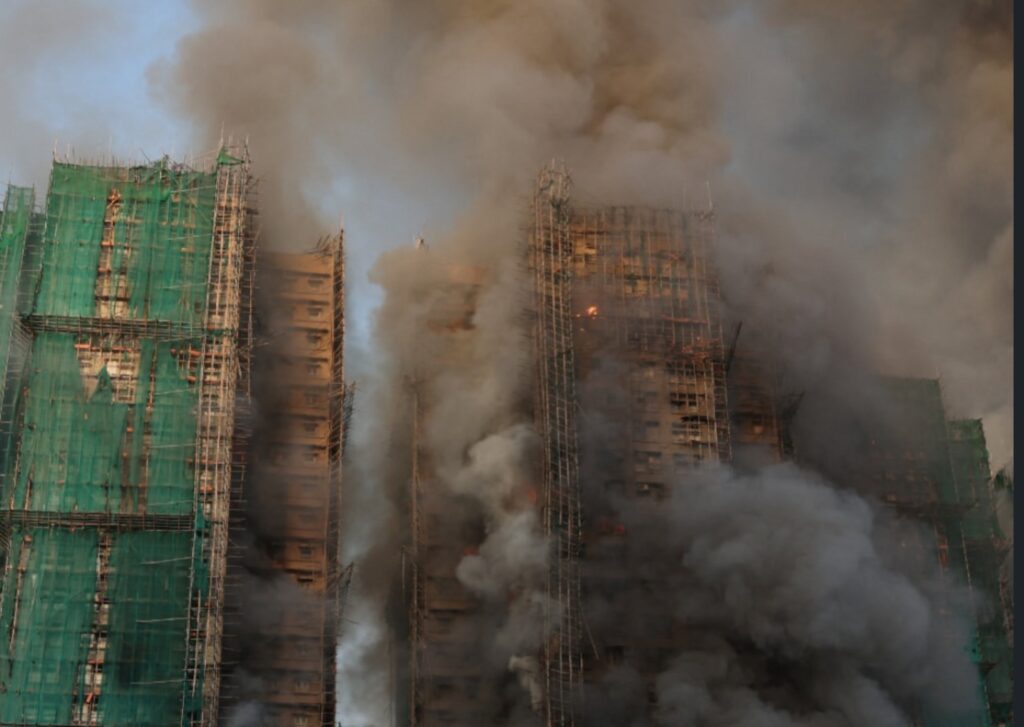
On November 26, the devastating fire that struck Hong Fu Court in Tai Po, Hong Kong, will mark its first anniversary. This tragic event not only claimed the lives of several residents but also left thousands homeless. A year has passed, and while some residents have accepted the government’s buyout offers, chosen new residences, and begun to rebuild their lives, many affected families feel that the matter of relocation does not signify the end of their ordeal.
Among those most affected is Ye Jiaqiu, who lost his wife, Bai Ruilian, in the inferno. The couple had moved into Flat 1701 of Hong Tai Pavilion in 2003. On the day of the fire, Ye’s wife bravely ran through the corridors, knocking on doors to alert neighbors and guide them to safety, saving at least four individuals and a dog in the process. Tragically, she missed her chance to escape and ultimately perished in the bathroom of their unit.
In an exclusive interview, Ye recounted the pain and anguish he has faced since losing his spouse. Following her death, he temporarily relocated to his elder son’s home, but he often finds himself alone during the day when his son is at work and his grandson is at school. This stark contrast to his previous life with his wife weighs heavily on him. He reminisced about how there was always someone to share stories and laughter with when he returned home; now, a profound silence fills the space, further amplifying his feelings of loneliness and grief.
Reflecting on that fateful day, Ye experiences a haunting sense of guilt. He wonders if they might have escaped together had he not gone downstairs first. He also emphasized that Bai’s intentions in alerting their neighbors were not sacrificial. Instead, she was motivated by the spirit of mutual assistance, fully believing she would manage to escape safely.
The incongruity of his wife being just two or three minutes away from safety, while a different fate awaited her, is particularly difficult for Ye to bear. He firmly believes that had there been proper fire safety measures and oversight in place in the building, residents would have had more time to evacuate. Unfortunately, thick smoke filled the corridors prematurely, nearly leaving them with no escape time. He thus sees inadequate governance and failures across multiple levels as significant contributors to this tragedy.
Beyond the sorrow of his personal loss, Ye has expressed dissatisfaction with the government’s post-incident plans and accountability measures over the past year. He feels that the government has simplified the complex issue of long-term housing into mere property transactions. Under circumstances of limited information and choices, residents felt compelled to sell their properties without truly wishing to, yearning instead to return to their original homes.
Ye has criticized the use of over 90% owner agreement on the buyout as a policy justification. He asserts that many residents had no viable alternatives and were forced into acceptance, and therefore, the signing ratios do not depict full satisfaction with the arrangements made. Moreover, he lamented the government’s failure to publicly release the post-incident building inspection report, which would help residents understand whether their homes could indeed be repaired, insisting that more comprehensive information is needed.
Regarding residential management reforms, Ye pointed out the disproportionate power held by a few individuals in owner meetings, which undermines the voting rights and influence of other owners. He expressed disappointment that the government did not set a limit on authorized votes during its revision of the Building Management Ordinance. He noted that similar concerns about building management had been raised in a report back in 2001, yet after 25 years, no substantial changes have been made.
Ye believes that the four government departments identified in the independent committee’s report should bear political responsibility. The publication of that report is just the beginning of accountability, not the end. Currently, he is consulting with a lawyer, exploring legal or other means to seek justice for his late wife and emphasizing that he will not easily surrender in his fight for accountability. He hopes the government will also organize official annual commemorative events to ensure that the society does not forget the lessons learned from this disaster.
As part of a “special sales program” introduced by the government for the residents of Hong Fu Court, some individuals have chosen new homes, but many still harbor reservations regarding the relocation arrangements.
Miss Hu, a resident of Hong Yan Pavilion, completed her selection process for a new unit on the last day of the special sales program, November 17. After discussing with her parents, she ultimately decided to return to Tai Po, desiring to keep close ties with familiar neighbors. Having lived in Tai Po for over 40 years, she had contemplated moving to places like Tung Chung, Tin Shui Wai, and Tsing Yi, but felt those options would distance her from those she knew well.
Upon finalizing her new house selection, when staff members congratulated her, she conveyed that the sense of joy was overshadowed by a feeling of melancholy, describing the selection as merely resolving one issue amid her misfortune. She firmly believes that the incident is not yet truly over; finding a new home is merely a temporary solution and does not equate to receiving just reparation for the tragedy.
Miss Hu pointed out that residents of Hong Fu Court did not voluntarily sell their original properties to later purchase new ones, yet they still had to pay stamp duty based on the price of their new units. Many neighbors lost their jobs following the fire and have had to dip into their savings to cover related costs. She hopes the government will consider waiving or reducing the stamp duty to alleviate the financial burden placed on the residents.
Additionally, she expressed a desire to return to her old home a third time to retrieve belongings. However, despite multiple applications through the “one household, one social worker” program, she has only received responses indicating that no upper-level directives have been issued. With the limited number of residents allowed to retrieve belongings each day and the slow progress, alongside concerns about deteriorating conditions in the old residences due to humidity, residents are eager for the government to expedite arrangements for them to return and gather cherished items.
She also raised issues regarding the quality of newly built homes, citing recent instances of exterior walls peeling and leaking in new developments. She urged the government to enhance oversight of residences under the special sales program to ensure residents can live comfortably once they move in.
As the anniversary of the fire approaches, Miss Hu mentioned her intention to return to Hong Fu Court for remembrance, believing that the 169 lives lost—168 residents and one firefighter—deserve the community’s proper mourning.
Another resident of Hong Yan Pavilion, Mrs. Chan, concluded the sales process with her stroke-victimized husband and daughter only at the last stage. She revealed that she deliberately delayed signing the sale intent until August 31 in hopes of making the government aware of their dissatisfaction, aiming to prompt a more reasonable explanation from authorities for the disaster victim’s plight.
The family ultimately selected a unit on the 21st floor of “Hao Yan,” a government housing project on Anderson Road in Kwun Tong. Chan expressed her initial concern over the use of “modular construction” techniques in many new buildings, but community support helped them find a unit not part of the affected modular structures. She appreciates that the new residence requires no renovation and relieves some financial pressure, but she lamented that the listed area of over 400 square feet refers to gross area, not usable space, wishing for larger and more conveniently located options from the government.
During the formal signing of the sale document, Chan’s husband was overcome with emotion, shedding tears over leaving their former home. Their daughter, Miss Chan, recounted how the fire destroyed childhood photos and stuffed animals that had accompanied her growing up, leading to her initial despair, but fortunately, she later was able to find a similar toy in the second-hand market. She reflected that while homes can be rebuilt, human relationships and emotional connections are the most precious.
The Chan family often accompanies their wheelchair-bound father on a charity-donated wheelchair taxi past the abandoned site of Hong Fu Court. Initially, each visit made them shed tears, but now they strive to say goodbye to their old home and begin anew. However, with the first anniversary approaching, seeing media reports and hearing from neighbors still stirs up suppressed emotions.
Mrs. Chan expressed admiration for residents seeking justice through legal channels against the government and relevant departments, noting that they endure immense psychological stress after losing their homes. She hopes that, alongside providing relocation plans, the government will also offer fair and reasonable compensation in terms of emotional and monetary reparations.
For some residents, the challenge lies not just in finding new housing but also in retrieving belongings and mementos from their old homes.
Originally residing in Hong Zhi Pavilion, Mr. Fung chose a unit in Yang Ya Court in Tai Po through the government’s special sales program. However, the new home is smaller than his previous unit, and he anticipates that it will be over three years before he can move in. He has worries about his ranking in the selection process due to submitting his application later, fearing that his chosen unit might be taken by someone else.
Regarding the government’s arrangements, Fung feels that acceptance is the only option at this point. Nevertheless, he hopes the government will allow residents to return to their former homes to retrieve personal items and family heirlooms. He indicated that despite selling the property, he still desires to reclaim personal belongings. Currently living in transitional housing, he described the conditions as reasonably satisfactory but lacking the essence of a true home, especially with the anniversary approaching and realizing that residents might not have the freedom to mourn as they wish plays heavily on his heart.
Mrs. Lee, another resident of Hong Chang Pavilion, also chose to remain in Tai Po, hoping to continue living in a familiar community. She shared that her husband once expressed a wish for her and their children to live well, which motivates her to keep moving forward. However, she yearns for the government to permit residents to return to their former homes for a final farewell despite the buildings being destroyed as they hold significant connections to her past life.
Lee openly admits to shedding tears whenever she passes Hong Fu Court, indicating that she hasn’t fully healed yet. However, she reminds herself that she must coexist with this experience while gradually working to resume a normal life.
In contrast, Ms. Wong, who selected a unit in Symphony Park in Kowloon Bay, expressed dissatisfaction with her new housing arrangement. She believes the new unit is smaller than her previous home, and the view has shifted from the sea to that of buildings, comparing the government’s options to providing public housing as if it were subsidized housing. Wong admitted that she never intended to sell her share in Hong Fu Court, but renting elsewhere with the current relocation funds would not suffice to cover long-term expenses, especially when considering her children’s housing needs, leading her to accept the arrangement ultimately.
Dorz, a resident of Hong Hong Pavilion, has lived with his elderly grandmother, who is over eighty, and after the fire, they stayed in transitional housing in Kai Tak. He later chose to sell his property and purchased one in Kai Cheung Court through the special sales program, hoping to arrange a long-term residence for his grandmother as soon as possible.
However, the unit in Kai Cheung Court is expected to be ready for occupancy only in two years, forcing him and his grandmother to live apart in two transitional units. Dorz expressed that he has felt homeless in nearly a year, describing their current living situation as akin to dormitory living, emphasizing that a true home signifies stability and roots.
He also stated that while his grandmother is gradually learning to let go of the past and view the fire as a test from fate, he struggles to do the same since he feels the involved parties have yet to accept accountability, hindering his ability to move forward.
Dorz openly criticized the government for its accountability measures, asserting that the heads of the four referenced departments in the independent report should resign. He condemned the government’s apology coming almost a year later and questioned why relevant officials had not taken responsibility.
He emphasized that prior to the fire, residents had repeatedly complained to the Home Affairs Department regarding issues such as collusion, authorization problems, and suspected organized crime activity that hindered owner meetings. Dorz recounted how neighbors had made hundreds of phone calls and sent numerous emails without receiving proper responses. He believes that had the relevant departments acted diligently, the expensive repairs and subsequent tragedy could have potentially been avoided.
Commenting on the government’s lottery system for purchasing public housing, Dorz likened it to a “blind box,” arguing that it is unfair for disaster victims to compete with ordinary applicants for housing units. He continues to hope that the government will consider rebuilding on the original site or offer the residents a one-for-one replacement housing plan akin to their former properties.
Miss K, a resident of Hong Chang Pavilion who lost both parents in the fire, shared that as the anniversary approaches, she and her siblings wish to return to the charred remains of their unit for a memorial service for their parents.
She noted that since the government allowed families to visit the site for the first time in May, it has been over 170 days without a response to her inquiries about when they can return.
K confirmed that her family has been seeing a psychologist since the ordeal yet still struggles to cope with grief. Late at night or after school, emotions of longing and pain resurface, often disrupting sleep. She expressed frustration that authorities have yet to provide clarity on how her parents lost their lives in the fire.
Regarding the government officials’ delayed public apology nearly a year post-disaster, K firmly rejected it, emphasizing that not a single official has reached out directly to the bereaved families, instead focusing heavily on property acquisitions and relocation efforts. She underscored her desire to return to her original home to pay respects to her parents, adamantly resisting any alternative that involves designated memorial spaces on the grass or other areas within the estate, as nothing could replace the significance of saying goodbye in her parents’ dwelling.
Towards the end of the selection process for government buyouts, some residents remain steadfastly unwilling to sell their properties. Miss Ho from Hong Sheng Pavilion stands out as one of the 13 homeowners who have thus far declined the government buyout offer.
Miss Ho described the past year as challenging, feeling as though time has not moved on since the fire, describing her days as merely “enduring.” She firmly believes that having worked hard since her early twenties to pay for her home, her rights should not be taken away without sufficient explanation.
She expressed dissatisfaction over the government’s failure to publish an inspection report regarding the building’s condition after the incident. Instead, they have diverted charitable funds toward property buyouts while setting a deadline for residents to sell, forcing them into significant decisions amid a lack of information. Ho contended that not all buildings in the estate were severely damaged, as only two suffered significant destruction, advocating that the government should explore other options like demolition and reconstruction rather than defaulting to property acquisition as the primary solution.
Currently residing in transitional housing at Chak Sing House in Tai Po, she described her living quarters as merely a place to sleep, devoid of any true sense of home. Despite feeling pressure, she expresses a strong determination to retain her property rights, not for increased compensation but rather to seek justice and a reasonable explanation from the authorities.
Ho criticized the government’s arrangements for rental subsidies and charitable funds, deeming them unjust. While the rental assistance lasts only one more year and authorities claim to hold certain funds for delayed occupancy residents’ rent in the coming years, they have not provided comparable rental protections for those who declined to sell their properties. She believes that funds should be fairly allocated to all impacted residents, allowing them to manage their rental situations independently.
She also emphasized that prior to the fire, residents frequently raised concerns about building maintenance and management issues, yet the government did not adequately address these complaints. Following the fire, their failure to listen to residents’ voices has led her to assign a “negative score” to the overall relief and housing arrangements.
Ho indicated that she may not continue living in Hong Kong in the future and has little interest in further investments in the city. Experiencing this incident has deeply shaken her confidence in the protection of private property rights and the quality of government-built housing in Hong Kong. Should she find that any compensation is insufficient for a future purchase, relocating abroad may be a more sensible choice.
On the anniversary, she plans to lay flowers at the site near Hong Fu Court to honor the deceased neighbors but feels a lack of understanding that terms like “Hong Fu Court” and “Rebuilding Hong Fu Court” have become sensitive phrases, leaving her in a state of helplessness.
As the first anniversary of the Hong Fu Court fire approaches, several memorial events have recently been canceled. The Chi Shan Temple in Tai Po had initially scheduled a memorial service for the victims of Hong Fu Court on November 26, but the temple later announced its cancellation, along with a lunchtime incense offering ceremony planned for the same day. This move prompted concern among the congregation, leading many to wonder if the temple faced outside pressure.
Additionally, an event organized in collaboration with Polytechnic University scholars and welfare groups, including a book launch, poetry readings, a play, and prayer sessions documenting the experiences of surviving domestic workers, was slated for November 22. Yet, the organizers canceled it less than 24 hours before the event, citing “unforeseen circumstances” while expressing hope to find an alternative venue for a future date.
Meanwhile, the Catholic Church of Our Lady of the Immaculate Heart in Tai Po intended to hold a memorial mass on November 15 for those who lost their lives in the fire, but following police inquiries after the announcement, the parish briefly deleted promotional posts and altered the theme to “Prayers for the deceased brothers and sisters of the entire year.” Eventually, the parish reinstated references to Hong Fu Court, and the mass proceeded as planned under the service of Auxiliary Bishop Joseph Ha Chi-shing of the Hong Kong Diocese.
After the mass, Bishop Ha explained to churchgoers that the staff initially struggled with the volume of inquiries, resulting in the removal of the promotional material and content adjustment, reaffirming that the mass was never canceled. He revealed that the police had questioned them about attendance numbers, guest lists, outdoor arrangements, and crowd control plans, to which the parish had responded.
Regarding the anniversary memorial activities, Secretary for Home Affairs Chris Tan stated on November 20 that the government would not impede any lawful remembrance activities and would offer assistance where needed. However, he cautioned the public to be aware of potential misuse of memorial events for illegal activities, assuring that police would monitor these events closely and act according to the law. Police Commissioner Raymond Siu previously mentioned that it is essential for officers to gather information regarding public activities from organizers, merely stating that “the overarching principle is legality and compliance with the law,” with responses tailored to actual circumstances as they arise.