
After the Chinese military suspended Baima Tea Co.’s eligibility for procurement, attention has turned to Wu Xiaoning, the wife of chairman Wang Wenli, and her past business dealings with the company.
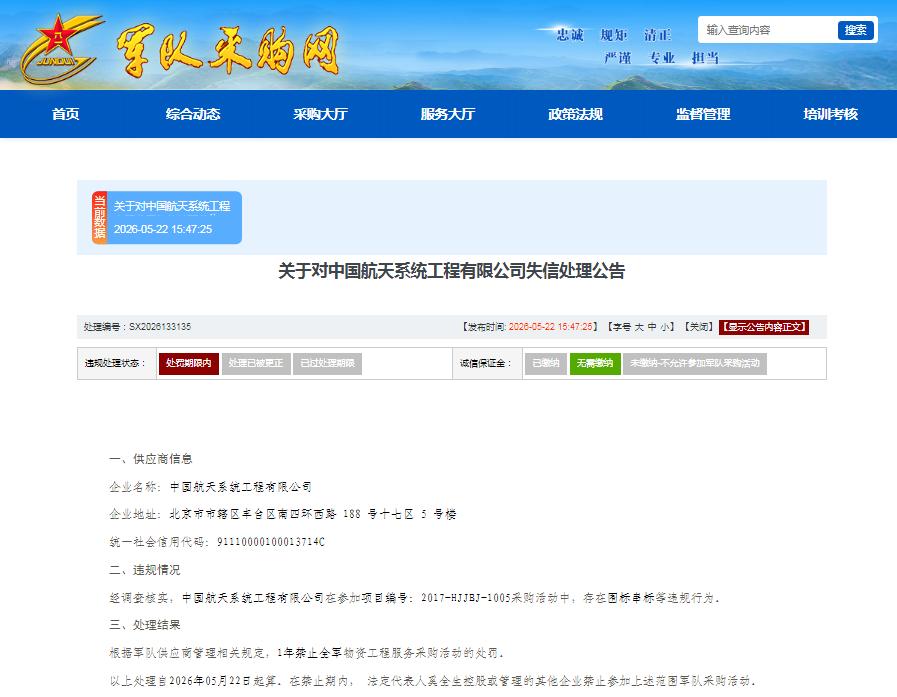
On November 19, the military procurement website issued a notice stating that Baima Tea had been suspended from participating in procurement activities related to military supplies due to “allegations of regulatory violations.” Wu Xiaoning was also named as a relevant personnel involved in this matter.
The military announcement did not specify the exact nature of the alleged violations or the duration of the suspension from procurement activities.
In a response issued by Baima Tea on November 22, the company did not provide further details, merely stating that it had never engaged in military-related bidding activities. The company characterized the suspension as a specific regulatory measure rather than a reflection on product quality, food safety, or everyday business operations, asserting that it had no impact on public sales, operations, or core business activities.
Beyond the procurement issues, there is mounting interest in the operational status of Baima Tea since it went public. Who exactly is Wu Xiaoning? What role does she play in the business framework of Baima Tea?
As a bearer of the national intangible cultural heritage of Tie Guanyin tea-making, Wang Wenli often appears at brand launches, industry forums, and interviews. Yet, within the family-controlled structure of Baima Tea, Wu Xiaoning remains a vital yet behind-the-scenes figure.
The prospectus from Baima Tea’s initial public offering in 2023 reveals that at that time, Wu Xiaoning held 3.982 million shares, accounting for 5.24% of the company’s total equity, making her the fourth-largest individual shareholder. She has also signed an agreement with Wang Wenli to act in concert with him regarding company matters.
From July 2011 to December 2014, Wu Xiaoning served as the head of the engineering department at Xiamen Xin Baima Tea Co., Ltd., before ascending to the position of engineering department director until June 2021. During her tenure, she also controlled several related companies, including Shouxian (Xiamen) Design and Decoration Engineering Co., Ltd., and Fujian Shouxian Furniture Co., Ltd. Through Shouxian, she held a 40% stake in Shenzhen Dajing Decoration Design Engineering Co., Ltd.
Between 2018 and 2020, Baima Tea procured services such as renovation and furniture from these companies. The procurement amount from Fujian Shouxian Furniture Co., Ltd. rose from 5.6753 million yuan in 2018 to 9.9449 million yuan in 2020. Over three years, the total procurement for store renovations and design services from Shouxian Decoration and Shenzhen Dajing amounted to approximately 37.54 million yuan.
The procurement transactions came with contractual constraints. According to the Commercial Franchise Contract, franchisees were required to use a unified store decoration design scheme from the company, and renovations had to be approved by headquarters. During this time, Shouxian Design publicly identified itself as the designated service provider for Baima Tea’s special venues and exclusive stores.
In November 2020, as Baima Tea was preparing for its IPO, Wu Xiaoning transferred shares in the aforementioned three companies to her cousin’s husband, Zhuang Yuehui. Subsequently, Shouxian Decoration continued to publicly advertise itself as Baima Tea’s designated service provider, claiming it designs over 500 stores annually and has served more than 3,000 stores in total.
By the end of 2025, Baima Tea operated 3,773 offline stores, netting an increase of 269 stores throughout the year. Of these, 3,538 were franchise stores, comprising 93.8%, while the number of directly operated stores totaled 235, a decrease of 14.
As of June 30, 2026, the company had expanded its store count to 3,845, with franchise stores reaching 3,619, marking a net increase of 81 in the first half of the year. Conversely, directly operated stores shrank to 226, a drop of 9. The company boasts a total of 1,213 franchisees, with only three of them managing over 100 stores each.
In terms of online sales, Baima Tea recorded a total gross merchandise volume (GMV) of 876 million yuan in 2025, reflecting an annual growth of 4.4%. For the first half of 2026, online revenues reached 512 million yuan, a significant growth of 36.1%.
In 2025, Baima Tea’s sales and marketing expenses reached 700 million yuan, including an advertisement expenditure of 303 million yuan, which represents a year-on-year increase of 9.8%. During the same period, research and development costs totaled around 14.019 million yuan, reflecting a decline of 15.06%. Marketing expenditures were approximately 50 times the amount spent on R&D.
In the first half of 2026, the company allocated 397.4 million yuan to sales and marketing, of which advertisement spending was 193 million yuan, up by 39.5% year-on-year. Research and development costs dropped to 5.88 million yuan, a decrease of 8.96%. During this time, sales and marketing costs were about 68 times greater than those committed to R&D.
Baima Tea officially debuted on the Hong Kong Stock Exchange on October 28, 2025, with an initial issue price of 50 Hong Kong dollars. The stock surged to a peak of 113.6 Hong Kong dollars the following day, leading to it being dubbed “the first high-end Chinese tea stock.”
Wu Xiaoning has remained out of the public eye, an archetypical ‘hidden’ family stakeholder, and did not attend the ringing ceremony for the company’s IPO.
As news of the Chinese military’s suspension of Baima Tea’s procurement eligibility emerged, the stock price closed at 21.4 Hong Kong dollars on November 20, marking a decline of over 80% from its peak, with a market valuation of approximately 1.77 billion Hong Kong dollars.