
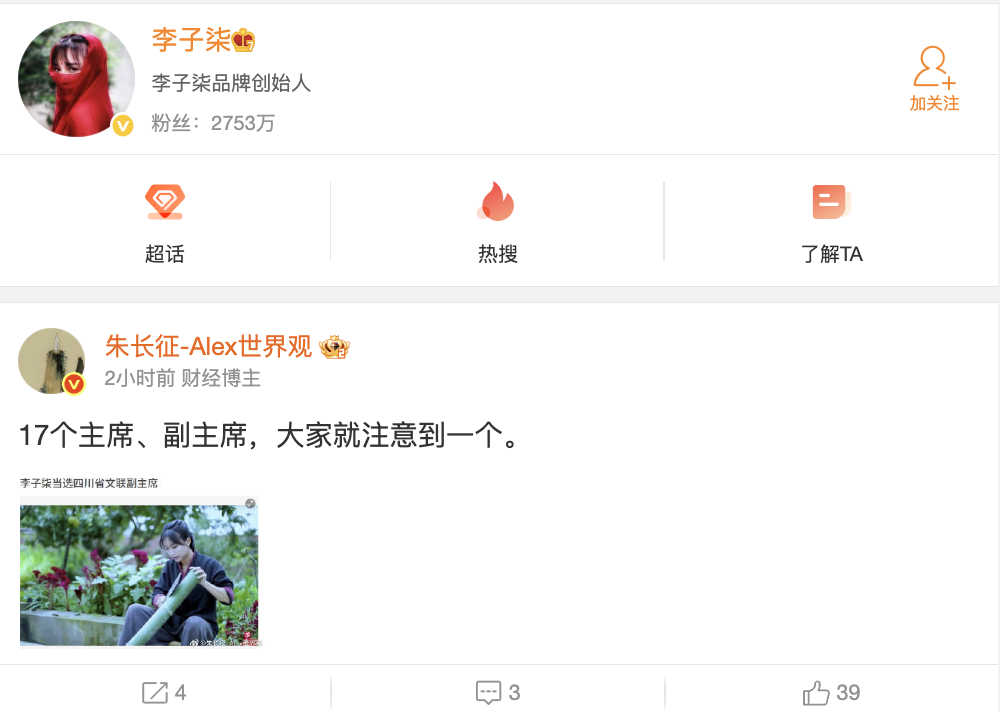
In a recent announcement by the Chinese Communist Party, popular internet influencer Li Ziqi has been appointed as the vice chair of the Sichuan Provincial Federation of Literature and Art. Li Ziqi, known for her rural lifestyle videos on platforms like YouTube, achieved international fame; however, many critics view her as part of China’s broader propaganda efforts.
According to sources from Sichuan’s literary and artistic community, the Ninth Representative Assembly of the Sichuan Federation of Literature and Art took place in Chengdu on November 19-20. This event resulted in the formation of a new leadership group, with Chen Zhiling serving as the president. Other newly appointed vice chairs include Wang Chuan, Wang Fei, Wang Xun, Wang Daoyi, Tian Jieyan, Bai Hao, Li Shu, Li Peng, Li Ziqi, Li Yanhao, Zhang Rong, Zhang Xudong, Luo Weizhang, Han Mei, Tong Ronghua, and Han Lu. Additionally, Zhong Xiaoling has been named the secretary-general of the presidium.
Li Ziqi’s rise to prominence has sparked considerable interest. Public records indicate that her real name is Li Jiajia. Born in 1990 in Mianyang, Sichuan Province, she is a creator of short videos centered around culinary themes. She began producing videos in 2015 and transitioned to Weibo in early 2016, later establishing herself on the international video-sharing platform, YouTube, where she gained substantial recognition.
In 2017, she co-founded a company named Ziqi Culture alongside Weinian. However, by 2021, Li Ziqi encountered disputes over profits with Weinian, which led to a halt in her activities. It wasn’t until late 2022 that both parties reached a reconciliation, allowing her to return to content creation in November 2024.
Li Ziqi holds various official titles, including “Ambassador for the Promotion of Intangible Cultural Heritage,” “Ambassador for the Shanghai World Skills Competition,” and “Promoter of China’s Rural Youth Wealth Creation.” In addition, she was recognized as the Cultural Communication Person of the Year in 2019.
State media outlets such as Xinhua News and CCTV have prominently featured Li Ziqi, highlighting her as a successful example of effectively sharing “China’s story” with the world.
Many commentators believe that Li Ziqi’s rapid rise to fame is closely tied to support from the Chinese government. The sophistication of her video production and the quality of content are seen as indicative of a professional production team, which is not typical for an average social media influencer.
Senior media figure Tang Hao discussed in his channel “World Crossroads” that it is well-known that YouTube is banned in China. Yet, individuals like Li Ziqi and certain propaganda channels can operate openly on YouTube due to government backing.
Tang contends that Li Ziqi’s videos portray both the lives of ordinary people and elements of traditional Chinese culture, often curated to showcase idealized, beautiful snippets that can subconsciously evoke a sense of longing for China and identification with its culture among international audiences.
He asserts that many people view Li Ziqi as a key player in the Communist Party’s overseas propaganda efforts. The government aims to leverage these internet personalities to subtly counter narratives surrounding the “China threat” on an international stage. This approach is seen as a strategy by the Communist Party to utilize the “soft power” of traditional Chinese culture to lessen global apprehensions towards the party, blurring the line between “China” and the “Chinese Communist Party” in the public consciousness.