
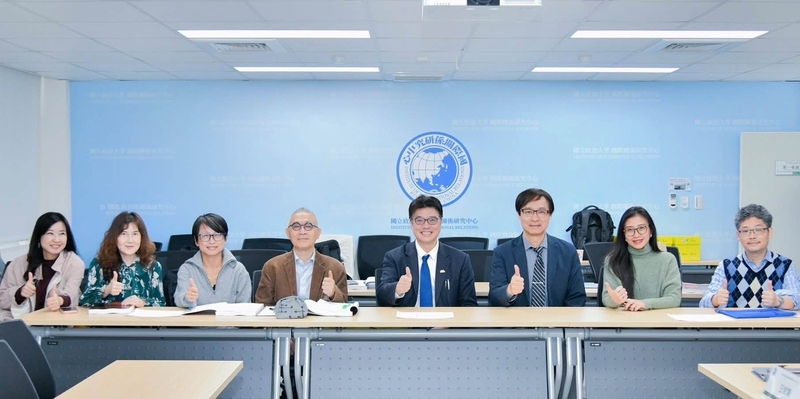
In recent years, the Chinese Communist Party (CCP) has employed a dual approach of both soft and hard tactics, as well as a complex pressure strategy towards Taiwan. The Chairperson of the Mainland Affairs Council, Chiu Chui-cheng, has highlighted these efforts, emphasizing the importance for the public to be vigilant regarding the CCP’s unification strategies and intentions.
On November 20, during the sixth “Understanding China’s United Front” workshop organized by the National Chengchi University’s National Affairs Center, Chiu delivered a keynote speech on “The Current and Future State of Cross-Strait Relations.” This gathering provided a platform for academics and experts to engage in discussions regarding the current situation in the Taiwan Strait and the evolution of cross-strait relations.
During his address, Chiu interacted with scholars, experts, and researchers, discussing the pressing issues surrounding the Taiwan Strait and the dynamics of cross-strait relationships. He commended the academic community for their long-standing commitment to analyzing the CCP’s United Front tactics and models, which serve to enhance the public’s ability to recognize and defend against such strategies.
In his speech, Chiu elaborated on the recent political and economic developments in China and their implications for Taiwan. He analyzed the CCP’s multifaceted approach involving military threats, diplomatic suppression, economic coercion, legal warfare, and cognitive operations. These efforts aim to alter the status quo in the Taiwan Strait. On the flip side, the CCP attempts to leverage platforms like the “Strait Forum” to present one-sided claims of “benefits to Taiwan,” further intertwining political objectives within cross-strait interactions. He urged both the public and attending scholars to remain aware of the CCP’s United Front methods and motives.
In light of the increasing pressure from the CCP’s unification tactics, Chiu emphasized the government’s commitment to upholding the “Four Persistences” and the “Four Invariances.” He affirmed that the government would fully implement President Lai Ching-te’s “Four Major Pillars of Peace Action Plan,” which focuses on strengthening national defense capabilities, ensuring economic security, and fostering resilience within society. Furthermore, Chiu stated that continuous collaboration with international democratic partners is essential for jointly maintaining peace and stability in both the Taiwan Strait and the broader region.
The sixth “Understanding China’s United Front” workshop included various discussions, addressing topics such as “International United Front,” “Strategies for Hong Kong, Macau, and Taiwan,” “Ethnicity, Symbols, and Narratives,” and “Religious United Front,” along with a roundtable forum. This comprehensive approach aims to deepen understanding and awareness of the complexities surrounding the CCP’s strategies and their implications for cross-strait relations.