
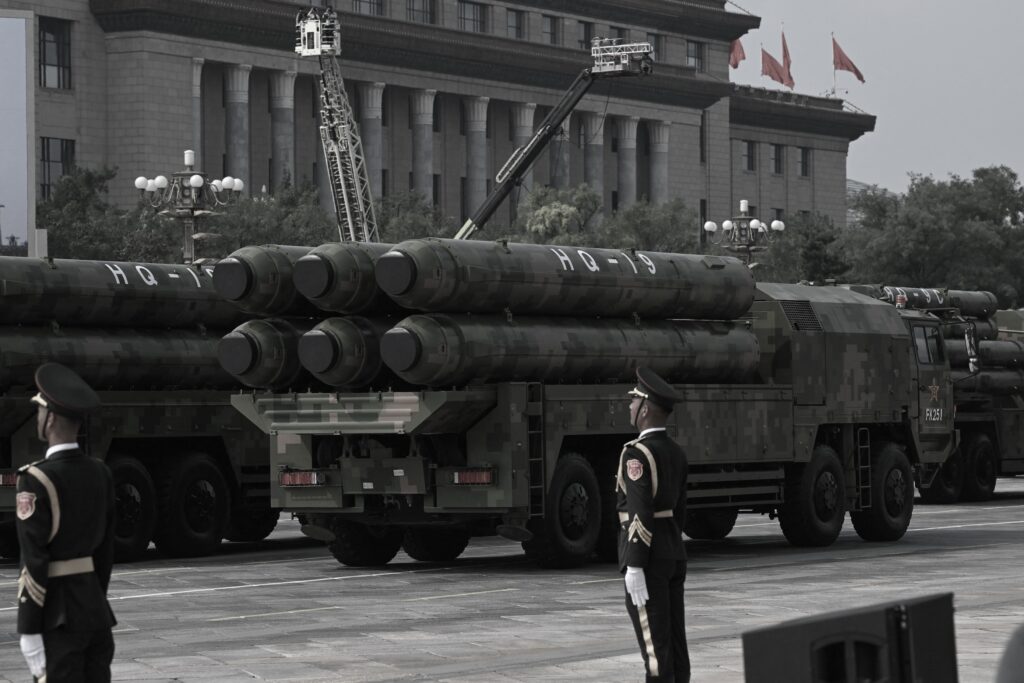
In recent developments within the People’s Liberation Army (PLA) of China, significant scrutiny has been directed towards the Rocket Force, particularly following the abrupt dismissal of several high-ranking officials. The inquiry has extended beyond traditional procurement practices to include a rare examination of grassroots logistics, encompassing the procurement of perishable goods and pharmaceutical supplies.
According to newly released information, two companies, SF Express and Eight Horses Tea, have been temporarily suspended from participating in military procurement activities due to alleged violations. Analysts suggest that the breadth and depth of this investigation into military corruption starkly illustrate the entrenched nature of misconduct within the ranks, indicating a system where complete eradication of corruption remains futile.
On November 19, the PLA procurement network issued a notification regarding SF Express, highlighting that the logistics giant is suspected of engaging in irregular activities, leading to its suspension from military procurement for materials, projects, and services. Notably, the announcement was made by the Logistics Support Department’s Procurement Service Center, though it did not detail the specifics of the alleged violations nor indicate how long the suspension would last.
SF Express, a leading logistics enterprise in China, previously had the capability to engage in various procurement projects across the military.
In a concurrent announcement, the Procurement Service Center disclosed that Eight Horses Tea had also been implicated in violations, resulting in its suspension from the same procurement activities. Interestingly, the announcement made no specific mention of what violations Eight Horses Tea was accused of, nor the duration of its suspension.
The controlling shareholder of Eight Horses Tea, Wu Xiaoning, has been designated as a related personnel subject to restrictions. During this suspension, the company’s legal representative and other enterprises managed or held by Wu Xiaoning will also face limitations, preventing them from representing other suppliers in related procurement activities.
Eight Horses Tea, which specializes in the sale of tea and related products, debuted on the Hong Kong Stock Exchange on October 28, 2025, with its issues priced at HKD 50 per share. However, as of November 20, 2026, the company’s shares closed at HKD 21.40, reflecting a notable decline of 6.96% for the day and a staggering drop of 57.2% from its initial public offering.
Back on August 24 of this year, the PLA procurement network had previously published a notice soliciting reports on violations related to procurement activities within the Rocket Force. This notice was targeted at suppliers, review experts, bidding agencies, and relevant personnel within the military, seeking information linked to irregularities in procurement for materials, services, engineering, and essential goods such as food and pharmaceuticals.
Earlier, on July 26, 2023, the Equipment Development Department of the Central Military Commission issued a similar notice, looking into violations related to expert reviews in procurement activities dating back to October 2017. This crackdown was perceived as a direct affront to former Defense Minister Li Shangfu, who had previously oversaw the department, and signaled the commencement of purges within the Rocket Force.
Notably, the focus of the 2023 inquiry targeted the broader military’s procurement review experts, while the most recent announcement has been explicitly directed at the Rocket Force itself. Furthermore, the scope of the recent investigation appears to broaden considerably; while the earlier notice specifically focused on weapons and equipment procurement, the current investigation encompasses routine materials, services, and curiously extends down to grassroots logistical needs.
Since July 2023, a notable number of senior officials within both the Central Military Commission’s equipment systems and the Rocket Force have been ousted. The military procurement network has repeatedly released notices aimed at addressing procurement malpractices.
In August 2024, several universities, including Xi’an Jiaotong University and Xi’an University of Science and Technology, were prohibited from participating in Rocket Force procurement activities due to violations, with bans lasting until August 2027.
Between August 28 and September 1, 2025, the logistics department of the Rocket Force released a series of 180 notices via the military procurement network, resulting in penalties for 74 review experts and 116 suppliers. This led to the disqualification of experts from participating in military project evaluations and supplier bans from bidding on military procurement projects.
On May 22, 2026, an announcement was made that China Aerospace System Engineering Co., Ltd. was banned from participating in military procurement for a year due to irregularities identified during a 2017 procurement event.
Established at the end of 2015, the Rocket Force is considered the heart of China’s strategic nuclear capabilities, with procurement involving high-technology, high-cost, and highly sensitive equipment systems. The current investigations are now extending to logistics support.
Li Linyi, a China issues expert, commented on these developments, indicating that while the fall of four consecutive commanders of the Rocket Force, including Li Shangfu, signals a serious internal purge, the cleaning process is far from over. Moreover, the ever-expanding scope of the purge reflects a troubling degree of entrenched corruption within the military. He noted that the persistent issues surrounding procurement are emblematic of systemic problems; without an overhaul of the underlying structure, even the most thorough cleansings would prove ineffective in tackling the issue of corruption.