
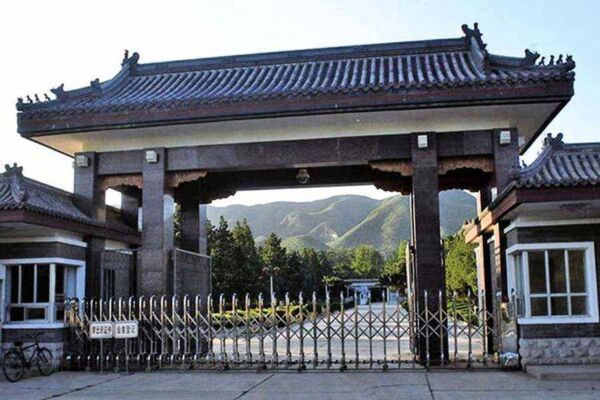
Qincheng Prison, established in the 1950s, is a secret facility in China dedicated to housing fallen officials and politically sensitive prisoners. Recent satellite imagery has revealed that the prison is undergoing the largest expansion since the Cultural Revolution, with at least 300 new cells being added to increase its capacity by approximately 50%.
As the prison expands, the political landscape within the Chinese Communist Party (CCP) is also shifting. Current party leader Xi Jinping has been relentless in purging high-ranking officials, with a significant number of ministerial-level officials having already fallen from grace. This expansion at Qincheng Prison not only demonstrates the intensifying political strife within the CCP but also raises concerns among observers about the potential for even more officials to be incarcerated in the future.
Located in Qincheng Village, Xingshou Town, in Beijing’s Changping District, the prison lies at the foot of the Yanshan Mountains in northern Beijing, just an hour’s drive from the city center. All details pertaining to the prison are classified as state secrets by the CCP.
Qincheng Prison has become notorious for detaining not only disgraced officials but also a number of student leaders from the Tiananmen Square protests in 1989. A former inmate described the experience of being incarcerated there as one of being treated as less than human.
The Economist’s analysis of satellite images confirmed that Qincheng Prison is indeed undergoing extensive renovations and expansions. Meanwhile, Xi Jinping’s campaign to purge the upper echelons of the CCP continues unabated. As of September of this year, over 105 ministerial-level officials have faced imprisonment or other forms of punishment, a figure that’s more than 1.5 times that of the entire year of 2025.
During the Cultural Revolution, the prison faced overcrowding due to the large number of purged officials, leading to its first expansion in 1968. The ongoing expansion of Qincheng may indicate a potential repeat of history.
Qincheng Prison is the only facility in China directly managed by the Ministry of Public Security. Among its most infamous inmates are Zhou Yongkang, the former Minister of Public Security, and Jiang Qing, the wife of Mao Zedong, who sent many high-ranking officials to Qincheng during the Cultural Revolution.
The internal management of Qincheng is highly secretive, with significant disparities in the treatment of prisoners. Many high-ranking officials experience an incarceration that bears more resemblance to a holiday than a punishment.
According to an interview conducted by Voice of America in 2019 with former prisoners and relevant sources, Bo Xilai was reportedly housed in a single room of about 16 square meters, where he could wear a suit and practice calligraphy. Zhou Yongkang enjoyed a small private courtyard and a vegetable garden, growing his own produce.
Additional reports have indicated that some cells for high-ranking officials are equipped with private bathrooms, western-style toilets, writing desks, and even washing machines. These officials have access to books, newspapers, and television, with provisions from their families for clothing and daily necessities.
In stark contrast, ordinary political prisoners face harsh conditions. Zhou Fengsuo, a student leader detained in 1989, recounted that his cell contained only a wooden plank for sleeping, with a diet primarily consisting of cornbread and very little meat. For an extended period, he was even forced to wear handcuffs.
The prison has outdoor courtyards without roofs, surrounded by tall walls, where only a select few inmates are occasionally allowed to breathe fresh air.
Solitary confinement, referred to as “small cells,” is a common occurrence at Qincheng Prison. One inmate reportedly spent as long as 20 years in solitary confinement. Standard cells accommodate multiple inmates, with as many as six or seven per room, which contains only a squat toilet. Some inmates have suffered from mental health issues as a result of prolonged imprisonment.
Inmates have revealed that the food offered at Qincheng is often sparse, with some staff members even tossing food directly into the inmates’ hands. Inmates are granted the privilege to shower only once every two weeks.
Qincheng Prison specifically houses fallen CCP officials and sensitive political prisoners to separate them from ordinary criminals. A former Ministry of Justice official voiced in 2018 that those sent to Qincheng are not there due to their rank, but rather because of what they know.
Scholar Ling Li from the University of Vienna has pointed out that Qincheng is heavily fortified, not only to prevent escapes but also to restrict unauthorized contact with the outside world, thereby avoiding the disclosure of information that could threaten the stability of the CCP regime.
An anonymous Substack blogger named Youshu was the first to disclose in 2021 that a large barrack for prison guards had begun construction on the western side of the prison grounds. This facility is reported to cover an area equivalent to ten football fields, featuring four dormitories, a running track, a parade ground, and possibly even an armory. The northeastern sector of the prison underwent renovations in 2022 to add outdoor activity areas.
The last new cell construction at Qincheng Prison took place in 2016. The current expansion involves the demolition of two old buildings to make way for larger structures, with the new facilities potentially rising six stories high. One of the demolished buildings was Building 203, which previously housed the Tibetan religious leader, the Panchen Lama, in 1968.
Satellite image analyses indicate that management facilities within the prison are also being expanded, with cranes already visible in the staff housing area on the east side. Additionally, two buildings of currently unspecified purposes are located within the internal walls of the prison, which also could be intended for inmate housing.
No reports of this current expansion have surfaced in CCP media. Former British diplomat John Gerson speculates that the lack of discourse may stem from the notion that no one can leave the facility to discuss it.
The Economist anticipates that the number of inmates at Qincheng Prison is almost certainly on the rise. Typically, when political changes occur within the CCP, the inmate population decreases. However, current indications suggest that Xi Jinping plans to maintain his grip on power for the long haul.