
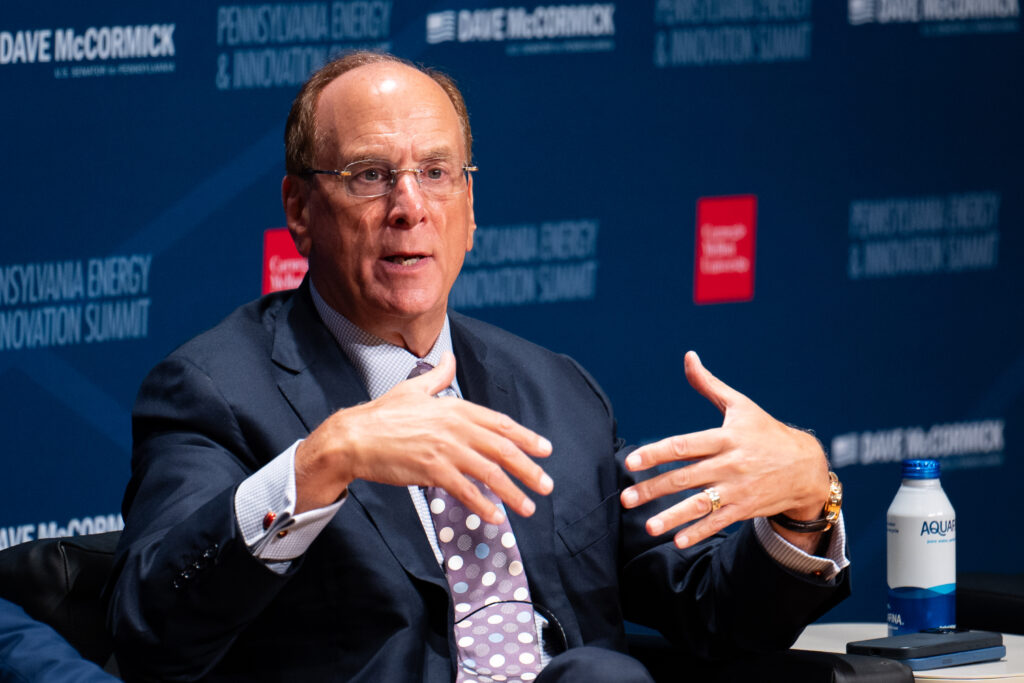
On November 19, Larry Fink, the CEO of BlackRock, one of the largest asset management firms in the United States, expressed significant concerns regarding the potential tightening of artificial intelligence (AI) regulations in the country. Speaking at a BlackRock board meeting in Japan, he cautioned that such regulatory actions could lead the U.S. economy into a recession and have detrimental effects on the global economy.
During a joint interview with the Nikkei and TV Tokyo, Fink highlighted that the political landscape in the U.S. was expected to shift substantially following the November 3 midterm elections, creating a climate where stricter AI regulations could emerge. He emphasized the importance of technology-related capital expenditures as a key driver of economic growth in the United States.
Fink argued that if the U.S. were to pause the construction of data centers for political reasons, it would be a misguided move that might exacerbate economic difficulties. He voiced concerns that regulatory restrictions could keep the costs of AI high while a shortage of computational resources would hinder the widespread adoption of AI technologies.
This is not the first time Fink has issued such warnings. He made similar statements during a CNBC interview on October 14, underscoring the urgency of the matter.
BlackRock itself has made substantial investments in data centers, leading an investment group that agreed to acquire Aligned Data Centers for approximately $40 billion in October 2025.
In a different context, Michelle Bowman, the Vice Chair for Supervision at the Federal Reserve, addressed the economic implications of the current AI investment boom in a speech on November 10. She pointed out that due to the transformative potential of AI technology, investment in data centers has soared, becoming a critical factor influencing the U.S. economy.
Bowman noted that expenditures on high-tech equipment, software, and data center construction have constituted a large portion of the growth in business fixed investments since 2025. This year’s real growth in business fixed investment has further intensified, echoing the momentum seen during the technology boom of the 1990s.
She also mentioned that AI-related price pressures account for about a quarter of core PCE inflation, which has exceeded targeted levels. Investors are currently reassessing their expectations of returns on AI investments, along with the risks associated with increased external financing for AI projects.
Bowman warned that if revenues related to AI are unable to keep pace with rapidly rising costs, particularly as public sentiment and local opposition could lead to increased regulation and construction delays, we could witness significant corrections in the stock prices of AI firms. This would likely result in higher financing costs and difficulties in securing credit, which could slow the construction of AI infrastructure while simultaneously softening overall economic activity and inflation.
Despite the rapid increase in AI revenues, she stated that those revenues remain insufficient to cover existing maintenance and development costs for current and new models or data centers. She indicated that related debt is projected to exceed $800 billion this year, with a significant amount of off-balance-sheet liabilities and signs of “revolving financing” appearing in the market.
However, she also commented that the primary lenders in AI and data centers seem capable of absorbing potential losses.
Fink estimated that the U.S. requires an investment between $7 trillion to $9 trillion in AI-related fields. He argued against excessive regulation, advocating instead for greater investment in AI infrastructure and improvements to financing channels.
Using Anthropic’s initial public offering (IPO) as an illustration, he noted that capital remains tight. Anthropic set its offering price at $83 per share on November 18, higher than the originally expected price range of $70 to $78, and began trading on NASDAQ on November 19. Fink reiterated that the issue of capital scarcity he previously mentioned continues to be a pressing concern.
To address the funding gap, Fink proposed the use of securitization to develop a direct financing model for the AI industry through capital markets, similar to the role that mortgage-backed securities (MBS) play in the bond market. He suggested that packaging AI chips into financial instruments comparable to auto loans or MBS could establish a funding mechanism to aid startups and mid-sized enterprises in securing necessary capital.
BlackRock is also exploring collaborations with other institutional investors. In 2024, the firm joined forces with Microsoft and other sovereign investment entities from the Middle East to form an investment alliance. Fink stated, “We are looking for other platforms to continue increasing our investments.”
Additionally, Fink commented on the resignation of Jensen Huang, CEO of NVIDIA, praising him as a “visionary leader.” However, he noted that the departure of a company’s leader would not disrupt the ongoing momentum of the AI boom.
This analysis draws upon various reports, including insights from the Nikkei.