
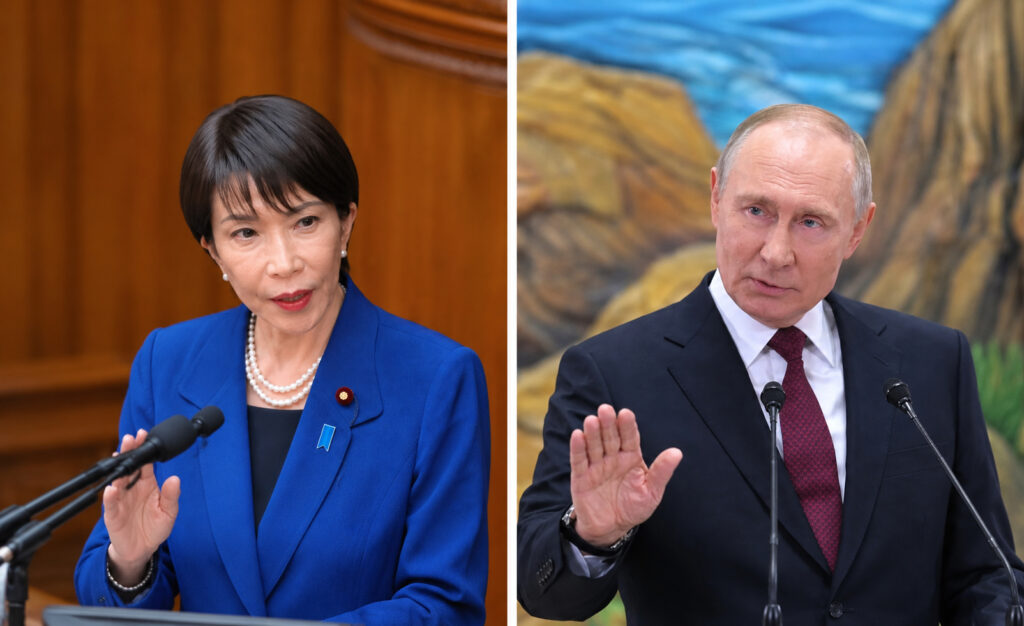
At the recent Asia-Pacific Economic Cooperation (APEC) summit held in Shenzhen, China, Japan’s Prime Minister Sanna Takashi engaged in a significant discussion with Russian President Vladimir Putin on November 18. This conversation lasted approximately 30 minutes, marking the first direct interaction between the leaders of Japan and Russia in seven years. Furthermore, it represents the first encounter at the head-of-state level since Russia’s full-scale invasion of Ukraine in 2022.
The meeting took place following an informal welcome dinner attended by leaders of various nations. Given the tight schedules of the attendees, the Japanese side did not organize a formal summit beforehand, opting instead for informal discussions in coordination with their Russian counterparts to facilitate this interaction.
According to officials from the Japanese government who disclosed details to the media, Prime Minister Takashi conveyed Japan’s stance on several bilateral issues during the conversation. One of the primary concerns raised was the demand for the immediate release of Yuki Imai, a reporter from Hokkaido Shimbun, who is currently detained by Russian authorities. The Prime Minister also stressed the importance of ensuring the safety and operational rights of Japanese businesses in Russia.
In recent months, the relationship between Japan and Russia has been under considerable strain, primarily due to a series of actions taken by Russia that have applied pressure on Japan. For instance, in August, President Putin made a notable visit to the Kuril Islands, known in Japan as the Northern Territories, which are embroiled in a sovereignty dispute between the two nations. This visit prompted strong protests from the Japanese government.
On October 13, the situation escalated when Russian authorities arrested Yuki Imai in the Far Eastern region of Sakhalin, accusing him of espionage and subsequently transferring him to Moscow for detention. The Japanese government has firmly denied these allegations, demanding his prompt release. Imai’s detention is set to expire on December 12, although Russian authorities have the option to extend it further.
Additionally, President Putin recently signed a decree placing the assets of Japan Tobacco Inc. (JT) in Russia under temporary management by Russian enterprises. On November 17, the Japanese government lodged a strong protest with Moscow regarding two suspected Russian military aircraft that allegedly violated Japanese airspace.
The last formal meeting between the leaders of Japan and Russia occurred in September 2019, when then-Prime Minister Shinzo Abe held discussions with Putin on various topics, including the Northern Territories dispute, economic cooperation, and the return of Japanese residents to pay respects at gravesites on the islands. Since the onset of Russia’s invasion of Ukraine in 2022, high-level direct dialogue between Japan and Russia has ceased.
The Japanese government has been actively seeking to restore communication with Russia. On October 30 of this year, the foreign ministers of both countries met face-to-face for the first time in five years. The recent direct exchange between Prime Minister Takashi and President Putin in Shenzhen is thus seen as a significant step in rekindling dialogue between the two nations after an extended period.
Despite the multitude of complex issues facing bilateral relations, the Japanese government has emphasized the necessity of maintaining communication channels at the governmental level. This underscores a recognition of the importance of dialogue in addressing ongoing challenges and fostering a more stable and structured engagement between Japan and Russia.