
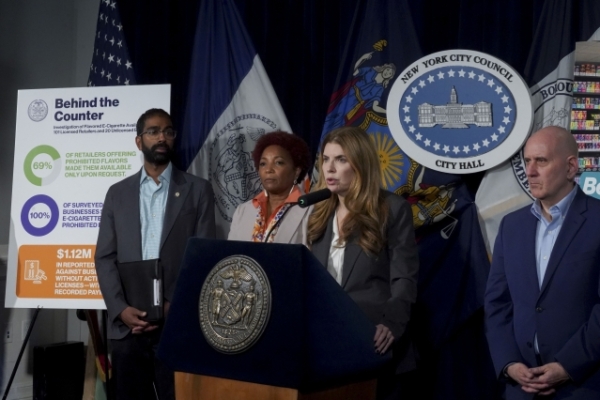
On November 18, 2026, the New York City Council released the results of a recent survey highlighting ongoing issues related to the illegal sale of flavored electronic cigarettes (vapes) near public middle schools and high schools. The investigation revealed that numerous shops continue to offer these products unlawfully, with some retailers resorting to hiding prohibited items behind the counter and only presenting them when customers explicitly inquired.
In an effort to address this concerning trend, the City Council is advocating for new legislation aimed at empowering the Department of Consumer and Worker Protection (DCWP) to enforce stricter measures against businesses that repeatedly violate sales regulations regarding electronic cigarettes.
City Council Speaker, Adrianne Adams, referenced the report titled “Behind the Counter,” which details the survey’s methodology. Investigators posed as customers and visited 193 retail outlets located within 500 feet of public middle and high schools. This included both licensed vape shops and unlicensed vendors that had received complaints about their tobacco or vaping products.
“The results of our investigation are deeply alarming and underscore the urgent need for enhanced regulation of flavored e-cigarette sales, particularly in proximity to our city’s public schools,” Adams stated. “We have a responsibility to protect our youth from the dangers of nicotine addiction, which necessitates ensuring that harmful products do not enter the hands of minors through legal means.”
The analysis examined the vicinity of 201 schools, revealing that in 32% of the cases, at least one shop selling banned flavored e-cigarettes was located within 500 feet. Furthermore, 35% of the schools had retailers displaying advertisements for tobacco or electronic cigarettes or showcasing related smoking paraphernalia.
An especially troubling finding from the investigation indicated that many prohibited items were not out in the open on store shelves. Instead, some shops concealed e-cigarettes behind the counter and would only produce them upon active inquiries from investigators regarding fruity or candy-flavored options. This practice complicated routine inspections, making it difficult to immediately detect illegal sales.
Among the sellers of e-cigarettes, 40% offered recognizable banned flavors such as fruit, candy, and dessert varieties. Another 43% sold products labeled as “Clear” (indicating light or neutral flavors), raising suspicions that some retailers might be using this designation to obscure the actual flavors and evade the ban. Together, these two categories accounted for a staggering 83% of the surveyed e-cigarette retailers who were found selling one of these two types of products.
There was also a noticeable disparity between licensed and unlicensed retailers. Among the 101 businesses with a city-issued vape retail license, over a quarter were found to be selling at least one type of banned flavor. In stark contrast, all 28 of the unlicensed vape shops identified during the survey were caught selling prohibited flavors.
Another significant factor prompting the City Council to push for new legislation is the ineffectiveness of current enforcement measures. The survey report indicated that the city had previously issued approximately $1.12 million in fines to businesses lacking a valid e-cigarette sales license; however, only a minuscule 0.5% of these penalties were actually collected. This raises concerns that fines alone are insufficient to deter illegal activities.
City Council Member, Mercedes Narcisse, introduced Bill No. 1167, which aims to change this narrative. The proposed law would authorize the DCWP to order the closure of businesses that have operated without a license for selling e-cigarettes at least twice within three years, or have violated sales regulations involving flavored e-cigarettes or sales to individuals under 21 at least three times within the same time frame, after providing notice and an opportunity for the business to respond.
The situation surrounding youth vaping is equally troubling. City Council Member Harvey Epstein noted that 64% of surveyed students indicated that vaping had become quite common in their schools. Thus, local government cannot turn a blind eye to this issue and must step up enforcement efforts alongside health education initiatives.
In fact, New York City had already enacted Local Law No. 228 back in 2019, which prohibits the sale of any electronic cigarettes that clearly display non-tobacco flavors. Following this, New York State implemented similar restrictions. Additionally, state law prohibits businesses from advertising e-cigarette products within 500 feet of a school.
To further address these pressing concerns, the City Council’s Committee on Oversight and Investigations, along with the Committee on Consumer and Worker Protection, will convene a joint oversight hearing this Friday. The purpose of this meeting is to compel city agencies to present their enforcement practices and discuss potential measures to close existing loopholes in the regulation of e-cigarette sales.