
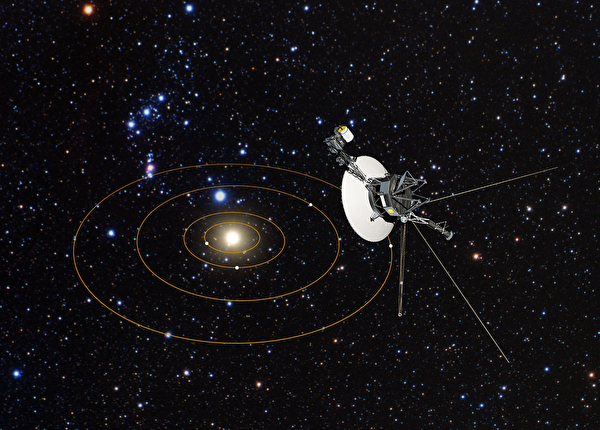
NASA’s Voyager 1 spacecraft has reached a remarkable milestone, becoming the first human-made object to travel a distance of one “light-day” from Earth. This historic event took place on November 18, when Voyager 1’s radio signals, moving at the speed of light, will take approximately 24 hours to reach our planet.
A light-day is defined as the distance light travels in 24 hours, which equates to about 16 billion miles or 26 billion kilometers. According to scientific calculations, Voyager 1 crossed this significant boundary at precisely 5:16:07 AM Eastern Time on Wednesday. However, engineers at NASA’s Jet Propulsion Laboratory (JPL) in California will need to wait about another day to receive the Voyager 1 signals, thereby confirming the spacecraft’s achievement. An event is planned for Thursday to celebrate and discuss this incredible milestone.
“This is an unprecedented event that may never happen again in the future; it is simply extraordinary,” said Kareem Badaruddin, the Voyager mission manager at JPL.
Suzanne Dodd, the project manager for Voyager, expressed her awe at this accomplishment, stating, “Reaching a distance of one light-day is an astonishing achievement, and I never imagined I would witness this moment.”
Dodd further elaborated on the scientific contributions of Voyager, saying, “Whenever the Deep Space Network points its antennas toward Voyager, we receive continuous readings about its journey, including data on magnetic fields, cosmic rays, and plasma waves.”
In celebration of this historic occasion, NASA invited people around the globe to join in a creative tribute. On the evening of November 17, they encouraged individuals to use their cell phones or flashlights to signal the night sky with Morse code messages spelling out “V-G-R,” which stands for Voyager’s call sign. This collective action was intended to create a golden wave of light honoring the mission.
Voyager 1 and its twin spacecraft, Voyager 2, were both launched in the latter half of 1977. They reached interstellar space in 2012 and 2018 respectively, becoming the only spacecraft to operate in interstellar territory and directly sample it. These missions stand as a testament to human ingenuity, having been in space for nearly 49 years and continuing to relay unique data about interstellar space back to Earth. Notably, they are the longest-operating and most distant spacecraft in NASA’s history.
The information gathered by the two spacecraft has significantly advanced our understanding of the heliosphere’s comet-like shape and how it protects Earth from high-energy particles and radiation found in interstellar space.
Astrophysicist Alan Cummings has noted that, based on current flight trajectories, Voyager 2 is expected to reach a distance of one light-day from Earth in approximately nine years, specifically in November 2035. However, there is growing concern about whether this spacecraft will continue to function in the harsh conditions of space for another nine years. After nearly 50 years of spaceflight, both Voyager crafts are facing increasing aging-related challenges. Engineers are actively exploring ways to prolong the operational lifetimes of these remarkable machines.
This extraordinary achievement not only marks a new chapter in space exploration but also highlights the relentless pursuit of knowledge that has characterized NASA’s missions for decades. As scientists continue to analyze the data being sent back by Voyager 1, the hope for future discoveries remains bright, inspiring generations to come in the quest to understand our universe more fully.