
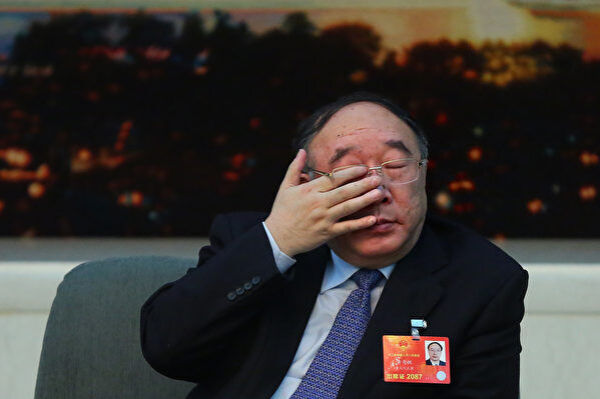
On November 17, 2026, Chongqing Road and Bridge announced that its chairman, Weng Zhenjie, is currently unable to fulfill his role due to personal reasons. Reports from Chinese media indicate that Weng is presently in a state of “loss of contact.”
Weng Zhenjie is notably referred to as the “King of Finance” in Chongqing and is a close associate of former Chongqing mayor Huang Qifan. In the lead-up to Huang’s abrupt removal from office on October 13, 2026, several senior executives from Chongqing’s financial state-owned enterprises were dismissed. Media reports have suggested that as the case against Huang developed, Weng and many other prominent figures in Chongqing’s financial sector have been taken in for questioning.
The timing of events coincides with significant political maneuvering during the CCP’s 21st National Congress, where Huang’s investigation has shed light on deeper issues within the internal power struggles at high levels of the Communist Party.
Late on the night of November 17, Beijing time, the A-share listed company Chongqing Road and Bridge announced that it had received a notification from its major shareholder, Chongqing International Trust Co., stating that chairman Weng Zhenjie could not perform his duties as chairman or as a member of the board’s special committees due to personal reasons.
As the leader of Chongqing International Trust, which is the largest shareholder in Chongqing Road and Bridge, Weng personally took on the role of chairman of the latter in December 2025. He became president of Chongqing Investment (the predecessor of Chongqing Trust) after it expanded its capital in 2001. Under his guidance, Chongqing Investment became the primary initiator and controlling entity of Chongqing Road and Bridge and facilitated its acquisition of the Yufu Expressway, shaping a unique asset structure of “road and bridge plus finance.”
Public records indicate that Weng chaired the fifth meeting of the ninth board of directors for Chongqing Road and Bridge on October 29, 2026.
Industrial media sources such as Trust 100 reported that Weng has not appeared at Chongqing Trust’s office this week, and meetings with risk project clients that were scheduled for the previous weekend were abruptly canceled.
According to various confirmations from the Economic Observer, Weng is currently in a state of “missing.” Several individuals close to him revealed that they lost contact with him last week. On the morning of November 18, attempts to call Weng went through numerous redirects, rendering the calls unanswered; messages sent directly to him also went unreplied.
Weng Zhenjie holds a prominent position in Chongqing’s financial circle, having been actively involved in the fields of trust, brokerage, and banking for a long time. He has led multiple significant financial restructurings, earning him the moniker of “King of Finance” in Chongqing.
Public records show that Weng was born in October 1962 in Huaiyuan, Anhui Province. He graduated from the PLA Nanjing Communications Engineering Institute and previously served as an instructor at the PLA Communication Academy and as the deputy general manager of Beijing Zhongguancun Science and Technology Development Co., Ltd. Since 2001, he has held key positions such as chairman of Chongqing Trust, chairman of Southwest Securities, and chairman of Guodu Securities, adding to his extensive portfolio which included the chairmanship of the Three Gorges Bank starting in 2008.
Upon his arrival in Chongqing in 2001, Weng took the helm as chairman of Chongqing Trust, which eventually matured into a formidable financial holding group controlling commercial banks, fund companies, and securities firms.
In September 2007, the Chongqing municipal government decided to restructure Chongqing Wanzhou Commercial Bank through Chongqing Trust, which was on the verge of bankruptcy at the time. By February 2008, Wanzhou Commercial Bank had been renamed Three Gorges Bank, with Weng stepping in as its first chairman post-restructure, guiding the foundational development and resolution of non-performing assets.
In February 2006, Southwest Securities found itself in crisis, with Chongqing Trust as its largest shareholder at that time. Under Weng’s management, Southwest Securities successfully underwent restructuring, leading to its reverse merger and listing on the Shanghai Stock Exchange in February 2009. Weng assumed the role of chairman at Southwest Securities in January 2010, serving until 2012.
In February 2016, Weng was nominated by Chongqing Trust to join the board of Guodu Securities and was formally elected as its chairman in 2020, serving until May 2025.
Chongqing Trust is also a major shareholder in Yimin Fund, where Weng served as chairman until June 2020.
With his leadership spanning Chongqing Trust, Southwest Securities, Guodu Securities, Yimin Fund, and Three Gorges Bank, Weng has held senior positions across the four major categories of financial institutions—trust, securities, banking, and funds—making him a rare figure both within Chongqing and nationally.
The investigation into Huang Qifan, a key figure in Chongqing’s political landscape who had recently stepped down after over a decade of service and who has faced numerous accusations of corruption and mismanagement, adds another layer of complexity to the situation. Huang was known for his efforts to reform local financial institutions, promoting their transformation into joint-stock companies and facilitating their public listings.
After Huang’s investigation began to unfold, it has come to light that several of his former allies in the financial sector have also been implicated, which has led to speculation about their collective fates.
In recent weeks, as various high-ranking officials have faced investigations, it has become increasingly evident that the political and financial ramifications will be extensive, leading to widespread speculation regarding how these developments might alter the fates of prominent local leaders.
As the situation evolves, it remains to be seen how these investigations will impact not only those directly implicated but also the broader financial landscape in Chongqing.
The unfolding events may continue to reveal deep-rooted issues within the local government and financial institutions, hinting at ongoing political turmoil that could have lasting effects on the city’s governance and financial integrity.