
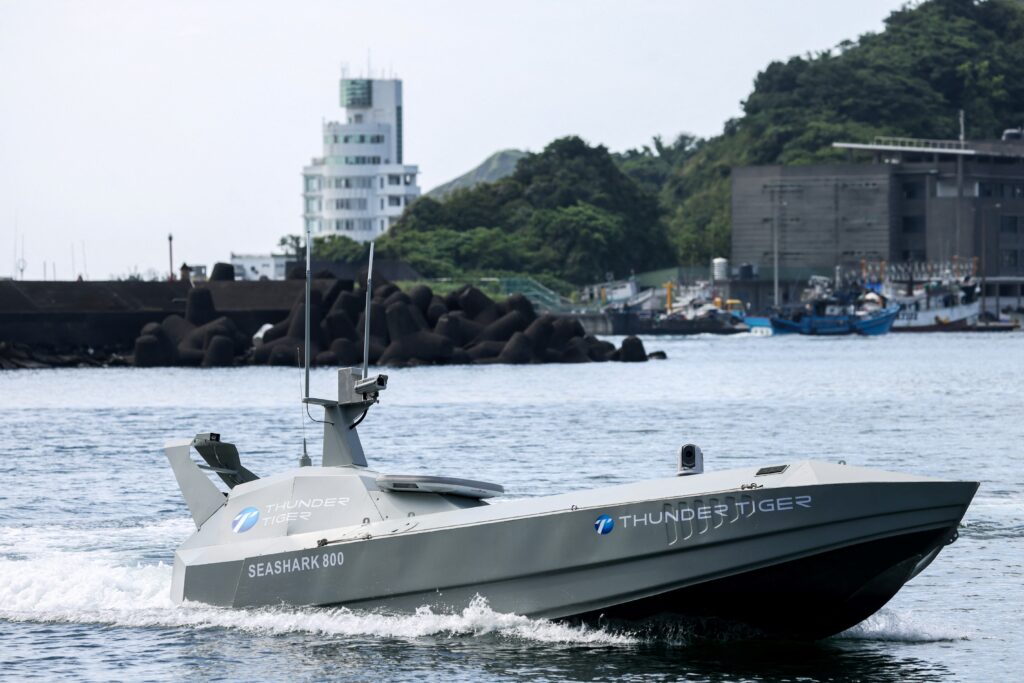
The ongoing conflict in Ukraine and Russia, which has surpassed four years, is prompting the international community to draw lessons for Taiwan. A recent report from a Ukrainian think tank emphasizes that Taiwan should proactively accumulate thousands of unmanned vessels before any potential conflict. Moreover, the report stresses the necessity for a robust, distributed, and fortified infrastructure to store these assets. In the event of a crisis in the Taiwan Strait, the primary contribution of unmanned vessels would be to undermine the operational tempo of the Chinese military.
The “Serpens Center for International Security,” an independent Ukrainian think tank focused on defense and security, has released a report titled “The Black Sea Blueprint for Taiwan: Ukraine’s Naval Lessons in Asymmetric Warfare.” This document analyzes how Ukraine’s combat experiences can be applied to counter a possible invasion by China.
Catarina Buchatskiy, co-founder and head of the analysis department at the Serpens Center, attended a discussion on the report organized by the Foundation for Defense of Democracies in Washington. During the event, she indicated that, based on stockpiling considerations, the report advocates for Taiwan to acquire approximately 5,500 unmanned vessels.
Buchatskiy also noted that there are limited locations in Taiwan that can adequately store these unmanned vessels. One of the report’s key recommendations is the establishment of fortified underground storage facilities to secure the assets from potential threats.
The report indicates that Ukraine’s maritime operations demonstrate that expendable unmanned systems can impose disproportionate costs on superior naval forces.
Furthermore, the report asserts that unmanned surface vehicles (USVs) can provide significant advantages for Taiwan’s defense by effectively utilizing unique environmental features and the vulnerabilities of the Chinese military during an invasion. The Taiwan Strait is often characterized by high waves and low visibility, conditions that, while viewed as operational limitations, could potentially allow unmanned vessels to approach targets undetected in light of China’s advanced intelligence, surveillance, reconnaissance (ISR), and automated vessel defense systems.
According to the report, Taiwan’s survival hinges on its ability to scale production and maintain a high-intensity rate of attacks while isolated and blockaded. This necessity requires a preemptive stockpile of thousands of unmanned vessels that can be deployed at any moment.
It also calls for these unmanned vessels to be widely distributed across a vast and fortified infrastructure, rather than being concentrated in just a few locations. This dispersion is essential not only to withstand preemptive strikes from the enemy but also to enable rapid deployment when required.
In scenarios of sudden conflict in the Taiwan Strait, the report suggests that the primary operational contribution of unmanned vessels will not be to sink frontline capital ships or prevent initial landings. Instead, it emphasizes their role in disrupting the operational tempo of the Chinese military. By targeting amphibious transport ships, supply vessels, semi-fixed offshore infrastructures, and exposed escort vessels, unmanned vessels can interfere with the enemy’s strategic deployment timing and logistics support.
This disruption is pivotal, as it determines whether invading forces can maintain their footing and transition from fragile beachheads into a sustainable operational frontline.
The insights drawn from Ukraine’s experiences can offer valuable strategies for Taiwan to enhance its defense posture as tensions in the region continue to rise.