
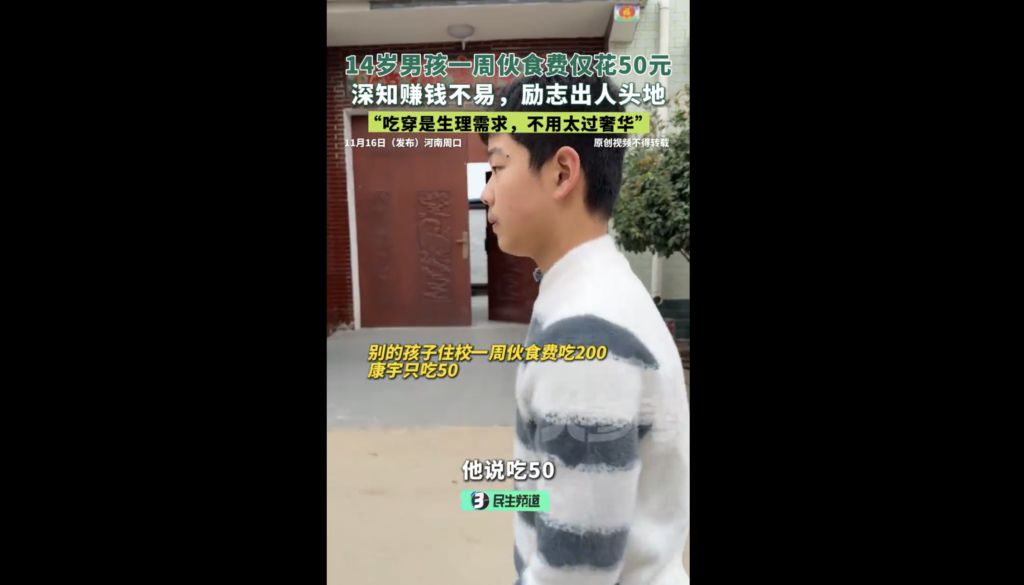
A recent story from Shangshui County, Zhoukou City, Henan Province, has captured the attention of netizens, sparking discussions online. The focal point of the tale is a 14-year-old boy named Wang Kangyu, who lives at school and reportedly spends only 50 yuan a week on meals by primarily eating steamed buns to save on food costs.
In a video report by Henan Radio and Television, Wang’s grandmother shared details during an interview. She noted that while other students living at the school spend approximately 200 yuan weekly on meals, her grandson’s expenditure stands at just 50 yuan. To conserve money, Wang primarily survives on simple foods like buns. Filled with emotion, his grandmother expressed her concern, stating, “I wondered why the child is so thin.”
Currently a student in the third year of junior high school, Wang Kangyu remarked that he views food and clothing as physiological necessities that do not require extravagance. Although his grandmother offered to give him a bit more pocket money, he declined. He firmly stated that he would not spend extra money on snacks or other non-essential items, being acutely aware of the financial difficulties faced by his elderly grandparents. During the off-season for farming, he assists his grandmother by weaving fishing nets to help supplement the household income.
The video has triggered widespread discussion among internet users, with many expressing concern that the lack of adequate nutrition could affect Wang’s physical development during his growth years. Some emphasized that inadequate nutrition might lead to significant health issues, including stunted growth or even chronic illnesses in the long run.
Numerous commenters recognized Wang as a commendable example of a good child, remarking that such selflessness is increasingly rare these days. Yet, other observers cautioned against encouraging such behaviors, stressing that this situation transcends issues of luxury and directly pertains to the boy’s nutritional needs. They warned that if this habit continues, it may have adverse ramifications for his future life and career prospects.
Some users argued for a more rational perspective on Wang Kangyu’s situation, emphasizing that the figure of “50 yuan a week” should not merely be packaged as an inspirational story. They highlighted the real concern: a junior high school student, during a critical period of physical development, is modifying his basic dietary requirements to alleviate the financial burden on his grandparents, reflecting deeper worries about the family’s economic status.
A user from Beijing noted that cases like Wang’s are not uncommon in impoverished areas. They recounted their own experiences in rural Beijing, stating that in schools, the cafeteria often serves a mixed dish of leftovers from previous meals, selling portions at around 2 yuan each without limits. They shared how a classmate consistently consumed rice with these mixed dishes for over two years, spending roughly 5 yuan on meals each day.
Zhoukou City, where Wang resides, is well-known for its traditional agricultural practices. In addition to crop farming, many rural residents depend on outside work and part-time jobs in the off-season to bolster their income.
A report from the Zhoukou Daily in December 2024 pointed out that approximately 100,000 workers migrate for jobs annually from Shangshui County, with over 50,000 individuals working within the county itself. Many rural women there have taken up activities such as hair processing and fishing net weaving during agricultural off-seasons to provide additional support for their families.
As the conversation continues, it is clear that Wang Kangyu’s situation highlights broader issues regarding food security and the challenges faced by families in rural China. The need for a supportive system that ensures all children receive adequate nutrition during their formative years is more critical than ever.