
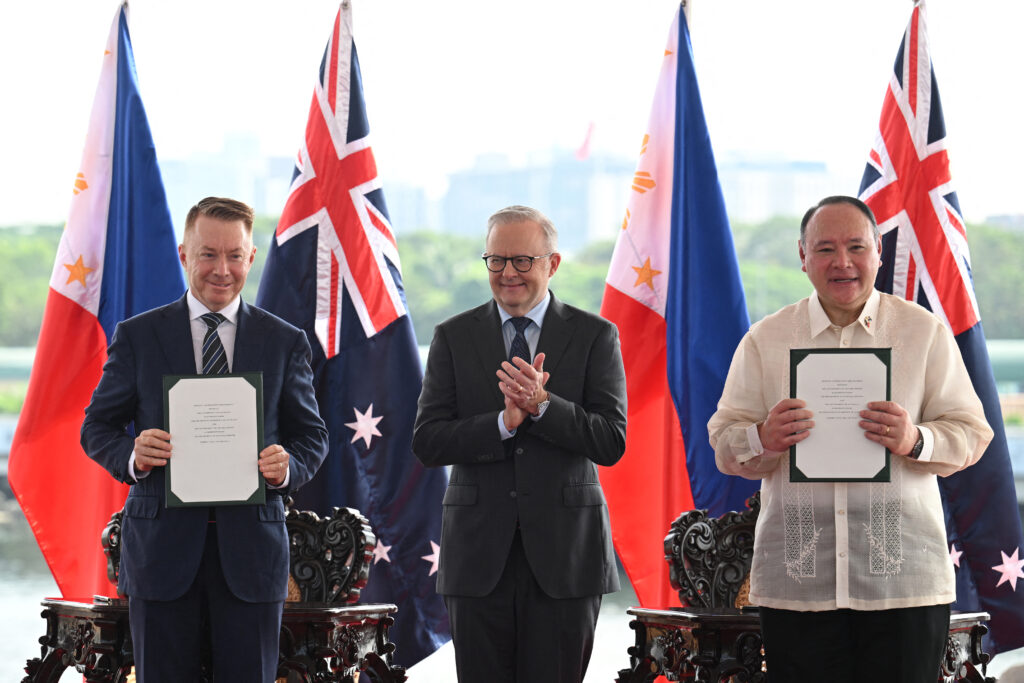
On Sunday, November 15, Australian Prime Minister Anthony Albanese attended the ASEAN Summit in Manila, where he witnessed the signing of the Australia–Philippines Defence Cooperation Arrangement. The agreement was signed by Marc Innes-Brown, the Australian Ambassador to the Philippines, and Gilberto Teodoro, the Philippine Secretary of National Defense, representing both nations.
This arrangement updates the Defence Cooperation Memorandum of Understanding that the two countries signed in 1995, providing a new framework for prioritized areas of collaboration. Key focuses of this initiative include enhancing maritime situational awareness, joint maritime operations, information sharing, strategic dialogue, planning, joint training, interoperability of forces, and development of defense infrastructure.
During a press conference, Teodoro expressed that this new arrangement would pave the way for closer cooperation among the maritime, aerial, and ground forces of both countries, as well as in humanitarian assistance and disaster response sectors. He noted that it would help fortify the Philippines’ “credible deterrence posture” in its territorial waters, including the South China Sea. The agreement aims to streamline coordination procedures, facilitating the smoother implementation of the Status of Visiting Forces Agreement (SOVFA).
In addition to the defense cooperation arrangement, Albanese also announced an increase in Australia’s investment in the Southeast Asia Maritime Partnerships. This initiative aims to support regional partners in enhancing maritime situational awareness and cyber resilience. It includes provisions for delivering aerial and surface drones, secure communication support, and operator training to improve detection and response capabilities against maritime and cyber security threats. The Australian government pointed out that this agreement coincides with the 80th anniversary of diplomatic relations between Australia and the Philippines, reflecting the maturity of their defense relations.
The defense relationship between Australia and the Philippines has deep historical roots. During World War II in 1942, the then President of the Philippines, Manuel Quezon, and his government relocated to Australia, which later provided crucial support for the Allied operations to liberate the Philippines. Formal diplomatic relations were established between Australia and the Philippines in 1946.
While Teodoro, Albanese, and Australian Deputy Prime Minister and Minister of Defence Richard Marles did not directly mention China in their public statements regarding the agreement, analysis from media outlets such as Reuters suggests that this move occurs against the backdrop of China’s continuous military presence in the South China Sea and ongoing maritime tensions between the Philippines and China. This reflects Manila’s proactive strategy to expand its security partnership network in response to regional challenges.
The Philippines has a Mutual Defense Treaty with the United States and has signed the Visiting Forces Agreement (VFA) as well as the Enhanced Defense Cooperation Agreement (EDCA), which allow greater U.S. military rotations and pre-positioning of equipment at bases in the Philippines. Furthermore, in 2024, the Philippines will sign a Reciprocal Access Agreement with Japan to facilitate mutual visits and joint training between their forces.
Both Australia and the United States are members of the ANZUS security treaty and are advancing cooperation in nuclear-powered submarines and advanced technologies through the AUKUS trilateral security pact with the United Kingdom.
In this context, the newly signed Defence Cooperation Arrangement between the Philippines and Australia can be viewed as a step forward in aligning security cooperation networks, complementing their existing agreements with the United States, Japan, and other nations. This collaborative effort underscores a collective commitment to regional security and stability amidst evolving geopolitical dynamics.