
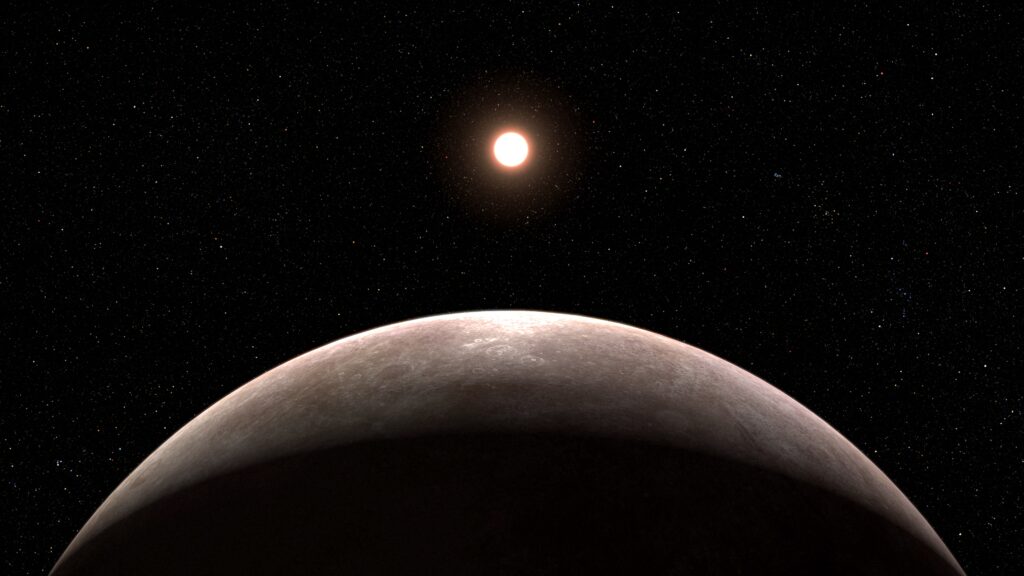
Astronomers have been observing a massive exoplanet for an extensive period of seven years, only to find that they can no longer detect it. Interestingly, the planet has not truly vanished; rather, it has been rendered invisible from telescopes due to the gravitational influence of an adjacent, unseen planet that has caused its orbital tilt. This phenomenon marks the first-ever recorded instance of a “disappearing planet.”
A press release from the University of California, Los Angeles (UCLA) on November 9 highlighted that the planet, designated TOI-2535 b, is located approximately 1,000 light-years from Earth. It is classified as a “hot Jupiter,” a type of gas giant that orbits very closely to its host star.
TOI-2535 b completes an orbit around its star, named TOI-2535, in a mere 8.25 days, which is nearly ten times faster than Mercury’s orbital period of 88 days around the Sun.
The research team led by UCLA discovered TOI-2535 b in 2019 using NASA’s Transiting Exoplanet Survey Satellite (TESS) and continued to monitor its movements until March 2026. During these seven years, they observed multiple transits of TOI-2535 b, where the planet passed in front of its host star. However, they eventually lost sight of it completely. Contrary to assumptions that it disappeared, astronomers determined that the planet’s orbital displacement was due to the gravitational pull from a neighboring planet.
Through careful monitoring, researchers noted that the transits of TOI-2535 b were not as consistent as those of most other exoplanets. Instead, they exhibited significant variations, arriving up to six hours earlier or later than predicted. Over the years, these transits became increasingly shorter and shallower, ultimately fading altogether by 2026.
These observations suggest that TOI-2535 b is being perturbed by the gravitational attraction of a “hidden” neighbor. The orbital pattern of this neighboring planet is misaligned with that of TOI-2535 b, leading to complex interactions between the two bodies that cause their orbits to wobble, much like spinning tops. This orbital shifting has moved them out of the observational range of TESS, resulting in the disappearance of the transits. This discovery represents the first documented exoplanet that has vanished from view.
Researchers anticipate that TOI-2535 b may reappear in transit within the next 30 to 50 years, while the neighboring planet may reveal its presence even sooner, as its orbit aligns back within the telescopic field of vision.
To date, astronomers have identified hundreds of hot Jupiters, yet typically, there are no substantial neighboring bodies nearby that could impact their orbits. The mechanisms underlying how these hot Jupiters migrate closer to their stars remain topics of discussion within the scientific community, with two primary theories emerging.
The first theory posits that planets may enter elliptical orbits due to dramatic events, subsequently being drawn inward by gravitational interactions with their star. The second theory suggests that these planets migrate toward the star alongside others within a protoplanetary disk, which would result in a relatively flat planetary system where the orbits of its planets are not inclined.
The wobbling exhibited by TOI-2535 b indicates that interactions among celestial bodies within the system may have influenced the orbital incline of the planet. Researchers propose that due to the influence of its neighboring planet, TOI-2535 b likely migrated inward through a slow, spiral process rather than being abruptly thrust into the system’s inner region. This mechanism, though not commonly observed, presents a fascinating perspective on planetary formation.
The findings from this research have been published in The Astrophysical Journal Letters, providing insights into the dynamics that govern planetary behavior in distant star systems.