
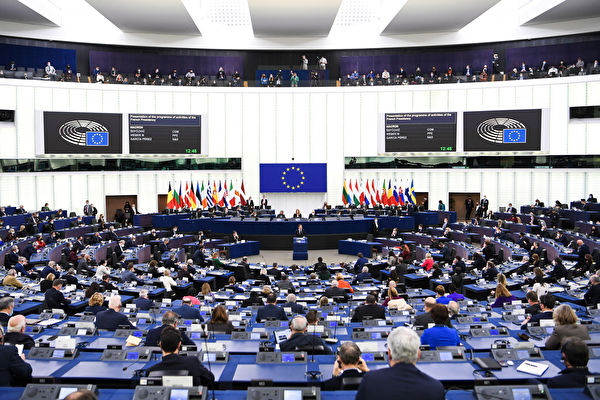
In recent weeks, at least three Czech members of the European Parliament have experienced various disputes with the Chinese Communist Party (CCP). Notably, one of the parliamentarians, who serves as the vice chair of the European Parliament’s China Affairs Subcommittee, was detained for one and a half hours upon her arrival in Beijing and has since demanded an explanation from the Chinese authorities. Another member condemned the CCP’s interference in European Parliament activities after receiving a protest letter from China due to his visit to Taiwan. The third parliamentarian criticized China’s deliberate attempt to manipulate information by attributing statements he never made to him.
According to reports from the Czech News Agency (ČTK), the three officials involved are Markéta Gregorová, Ondřej Krutílek, and Tomáš Zdechovský. They believe that these incidents reflect the various methods the CCP employs to pressure European lawmakers.
At the end of October, when a 15-member European Parliament delegation arrived in Beijing, Gregorová was the only member who was halted during border checks by Chinese authorities. She reported that officials refused to provide an explanation for her detention and prohibited her from using her mobile phone. Despite presenting her diplomatic passport and an official invitation, she was held for about an hour at a passport control area and then spent an additional 30 minutes in a room where several police officers were present.
“Even now, I still do not know the reason,” Gregorová stated in a recent media interview. She speculated that the incident might be related to a case involving a Chinese national accused of espionage in the Czech Republic, who was on trial while she was visiting China. However, she has yet to confirm any direct connection between the two events.
Currently, Gregorová is demanding an explanation from the Chinese government and plans to report the incident to the leadership of the European Parliament.
As the vice chair of the European Parliament’s China Affairs Subcommittee, Gregorová visited Beijing as a member of the delegation focused on EU-China trade negotiations. Prior to this visit, the EU Trade Commissioner Maroš Šefčovič had engaged in discussions with Chinese officials.
Another European Parliament member, Krutílek, visited Taiwan with the European delegation at the end of October. On the day he was set to return to Europe, he received a protest letter from the Chinese delegation to the EU, vehemently opposed to his Taiwanese itinerary. Other European parliamentarians also received similar letters.
The Chinese delegation insisted that Krutílek adhere to the “One China Principle” and cease any official contact with Taiwanese authorities.
In response, Krutílek stated that he was not surprised by the protest, explaining that Beijing has long pressured politicians who maintain contacts with Taiwan. He further expressed, “The Chinese Communist Party has no right to intimidate members of the European Parliament or interfere in their parliamentary activities.” He asserted that this represents a systematic effort by Beijing to prevent European politicians from collaborating with Taiwan and that other European lawmakers should not yield to such pressures.
This Czech member of the European Parliament believes that while the EU should remain open to pragmatic dialogue with Beijing, this in no way necessitates compromising on the development of ties with Taiwan. He highlighted that experiences from the Czech Republic indicate that collaboration with Taiwan has fostered investment and job opportunities, whereas promises made by Beijing in this regard have largely gone unfulfilled.
Meanwhile, Zdechovský criticized the Chinese state media outlets, such as China Global Television Network (CGTN) and China Radio International (CRI), for misusing his name. They attributed statements made by another European Parliament member, Ondřej Dostál, to him, leading to misconceptions that he praised Chinese digital technology and urban governance methods. This content was subsequently circulated on social media.
Dostál represents the Czech extreme left party “Enough!” (Stacilo!) and had attended a forum in Beijing in October.
Zdechovský views the actions of the Chinese state media as deliberate misinformation rather than a mere mistake. He plans to raise this issue within the European Parliament’s Committee on Civil Liberties, Justice and Home Affairs (LIBE) and address it to the European Commission through formal inquiries.
“I find it completely unacceptable that Chinese state media would misuse my name and attribute comments I never made to me. I personally don’t believe this was just a coincidence or an unintended editorial error,” he remarked. “I see this whole incident as part of the CCP’s broader strategy to influence the information space in Europe. For this reason, the EU must address this issue.”
He has also taken steps to raise this matter with the Chinese Embassy in Prague.