
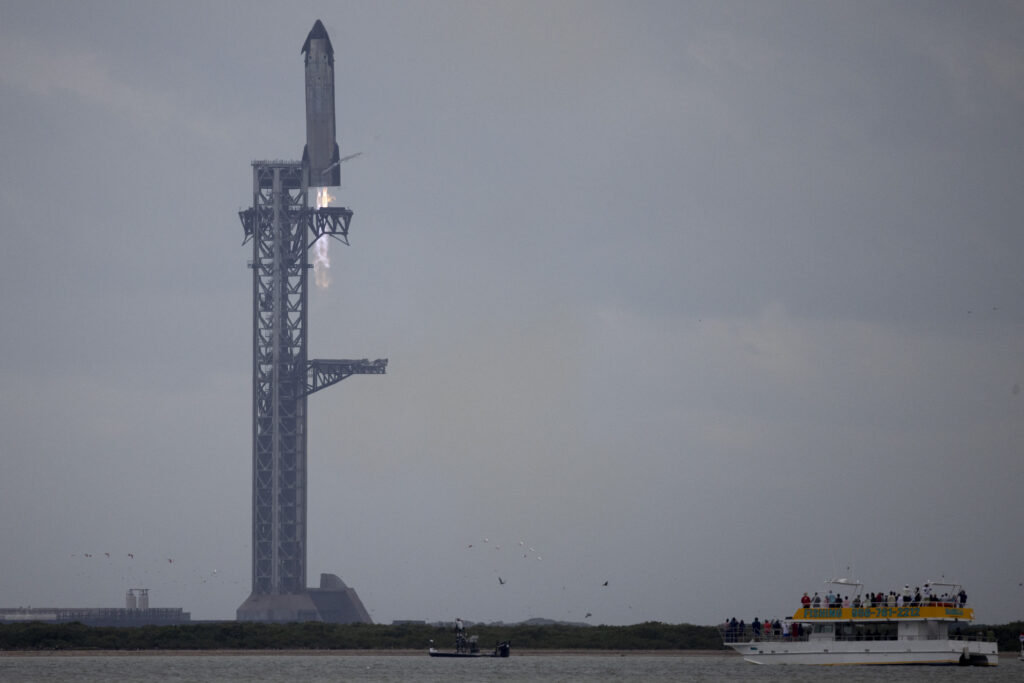
On Saturday, November 14, SpaceX’s “Starship” spacecraft made a historic landing, deftly descending onto its launch tower and being successfully captured by its recovery system nicknamed “Chopsticks.” This remarkable feat marks a significant milestone in the annals of human space exploration.
This launch was the 15th test flight of the Starship program. The spacecraft lifted off at 5:47 PM Eastern Time on Friday, November 13.
At the time of the launch, the Federal Aviation Administration (FAA) had issued a nationwide ground stop order. However, the tracking and navigation systems utilized by the rocket differ from those used in commercial aviation, allowing the launch to proceed without interruption.
After spending nearly a full day in space, the spacecraft re-entered the atmosphere and detached from its orbital trajectory around 3:23 PM Eastern Time on the 14th.
Approximately at 4:20 PM, the nearly 171-foot-tall (about 52 meters) vehicle perfectly landed upright between the two mechanical arms of the launch tower, known colloquially as “Mechazilla,” which are referred to as “Chopsticks.”
This operation marks the first occasion in history that a rocket’s upper stage has returned safely and upright from orbit. The technological advancements achieved here could pave the way for the reusability of spacecraft, allowing for multiple flights and significantly reduced costs.
According to Lars Blackmore, SpaceX’s senior engineer for Mars landings, the challenge in the aerospace sector typically involves the separation of rockets from spacecraft. He elaborated that, traditionally, a second-stage rocket is responsible for propelling a spacecraft into orbit, while the spacecraft itself ultimately returns to Earth via parachutes. This often results in the costly second-stage rocket burning up or crashing into the ocean after each use, as historically, no upper stage has been designed for reusability. The Starship, however, consolidates both roles, functioning as both an interplanetary vessel capable of carrying satellites and crew members, and as its own second-stage rocket.
After the launch, SpaceX attempted to guide the “Super Heavy” booster in for a precise landing on the launch tower but was unable to do so. Instead, the booster was allowed to splash down into the Gulf of Mexico.
Meanwhile, the Starship successfully achieved orbit and deployed several Starlink internet satellites. The spacecraft was scheduled to orbit the Earth 14 times before landing, and the entire mission spanned approximately 22 hours.
While returning to the launch tower, the spacecraft needed to navigate over densely populated areas in Texas and Mexico, passing over popular tourist locations just north of South Padre Island. Interestingly, the landing site “Mechazilla” was situated less than five miles (about eight kilometers) from the closest observers.
Prior to the flight, SpaceX engineers had repeatedly assured the public that all necessary safety risks had been carefully considered, and the company was prepared to abort recovery attempts if any issues arose, affirming that flight controllers would act conservatively.
As stated on SpaceX’s official website, during re-entry, the spacecraft could adjust its flight path using movable external fins to maintain a predictable and safe trajectory, heading towards the Starship landing site. These fins also enable the spacecraft to make minor course corrections, specifically targeted to traverse areas with sparse populations in northern Mexico and southern Texas.
SpaceX emphasized that during re-entry, flight controllers have various options available, including allowing the spacecraft to roll deliberately, which would cause it to disintegrate in the atmosphere before reaching land. If any system malfunctions occurred post-re-entry, preventing secure recovery at the landing site, the spacecraft could instead navigate towards the Gulf of Mexico.
As it entered the dense layers of the atmosphere, the spacecraft was traveling at speeds exceeding 17,000 miles per hour (approximately 27,000 kilometers per hour). This extreme velocity resulted in air particles being torn apart on a molecular level, creating a layer of superheated plasma on the spacecraft’s surface, with temperatures soaring above 2,500 degrees Fahrenheit (about 1,370 degrees Celsius).
The Starship is equipped with thousands of hexagonal heat shield tiles that form its thermal protection system, preventing the vehicle from melting during re-entry. Phil Wilson, the senior manager for thermal protection hardware at SpaceX, explained that the heat load during re-entry can be visualized akin to a river; if the heat impacts vertically, the heat shield tiles could be eroded away. However, if the heat flows along the surface of the spacecraft, it will not damage the coating of the tiles in time to prevent their protective function.
These innovations represent a significant leap forward in the design and functionality of spacecraft, emphasizing SpaceX’s commitment to reducing the costs of space travel while enhancing safety and reliability for future missions.