
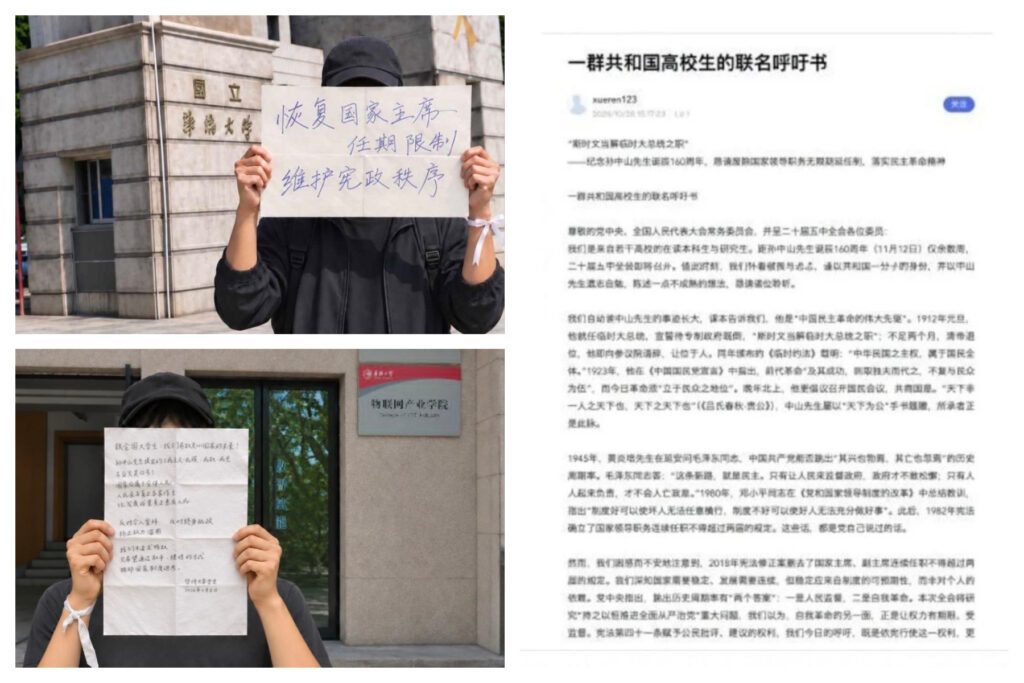
In the aftermath of the 20th National Congress of the Communist Party of China, social media reports have surfaced suggesting that students from overseas Chinese universities are calling for a revival of the “White Paper Movement.” This movement seeks to oppose the unlimited term of the President and advocate for democracy while challenging dictatorship. A source familiar with the situation confirmed this development, though the details are still pending further verification.
On November 13, images began circulating on overseas social media platforms showing students from the Overseas Chinese University holding blank sheets of paper against the backdrop of their campus. These students are calling for the restoration of presidential term limits and the maintenance of constitutional order, urging their fellow university students nationwide to take action against personality cults and other issues.
The Overseas Chinese University, which is directly administered by the United Front Work Department of the Chinese Communist Party, is witnessing a surprising emergence of student expression.
This indicates that young people are not indifferent to political matters nor are they lacking in judgment. They simply wish to ask: Why shouldn’t there be term limits for the President? Why can’t power have boundaries?
A blank sheet of paper, with a few lines of handwritten text, may not seem revolutionary, yet it is enough to cause unease among certain authorities.
“Support those brave students who dare to express themselves! Carry the blank paper and wear a white scarf!” proclaimed a tweet from Yunxiao Han on November 12.
While some online users have questioned the authenticity of the photos, activist Li Shangkai, now in Australia, informed that several students from the Overseas Chinese University had recently, during a quiet period on campus, raised sheets of paper inscribed with their demands while tying white scarves around their hands to express silent protest. He mentioned having communication with one participating student, identified as Zhang Jun (a pseudonym), and showed chat records confirming their actions.
Previously, on October 26, the opening day of the Communist Party’s Fifth Plenary Session, an open letter purportedly signed by students from various universities in China circulated online demanding the abolishment of the practice of unlimited presidential terms.
This letter invoked the oath made by Sun Yat-sen when he assumed the position of Provisional President in 1912, which emphasized the idea that “the world belongs to all.” The document named several universities, including Peking University, Renmin University of China, Tongji University, Xi’an Jiaotong University, Xiamen University, and Nankai University, among others, indicating that the petition was “still ongoing,” but it did not provide any personal signatures or proof of endorsement.
However, investigations revealed that the website hosting this petition, “Siyuan Lake BBS,” utilized servers based in Tencent Cloud’s data center in Seoul, South Korea. Thus, verification of the claims inside this incident remains unconfirmed.
In dialogue with Li Shangkai, Zhang Jun mentioned that they first encountered the call to action initiated by students at Peking University, which quickly sparked discussions at the Overseas Chinese University. Actions taken by authorities concerning their movements had instilled considerable pressure on the students, who felt they should not be subjected to such treatment by the government.
“We hope that by responding to this initiative from Peking University, we can reignite the White Paper Movement and encourage college students nationwide to join us in expressing our demands on blank sheets of paper. We want to take photos with white scarves tied around our arms,” Zhang Jun expressed during their conversation.
The Overseas Chinese University, located in Quanzhou and Xiamen in Fujian Province, is overseen by the United Front Work Department of the Communist Party. The institution has historically attracted students from Taiwan, Hong Kong, Macau, and Southeast Asia, but most of its student body comprises students from mainland China.
November 12 marks the 160th anniversary of Sun Yat-sen’s birth, an occasion that was ceremoniously commemorated by the Communist Party.
Li Shangkai noted that Zhang Jun voiced their determination to participate in this activity. “We want to awaken the Chinese people on the anniversary of Sun Yat-sen. We demand democracy, not a dictatorial government. We hope our voices can be heard outside, and we wish all university students across the country can bravely stand up, write down their demands, and tie white scarves to make China better.”
The circumstances surrounding the actions of the Overseas Chinese University students in raising blank papers to express their demands still await further verification.
Exiled Chinese democracy activist Jie Lijian commented that “the Overseas Chinese University is one of the schools where the Chinese government conducts particular ideologically driven education, falling under the supervision of the Communist Party’s United Front Work Department. These students have chosen to speak out and take action within such an educational system, whether by holding slogans or by penning their own declarations, putting themselves at considerable risk. They are aware of the potential repercussions of their actions, yet they still choose to proceed.”
“They chose to act on the anniversary of Sun Yat-sen’s birth to hope that the principles of the Three People’s Principles can continue to spread in China, ultimately overthrowing the ghostly rule of dictatorial communism.”
“The current consciousness awakening among many young people in mainland China is quite intense. Many are now accessing information beyond the Great Firewall, and after the pandemic, certain schools have started randomly checking students’ mobile phones out of fear that students might learn the facts about the various crimes committed by the Communist Party. This illustrates that the Communist Party is, indeed, very afraid of the awakening among young people and students,” he emphasized.