
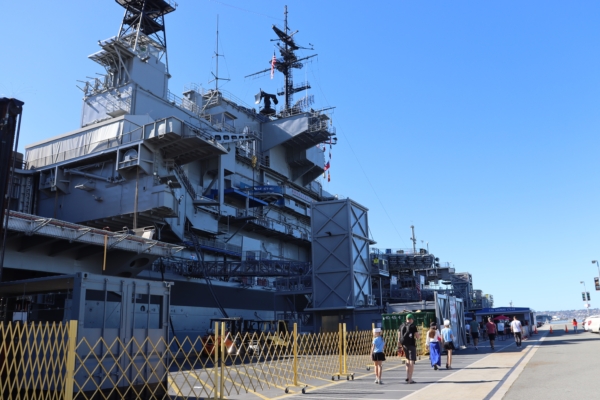
On November 11, 2026, to celebrate Veterans Day, the USS Midway Museum opened its doors for an incredible experience. Visitors were treated to a variety of activities, including the opportunity to converse with Navy pilots who served on this iconic aircraft carrier for nearly 20 years, listen to their scheduled talks, and get up close with various fighter jets. Additionally, attendees could immerse themselves in flight training simulations and tabletop combat demonstrations while enjoying the pleasant weather and refreshments on the deck, all while paying tribute to veterans.
One of the notable figures at the event was retired Navy Commander Nigal Miller, who piloted the F-4 Phantom fighter jet during the Vietnam War and operated from the USS Midway. He reminisced about his time, stating, “At that time, the North Vietnamese forces were flying Soviet-made aircraft. Our primary mission was to defend against enemy fighter attacks to protect our bomber groups.”
Miller recalled the rigorous training he underwent that mirrored the intense experiences depicted in the film “Top Gun.” In his first month in Vietnam, he shot down five enemy aircraft while suffering no losses. Joining the Navy in 1958, he became a naval aviator due to a pressing need for personnel, although candidates had to be university students. He earned his wings in 1961, embarking on a remarkable flying career that lasted two decades.
“The most challenging part of flying operations on the aircraft carrier was landing during nighttime or inclement weather; it was extremely demanding and stressful,” Miller explained. “During the day, you can keep your eyes on reference points, with the horizon being the best. But at night, you can’t see anything, and you must focus entirely on the instrument panel to control the aircraft.”
Miller noted that the difficulty did not stem from the short landing distance but from the lack of visibility—though it was much better on full moon nights. With personnel on board to guide them, pilots would receive instructions on navigating through clouds and aligning with the landing area. “I wouldn’t even look outside until someone said, ‘You’re three-quarters of a mile from the carrier,’ at which point I’d check the ball—a signal light system crucial for landing. We referred to it as the ‘meatball,’ which indicates where the aircraft should be positioned.”
Today, modern fighter jets can utilize an “autopilot” mode that assists with safe landings, especially during nighttime. However, Miller prefers manual control, stressing the importance of visual targeting. “You should only enable autopilot after developing proficient manual flying skills.”
Miller explained that the F-4 Phantom was among the primary fighter aircraft used in Vietnam. He described how, underneath the plane, six missiles were carried, including the Sidewinder—an infrared homing short-range missile that autonomously targets enemy aircraft after launch—and the Sparrow, a longer-range missile that required the pilot to maintain a lock on the target until impact.
The USS Midway housed 74 aircraft in total, with about 50 on the upper flight deck and the remaining on the lower level. Elevators were used to transport planes to the lower deck for maintenance. Unlike now, when we see enclosures at museums, the active-duty carrier did not have these barriers.
Mark, a veteran with 21 years of service in the Navy, explained, “The USS Midway was built for World War II and named after that famous battle, but it didn’t officially enter service until a week after the war ended. It was classified as a ‘straight-deck’ carrier by wartime standards.” Pilots were required to lower their flaps, engage the tailhook, and catch the arrestor wires upon landing; a secondary line of small obstacles was also built to ensure that planes would come to a stop.
Following the war, the Midway underwent modifications, including the addition of an angled deck. It featured three arrestor wires, each measuring 100 feet long, coiled to connect to a power system below (the arrestor engine). Regardless of the aircraft type, the objective was to stop the plane after a landing run of 340 feet.
Mark humorously noted that when the arrestor cable wore out and could not be replaced in time, they would use a bundle of soft tissues for support, emphasizing that even if they accidentally got sucked into the jet’s engine, they would not cause any damage.
He further added that even today, all aircraft carriers require winds of 25 to 30 knots across the deck for safe takeoffs and landings. If it were a day with a 16-knot breeze, the carrier would turn to face the wind as the aircraft was about to land, with the carrier’s propulsion system supplementing the remaining 14 knots.
As planes approach the carrier, they typically maintain an altitude of 800 feet, flying at speeds between 350 and 450 miles per hour. They execute a maneuver known as the “carrier break” at the bow of the ship, slowing down in a wide arc to align with the landing area at the rear of the carrier, about three-quarters of a mile away. During this critical moment, radio communication typically goes like this: “Aircraft 101, Phantom, Ball, 4.0,” which indicates the aircraft number, type, landing light system, and fuel status.
Pilots must continually adjust three factors: align with the centerline, control their angle of attack, and manage descent rate. Personnel dressed in different colored vests on deck signal instructions and track the pilot’s moves from approach to landing, scoring their performance along the way. “For pilots, earning a good landing score is a point of immense pride,” Mark noted.
From spotting the “ball” to landing, there are merely 15 to 20 seconds, during which a pilot may make up to 300 corrections. The landing area is only 80 feet wide, roughly the size of a tennis court. Mark piloted an E-2C Hawkeye with a wingspan of 80 feet 6 inches, leaving very little room for error, and any deviation could lead to a collision with parked aircraft on the deck.
“On sunny days with calm winds, it feels fantastic! However, in reality, landing can result in intense vibrations on the deck,” Mark explained. Upon touching down, immediate throttle application is essential to prevent the tailhook from missing the arrestor wire, requiring the pilot to climb back up and attempt again.
Once the aircraft comes to a stop, the pilot looks out the right side window for the deck crew members in yellow vests. They issue commands: release the brakes, retract the tailhook, and fold the wings—because another aircraft is scheduled to land at the same spot in just 45 seconds. Meanwhile, they also look for ground crew in green vests; if the aircraft is in good condition, they will refuel and rearm it, preparing it to take off again.