
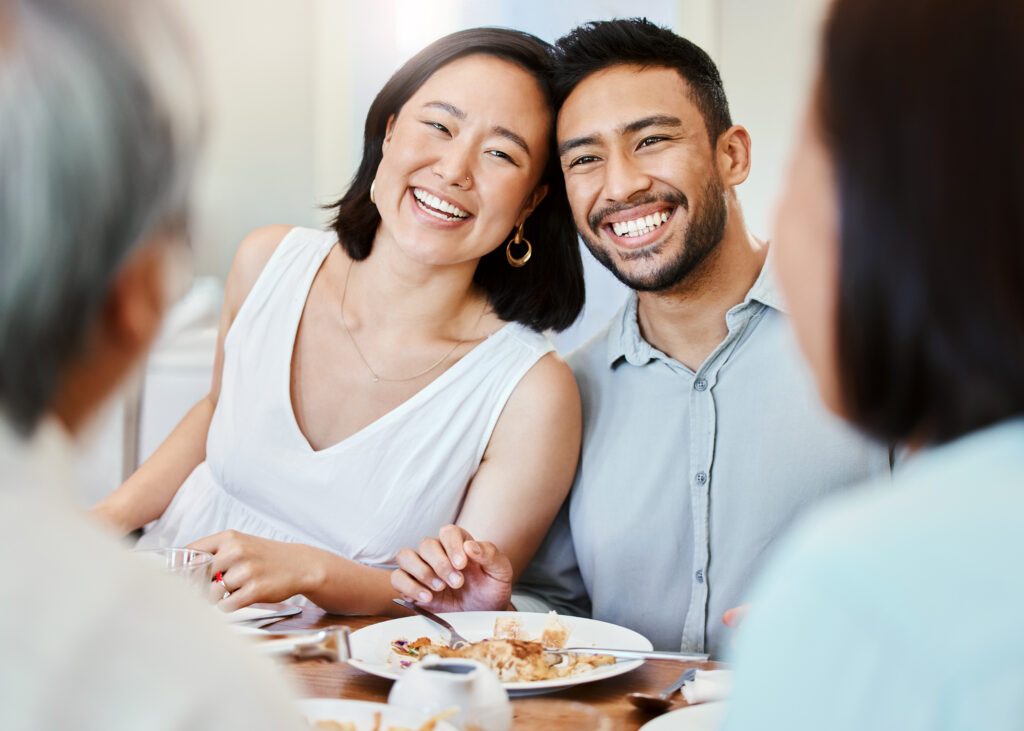
As the holiday season approaches, it may be the perfect time to slow down and enjoy quality meals with friends and family. Research indicates that sharing meals with others not only enhances interpersonal relationships and increases feelings of happiness, but it also has tangible health benefits, such as lowering blood sugar levels.
When you savor a piece of chocolate with another person, you’re likely to enjoy the flavor more than if you were indulging alone.
A study published in the journal *Psychological Science* in 2014 confirmed this phenomenon. The study’s author, Erica Boothby, a clinical professor of organizational behavior at Dartmouth College’s Tuck School of Business, stated in an interview that “sharing amplifies our experience.”
This research highlights the profound impact of dining together. Whether it’s breakfast, lunch, or dinner, sharing a meal with others goes beyond mere sustenance; it holds deeper significance in our lives.
Historically, communal dining was far more prevalent among societies. In contrast, modern eating habits have undergone significant changes. Nowadays, people often struggle to carve out time for meals amidst their packed schedules. It is not uncommon to find individuals hurriedly eating alone at their desks or standing by the kitchen counter.
However, recent studies suggest that regularly dining with others can enhance well-being and may even help stabilize blood sugar levels.
The act of eating and drinking together, scientifically known as “commensality,” fosters social connections and a sense of belonging.
Robin Dunbar, a psychologist and anthropologist at the University of Oxford, has spent years investigating the relationship between social meals and friendships. In a study published in 2017 titled *Breaking Bread: The Functions of Social Eating*, he asserted that from elaborate feasts to everyday meals, shared dining is a universally present behavior among humans.
Dunbar’s cross-sectional survey involving 2,000 adults in the UK revealed that individuals who frequently share meals with others typically report higher levels of happiness and life satisfaction, alongside stronger ties to their communities.
He explained this phenomenon through the workings of the brain. Dining with others triggers the release of endorphins, natural pain relievers that produce feelings of pleasure, improving our mood and strengthening interpersonal relationships.
Furthermore, the laughter, storytelling, singing, and other shared activities that often accompany meals can synergize to increase the release of these feel-good chemicals.
Dunbar also highlighted that close friendships serve as one of the most crucial indicators of physical and mental health, even correlating with longevity. Sharing meals is a pivotal way to build and maintain these friendships.
Interestingly, the conversations at the dinner table do not need to be profound. As Dunbar noted, “The content of the conversation isn’t what’s important; what matters is that there is communication.”
Taking the time to be with someone inherently shows that you value their company.
One of the appealing aspects of communal dining is its ability to slow us down in life.
When eating alone, our attention may drift to our phones or to-do lists, causing us to overlook the flavors and textures of our food.
In contrast, when we are with others, our senses can be reinvigorated: the food before us, the aromas of freshly cooked dishes, the various tastes, and even the sounds of utensils clinking together can all immerse us more deeply in the present moment.
Ciarán Forde, a professor of sensory science and dietary behavior at Wageningen University & Research in the Netherlands, remarked in an interview that “When we dine with friends and family, we naturally tend to slow down our eating pace.”
Forde’s research explores how food texture and eating speed influence metabolic health. His studies consistently find that individuals who eat quickly tend to consume more calories.
When we ingest food at a rapid rate, the brain takes about 20 minutes to signal feelings of fullness. Eating too quickly can lead to lower satiety per calorie consumed, a higher body mass index (BMI), increased body fat, and a greater risk of various cardiometabolic diseases, including heightened risks for diabetes and heart conditions.
Moreover, communal dining may assist the body in processing food in another way as well. Research published in *Science Advances* indicates that participants who shared a standardized carbohydrate meal with others experienced less of a spike in blood sugar and returned to baseline levels more quickly compared to those who dined alone.
Researchers refer to this idea as “social physiology,” suggesting that the presence of others may help individuals more effectively regulate their physiological responses.
While in the company of trusted partners, individuals may experience increased oxytocin release, decreased cortisol levels, and a calming of the nervous system.
A growing community movement is championing the revival of shared dining experiences.
In New York City, an initiative called “The Longest Table,” co-founded by Maryam Banikarim, emerged during the COVID-19 pandemic. This period of isolation made Banikarim acutely aware of her lack of familiarity with her neighbors. After the pandemic, she aimed to change this reality.
Today, the organization hosts community-driven events in numerous cities and towns across the United States and beyond. Participants gather in public spaces, sometimes reaching numbers of hundreds or even over a thousand.
The initiative follows a simple model: local organizers provide tables and chairs for community meals, while each participant brings food to share with one another.
Banikarim stated, “This event gives neighbors the opportunity to step outside their homes, connect with one another, and gradually rebuild trust within their community.”
She emphasized the necessity of such initiatives.
Preliminary research conducted by Eric Klinenberg, a social sciences professor and director of the Institute for Public Knowledge at New York University, revealed that over 85% of individuals rarely or never sit down to eat with acquaintances or nearby neighbors.
Many people simply lack an invitation.
Each year, Cri Campbell Schine and her family look forward to hosting an open gathering called “Friendsgiving.”
Schine, a psychologist and mental health advocate from California, pointed out that we live in a culture that prizes achievement, efficiency, and constant busyness. People often feel they need a concrete reason to slow down and connect with others.
Thus, she chooses a convenient day outside the busy holiday season to invite friends and family together.
She mentioned, “Thanksgiving reminds us that belonging is something we can create actively.”
“When conversations are not confined to schedules and daily trivialities, we have time to listen, notice one another, and enjoy simply being together.”
She added that the act of inviting has significant value, especially for those who may feel alone or disconnected from society, as it indicates that someone has thought of them and is willing to make space for them.
“One does not need to know what others may be enduring or fully understand their experiences to extend a hand of kindness.”
Regular family dinners can also prove beneficial. According to a 2022 survey by the American Heart Association, 91% of parents reported that family mealtime noticeably reduced stress in the home; 54% of respondents noted that shared meals act as a reminder to slow down and take a momentary break.
Dining together doesn’t always require meticulous planning.
Italian-American Sylvia Farinati recounted a spontaneous gathering with friends in Venice, where they tied their boats together on the Grand Canal. Using an improvised kitchen, they prepared freshly caught fish.
She shared in an interview, “At that moment, no one had organized activities, there was no formal menu, nor did we even give the dinner a formal name.”
Schine commented that this spontaneity captures the essence of communal dining.
She asserted, “Sharing meals can reinforce our sense of belonging. Not every conversation needs to be profound, and not every meal has to be perfect.”