
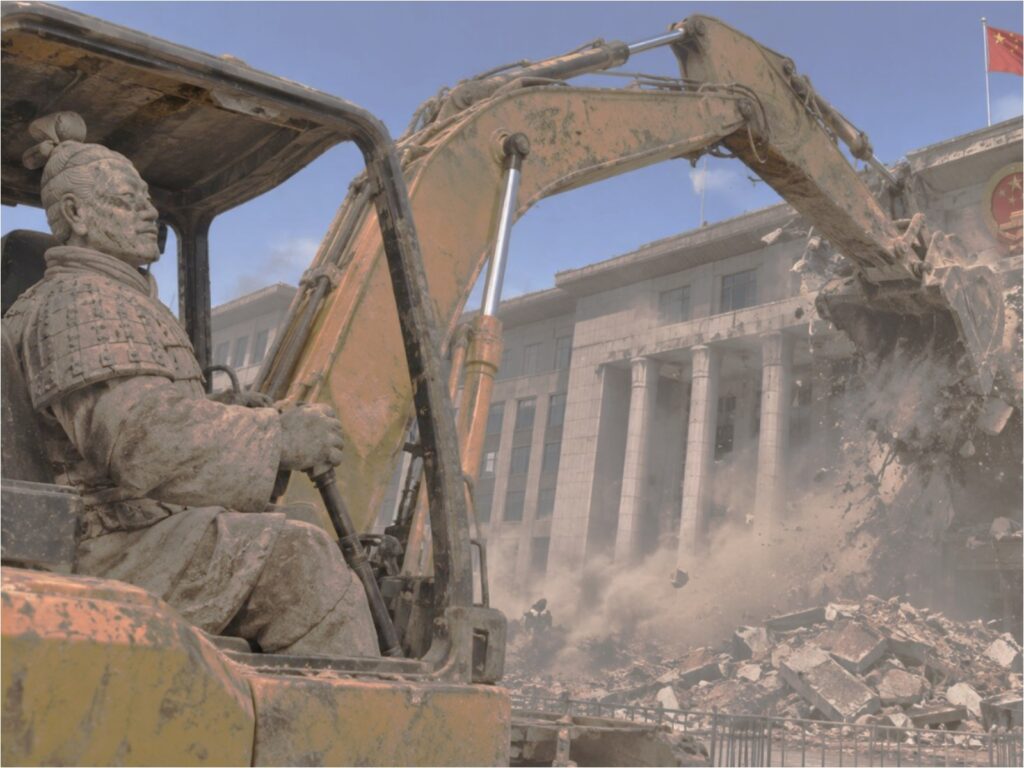
In a recent incident in Xi’an, Shaanxi Province, a man drove an excavator to demolish a government service center as part of a protest over unpaid wages. Following this event on November 9, local internet police reported on November 11 that three individuals were penalized for using AI technology to create synthesized videos related to the incident. The authorities highlighted that the videos in question included blatantly fictional and satirical elements, such as scenes depicting the Terracotta Warriors operating an excavator. This designation of the videos as “rumors” has provoked significant backlash from netizens, who are questioning the government’s heavy-handed approach and their commitment to free speech.
The protest occurred in the Fengdong New City area of the Xixian New District in Xi’an, where an ordinary citizen took matters into his own hands by using an excavator to forcefully tear down the entrance of the government service center. This dramatic act was purportedly driven by frustration over unresolved wage disputes.
In the wake of the incident, the Xi’an internet police issued statements claiming that certain individuals were capitalizing on this event to “fabricate and disseminate false information” in order to garner attention and traffic. One individual, identified as Chen, created a video using AI technology that featured an excavator being operated by the Terracotta Warriors, which gained approximately 13,000 views. As a result, he faced administrative detention. Another individual, Zhao, produced a video falsely depicting damage to other government facilities caused by excavators, which attracted over 1,000 views, leading to a monetary fine. A third individual, Ren, was reprimanded for sharing an AI-generated video of an excavator damaging unrelated office spaces; he was ordered to delete the post and received a warning.
The online response to these punitive actions was swift and vehement, with many users expressing skepticism regarding the government’s justifications. Numerous netizens took to social media to argue that the AI-generated content was clearly a humorous satire of recent events. Comments flooded in questioning the authorities’ decision to label such creations as “rumor-mongering,” with messages like, “Isn’t this a satire of what happened just a few days ago? How can this be classified as spreading rumors?” and “It seems even the idea of the ancestors coming to life is something to be feared.” Additionally, some users lamented the excessive sensitivity displayed by the government, stating, “Why does the Chinese government feel threatened by just 13,000 views expressing an opinion? It seems like any excuse will do to impose penalties,” and, “Critiques and satire being labeled as rumors feels reminiscent of the Cultural Revolution.”
As the discourse continues online, the incident serves as a reflection of the growing tensions between state oversight and the public’s right to free expression in China. The contrasting sentiments highlight a society grappling with its relationship to authority, as individuals seek to voice their frustrations through various forms of expression, including satire, even under the threat of government backlash.