
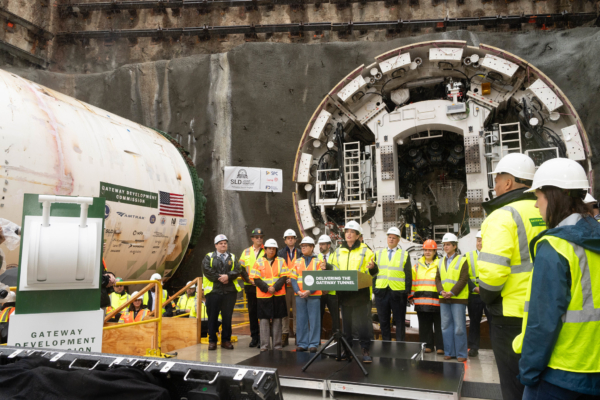
The Hudson Tunnel project connecting New York and New Jersey officially began excavation on September 28th. The massive tunnel boring machine, weighing over 1,680 tons, was launched from the New Jersey side, starting to cut through the rock formations of the Palisades region, progressing towards the Hudson River and New York. This marks the beginning of the large-scale excavation phase for the new railroad tunnel that has been planned for over a decade.
The Hudson Tunnel project aims to construct a new dual-tube railroad tunnel between New York and New Jersey. Once the new tunnel is operational, the existing North River Tunnel will undergo renovations. The old tunnel, in use since 1910, has surpassed a century and serves as a crucial passageway for Amtrak and NJ Transit trains entering and exiting New York, with approximately 200,000 passengers using it daily.
On the day of the launch ceremony, New York Governor Hochul and New Jersey Governor Sherrill, among others, attended the event in North Bergen, New Jersey. The Gateway Development Commission, responsible for the project, stated that this is the first new railroad tunnel under the Hudson River in over a hundred years.
The initial two tunnel boring machines will start from North Bergen, drilling through approximately 5,100 feet of hard rock to reach a shaft in Hudson County’s Weehawken. The machines are expected to advance an average of about 30 feet per day, with this segment anticipated to be completed in about a year.
These two “underground giants” have a cutterhead diameter of 28 feet 8 inches, with the entire equipment extending around 500 feet and weighing over 1,680 tons each. Tunnel boring machines are large construction machinery used to excavate tunnels, passageways, or underground spaces. They crush rock or soil while transporting the excavated material, and some models can simultaneously install tunnel support structures. The enormous rotating cutterhead breaks the rock ahead, as the machine advances and lines the tunnel walls.
The current excavation has not yet reached the bottom of the Hudson River. Once the two machines reach Weehawken, they will be hoisted out, and another two tunnel boring machines will continue the excavation towards Manhattan.
The existing North River Tunnel experienced saltwater inundation during Hurricane Sandy in 2012, causing continuous erosion of concrete and electrical equipment. Cross-river trains heavily rely on this century-old tunnel, and if one tube is out of service, rail capacity to and from New York will significantly decrease. The completion of the new tunnel and the renovation of the old tunnel will enhance the transportation capacity and reliability of the cross-Hudson River trains for Amtrak and NJ Transit.