
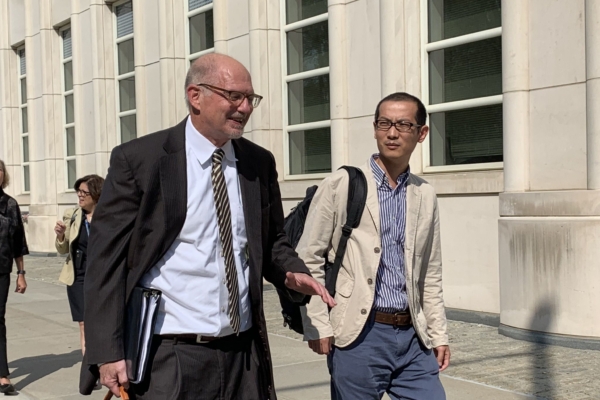
The ongoing Huawei criminal case trial in the US has shifted its focus to the commercial secrets of CNEX Labs, a Silicon Valley storage technology startup. Testifying on the 18th, former CNEX employee Kenny Coker stated that a circuit board provided by CNEX to Chinese Xiamen University professor Bo Mao for research testing had shown signs of warping and deformation upon being sent back to the US, with some key components appearing to have been tampered with.
Coker, who worked at CNEX from 2017 to 2020 as Vice President of Systems Engineering and Solid State Drive (SSD) technology, explained to the jury that the circuit board was a core component of the company’s cutting-edge data storage technology. The ASIC controller at its center acted as a miniature computer housing many of CNEX’s innovative technologies, while the JTAG interface connected to the ASIC contained internal design information.
The chips used on this circuit board were not publicly available at the time and were only provided by CNEX to specific clients through private consultations. Coker mentioned that while CNEX had showcased the circuit board externally to demonstrate the advantages of its open SSD technology, the company was not overly concerned about individuals taking front-facing photos as it wouldn’t necessarily reveal the complete design.
He emphasized the real concern lay in someone obtaining images of both sides of the circuit board simultaneously, as this could reveal the complete component configuration, providing insights into CNEX’s technological capabilities and how much research and development effort competitors would need to produce similar products.
Coker disclosed that after CNEX provided a circuit board for research and testing to Professor Bo Mao at Xiamen University, anomalies were discovered upon its return. The most visibly damaged area was the JTAG connection region, directly associated with the ASIC controller carrying CNEX’s core design.
Examiners found that some resistors on the connectors had been removed, and traces of heated and secured wires were left on the circuit board. Based on what he knew, these alterations did not match the original structure of the circuit board.
During his testimony, Coker provided another insight related to Huawei. Around 2016, while working as a Senior Development Manager at Micron, discussions took place between Micron and Huawei regarding a joint storage product development. A confidentiality agreement was signed, with Micron set to provide the SSD for the product.
At one of the meetings, an encounter with Carlos, a representative from Huawei’s San Jose office, was interrupted by around five to six Huawei engineers from China, catching Micron off guard. The engineers began questioning specific details related to SSD development, unrelated to the ongoing joint development project, but concerning topics such as error handling, engineer configurations, and SSD longevity.
These details were exclusive to Micron and highly valuable for designing competitive HDDs. Stephanie Woodbury, Coker’s superior, felt uncomfortable with the discussion and ultimately halted it.
The upcoming court proceedings for the Huawei case will witness closed-door testimonies from at least three witnesses. On September 18th, the judge approved relevant motions from the prosecution and requested the timely submission of edited trial transcripts post-witness testimonies, with detailed reasons for sealing the transcripts to be disclosed later. This indicates that some subsequent trial content regarding the case will not be publicly disclosed for the time being.