
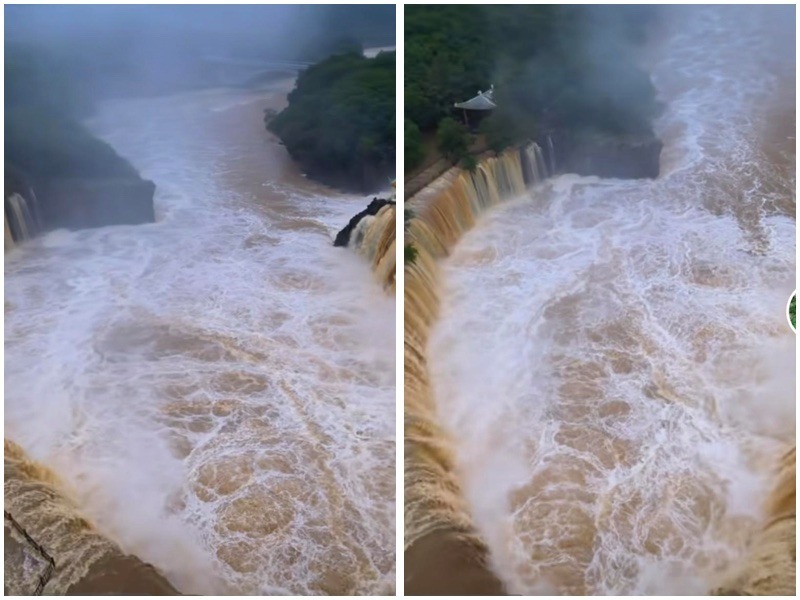
On July 29th, severe flooding occurred in Ning’an City, a subordinate city of Mudanjiang City in Heilongjiang Province, due to the overflowing of Jingbo Lake. The local Xiaoma River bridge was washed away, railway tracks were emptied, villagers’ houses were destroyed, some villages lost contact, and there were power outages, water cuts, and internet disruptions.
According to mainland media reports on the 30th, the Ning’an City Transportation Bureau confirmed for the first time that on the afternoon of July 29th, the Xiaoma River Bridge on G201 National Road was washed away by floodwaters, with a 50-meter section of the bridge collapsing.
Officials claimed that traffic control was implemented on the bridge at around 2:30 pm, and the bridge was washed away around 3 pm. It wasn’t until 4:35 pm that the Ning’an City Highway Maintenance Center issued collapse and detour alerts.
In addition to the Xiaoma River Bridge, many other roads in the area were damaged and disrupted by the floodwaters.
Officials and state media explained that the bridge collapse was caused by the sudden rise in river water levels due to heavy rain. They attributed the collapse of the bridge to its age of over 30 years, stating that it was susceptible to collapse when hit by floods.
Local residents, however, described how Jingbo Lake’s “Yanghui Dam” experienced a second overflow on the early morning of July 29th. Video footage from the scene showed a long strip of cement dam with a relatively gentle lake surface on the right side, but after water overflowed the dam, it created a large area of turbid yellow rushing water on the left side, with the dam continuously rolling and discharging a large volume of water.
Jingbo Lake, located within Ning’an City, Mudanjiang City, Heilongjiang Province, is a large barrier lake formed by a volcanic lava blockage in the upstream of the Mudan River. When the water level of Jingbo Lake rises and overflows or bursts, the floodwaters will progress downstream towards Ning’an, posing a direct threat to villages, roads, bridges, and railways.
Although officials emphasized that the bridge was closed in advance and no casualties or vehicle losses occurred, they have not disclosed the water level of Jingbo Lake on July 29th, the specific overflow volume, downstream warning time, and the cause of the second flood peak. It is worth noting that the provincial-level yellow flood warning for small and medium rivers was not issued until 8:30 pm that evening, approximately 5 and a half hours after the collapse of the Xiaoma River Bridge.
Local residents also confirmed in online forums that the water flow from Jingbo Lake on the 29th was very violent, leading to the suspension of diving activities in the scenic area and the closure of the area. Some locals speculated online that the flooding in Ning’an this time was not caused by local rainfall but by the continuous increase of water from upstream of Jingbo Lake, resulting in high water levels at the lake overflowing and a large amount of floodwater concentrated downstream along the Mudan River.
On July 29th, water levels rapidly rose downstream in Bo Sea Town, Dongjing Town, and villages along the river from Jingbo Lake. Various on-the-ground videos taken by villagers at the time indicated that the disaster was quite severe.
In the morning of the same day, flash floods occurred in Haodou Village, Mahe Township, Ning’an County. Currently, there is a disruption of communication due to power and internet outages in the village.
In Xingshan Village, Bo Sea Town, Ning’an City, the flood submerged village roads, courtyards, and large areas of farmland, turning existing roads into waterways, hindering the passage of vehicles and residents.
In the area around Xiaoma River in Dongjing Town, local villagers mentioned that this was the second major flooding event within a week. The water level rose by about 3 meters rapidly, submerging vast areas of crops and low-lying areas.
It is noteworthy that on July 29th, official public information mainly focused on the heavy rain warnings, with no detailed explanation provided for the water level of Jingbo Lake that day, specific overflow volumes, time of downstream notifications, reasons for the formation of the second flood peak, and comprehensive explanations of the affected villages and townships.