
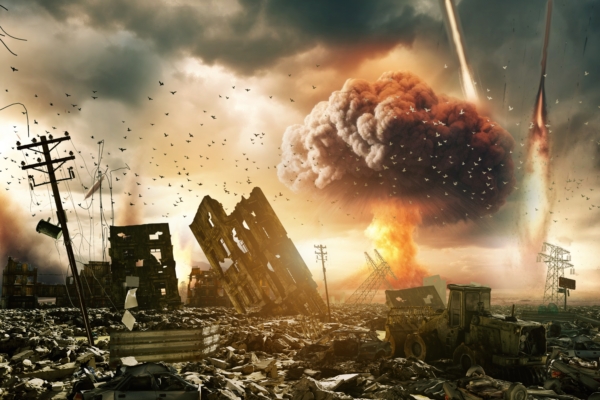
In 1960, three American scholars from the University of Illinois, Heinz von Foerster, Patricia M. Mora, and Lawrence W. Amiot, published a paper in the journal “Science” predicting a doomsday scenario caused by overpopulation, with a calculated date of November 13th this year. Their warning was based on a mathematical equation projecting that human population would reach infinity if growth continued as it had for the past two millennia.
According to a report by the British Daily Express on January 8th, these scientists reached their startling conclusion after analyzing the development trends of Western societies in the previous century. They attributed the exponential growth of the global population to advances in medical science and predicted severe food shortages by a certain point in 2026.
By early 2026, the world’s population had already surpassed 8 billion, a significant increase from the estimated 3 billion in 1960. There are no signs indicating a slowdown in this growth trajectory, although current projections suggest a turning point towards population decline by around 2080.
Thomas Malthus, a British economist in 1798, warned of inevitable food shortages due to the exponential growth of the human population, stating that “famine seems to be the last, most dreadful resource of nature.” Despite advancements in agricultural production keeping pace with the growing population, some individuals, particularly wealthy elites like Meta’s Chairman and CEO Mark Zuckerberg, have begun preparations for a potential apocalypse.
Zuckerberg reportedly spent $187 million to acquire 1,600 acres of land in Hawaii, intending to build a high-end ranch with a 5,000 square foot underground bunker equipped with independent energy and food supplies. Similarly, Amazon’s founder Jeff Bezos invested $147 million in two properties on Indian Creek Island in Florida, and Oracle’s co-founder and Chairman Larry Ellison almost entirely purchased Lanai Island in Hawaii.
In anticipation of a possible doomsday scenario, Business Insider previously listed 14 global locations suitable for refuge in case of a catastrophic event. These locations were chosen based on various criteria such as remote geographic positioning, high altitude, ample food resources, and abundant minerals.
The list includes Iceland, Isle of Lewis in Scotland, the capital of Switzerland, Bern, Tristan da Cunha in the South Atlantic, Cape Town in South Africa, Chiang Mai in Thailand, Puncak Jaya in Indonesia, Guam, Denver, Kansas City, the Yukon in northwestern Canada, Necker Island in the British Virgin Islands, Tierra del Fuego in South America, and Antarctica.